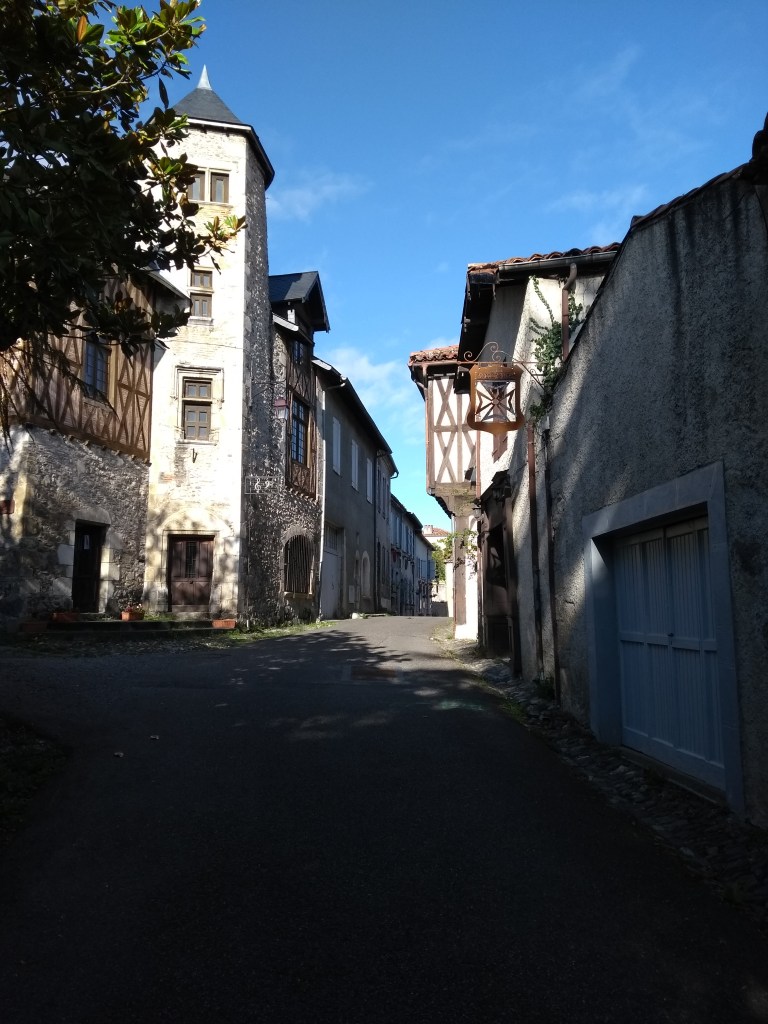
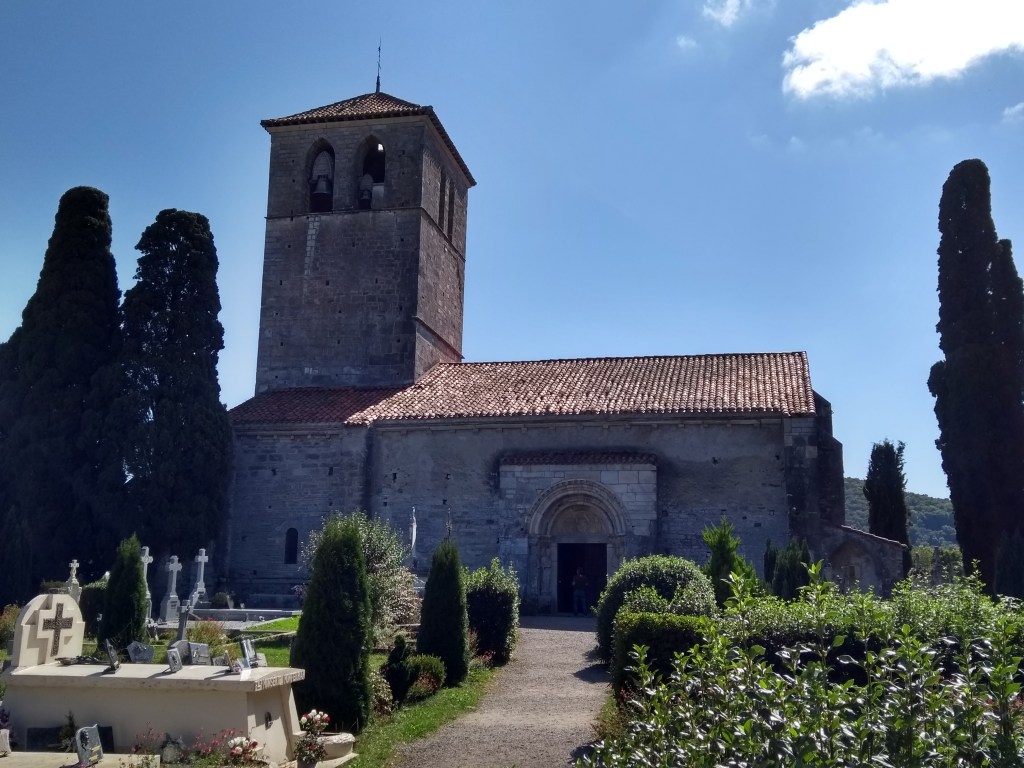
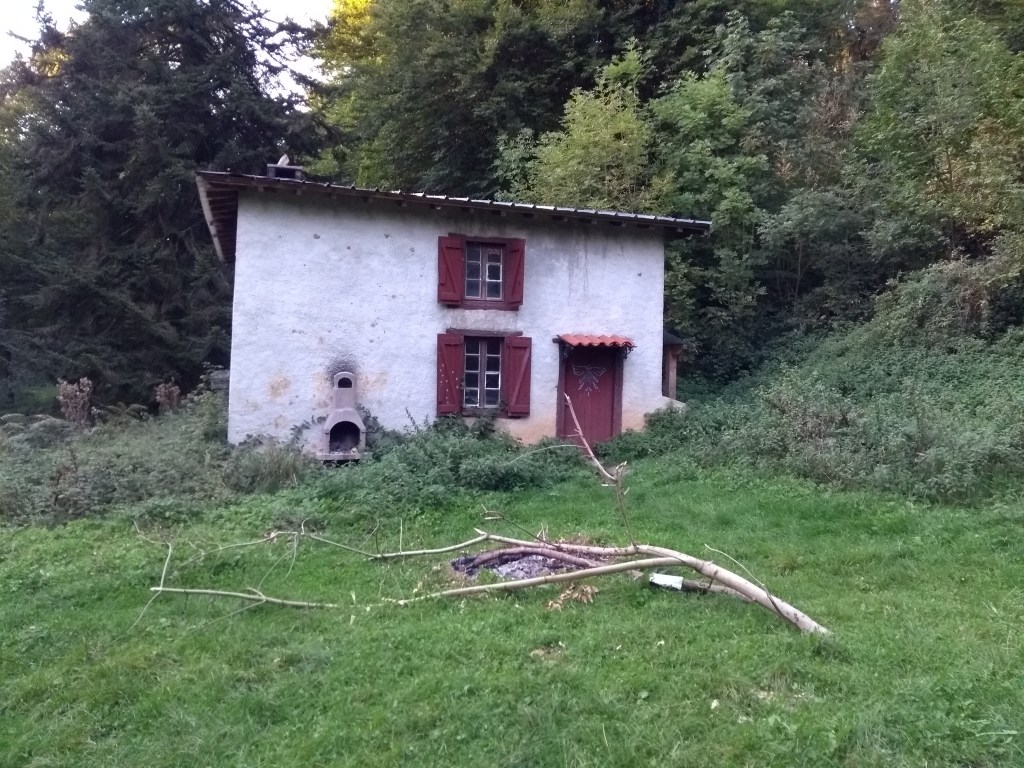
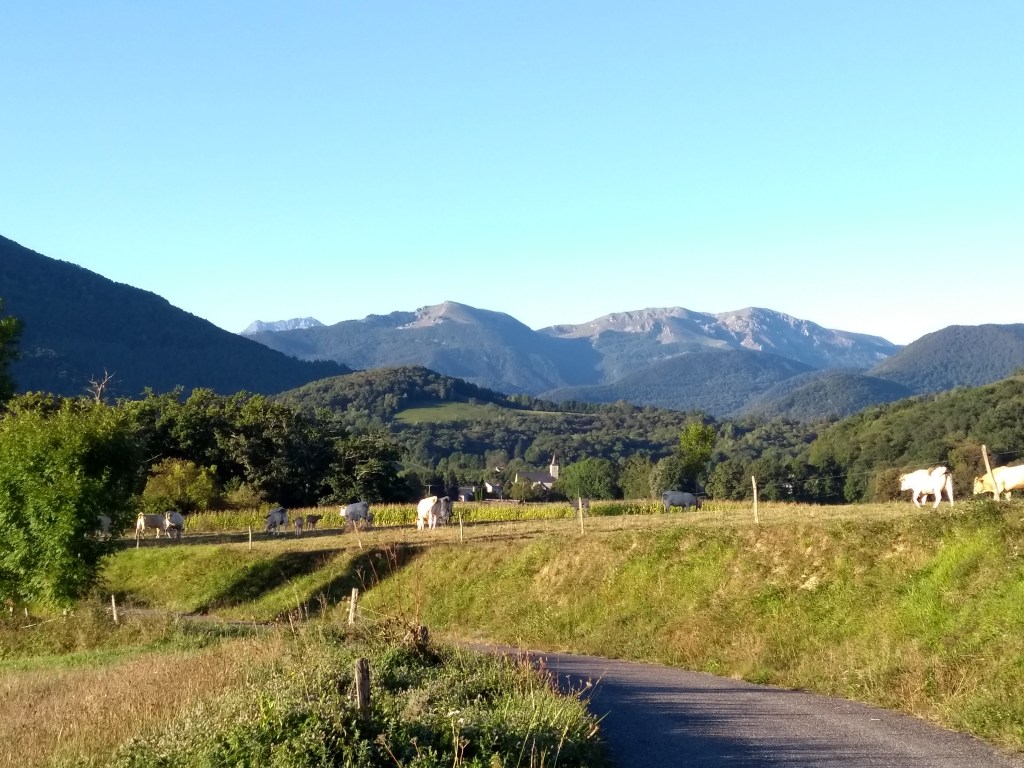
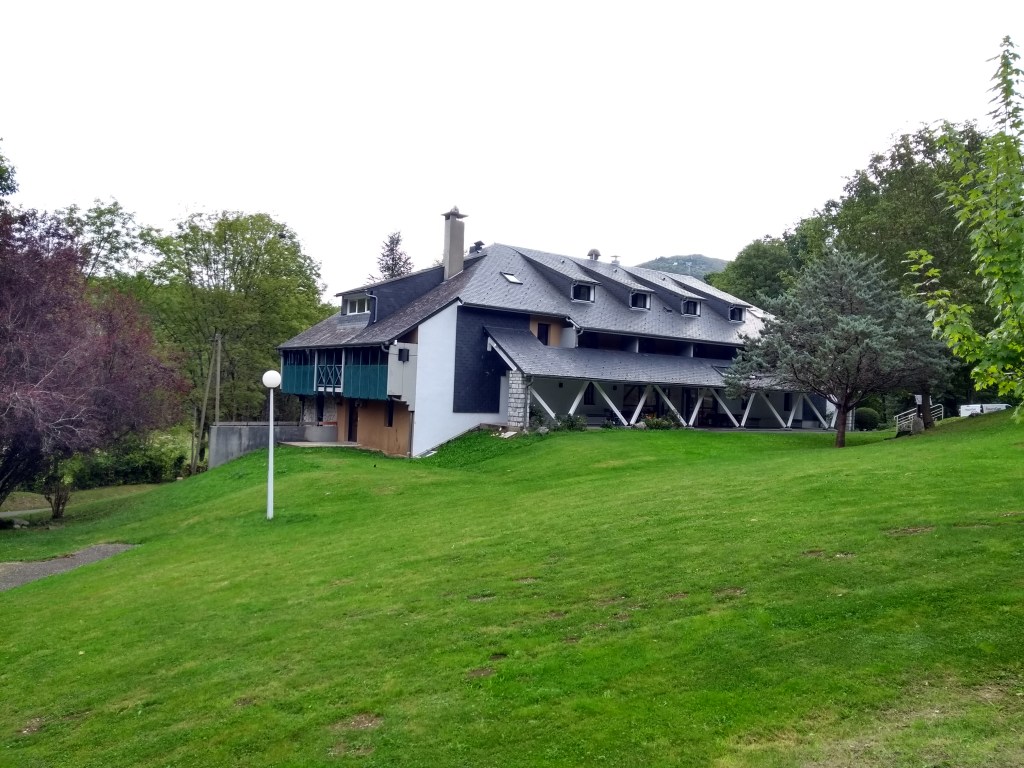
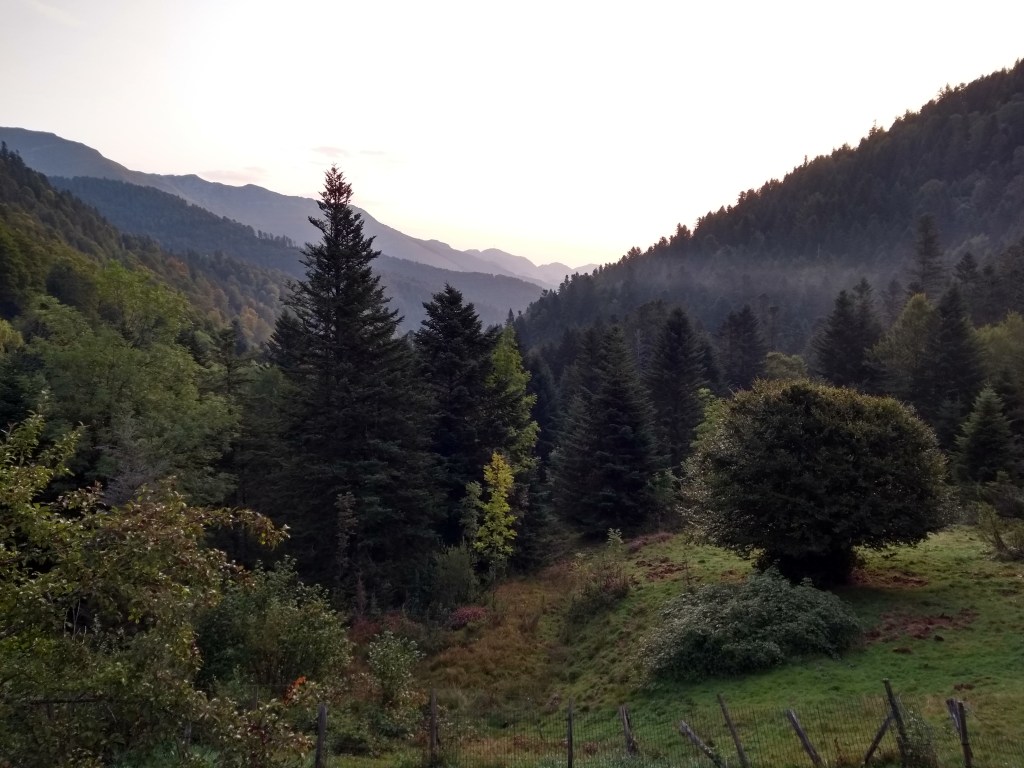
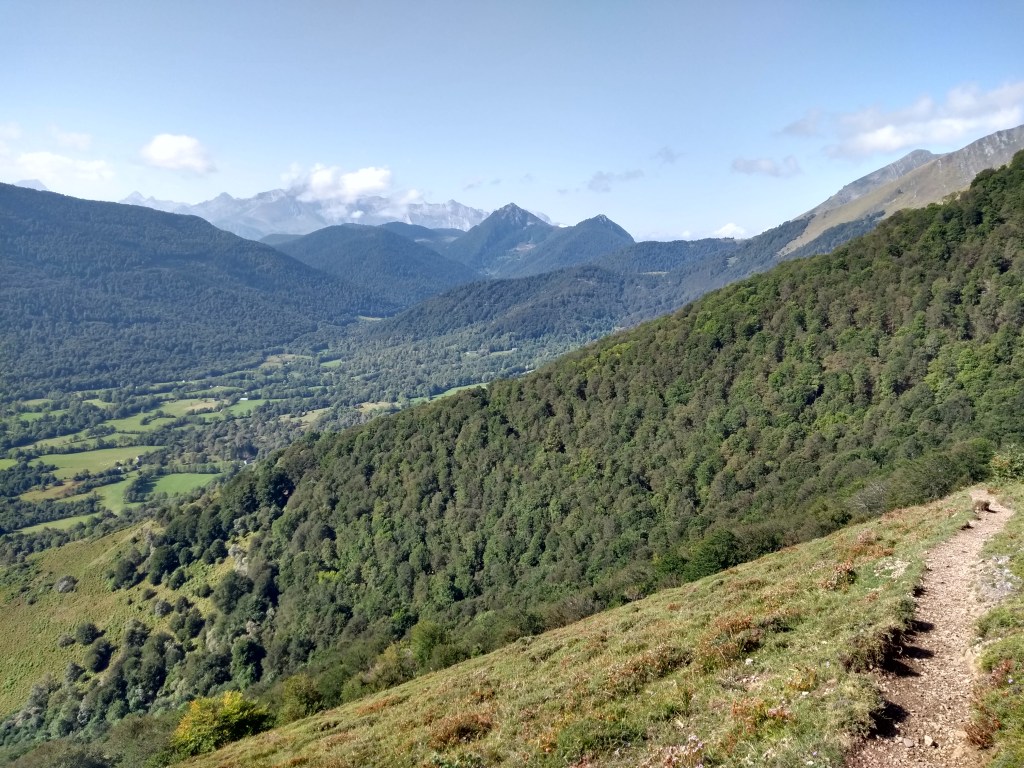
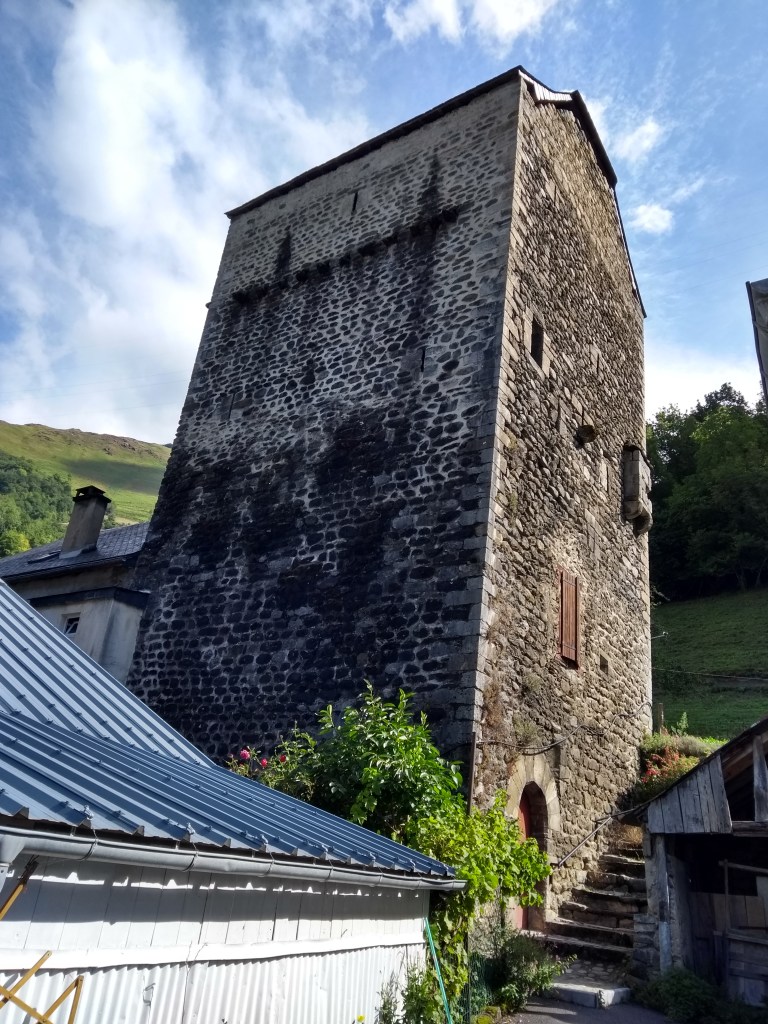
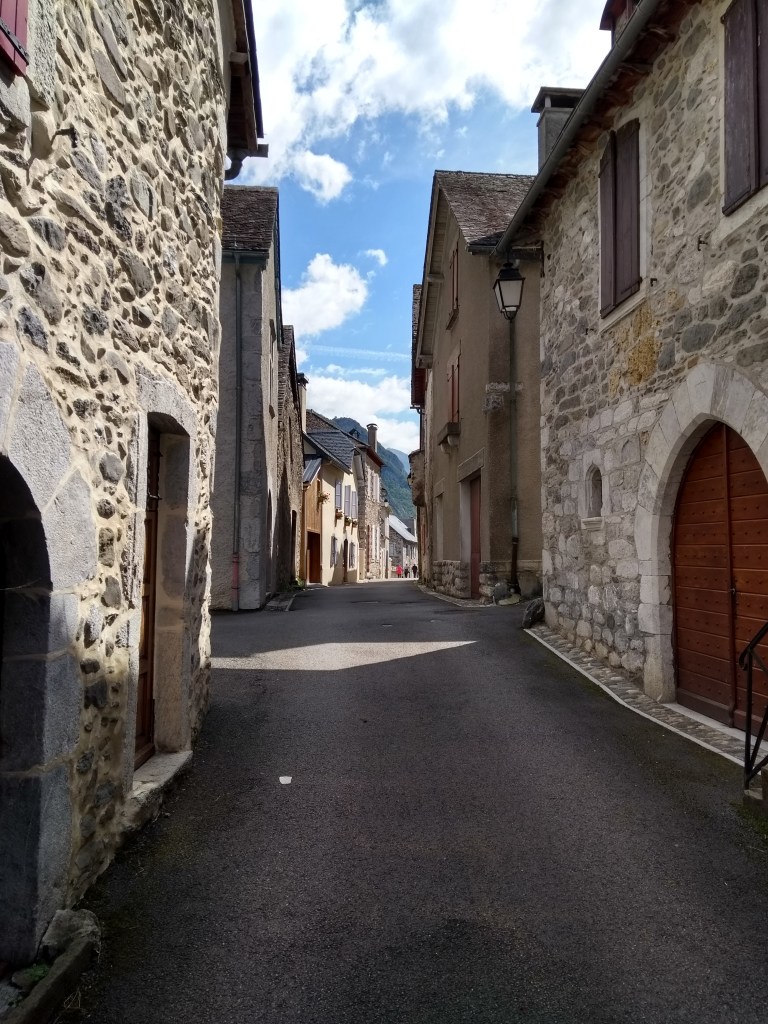
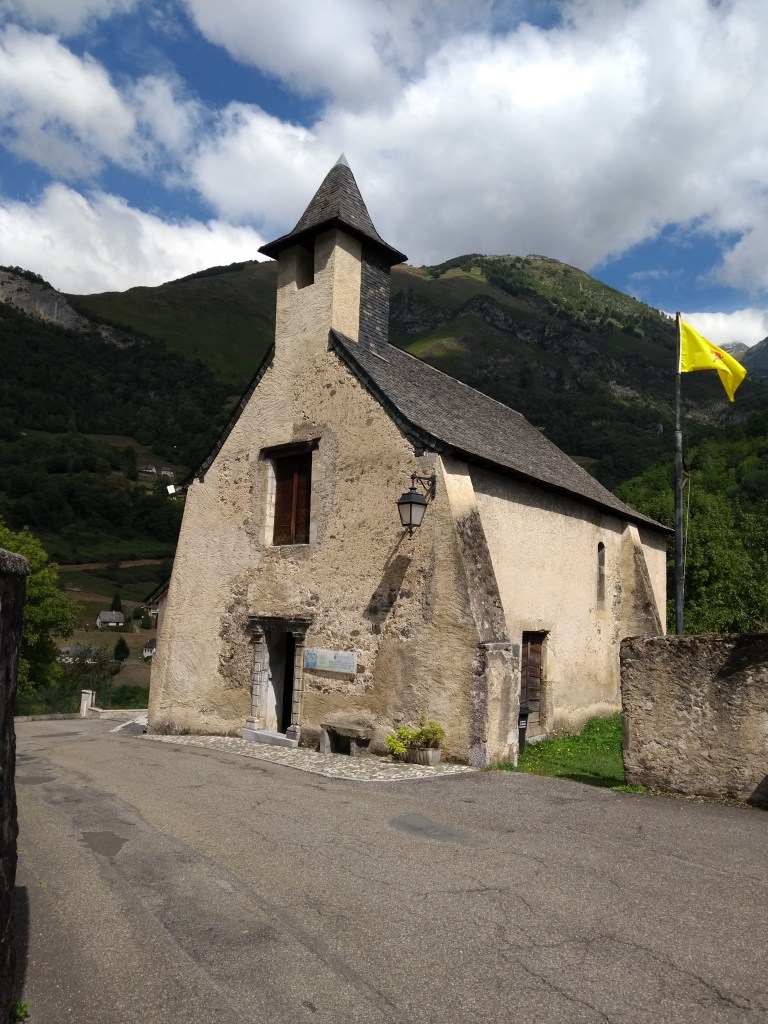
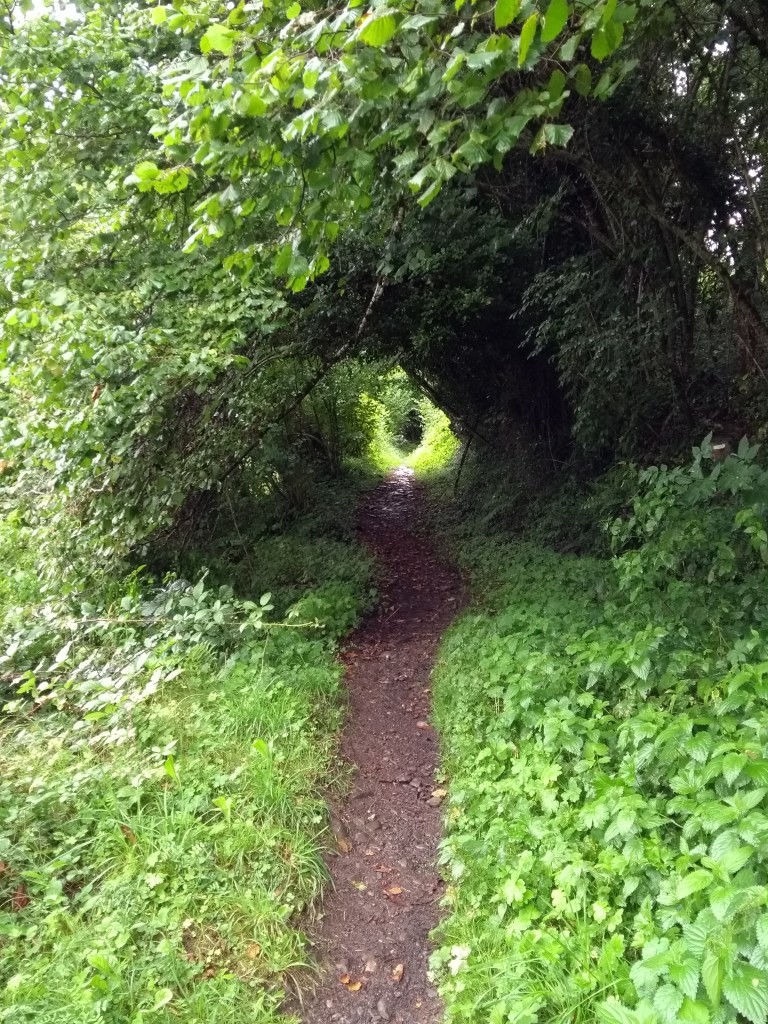
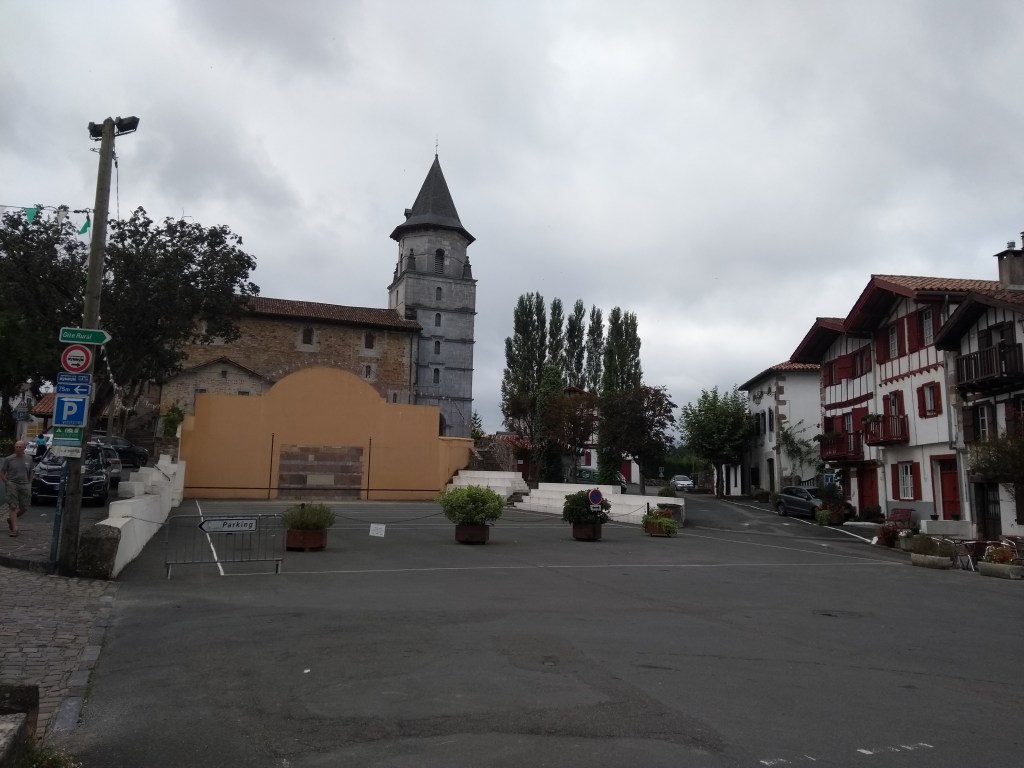
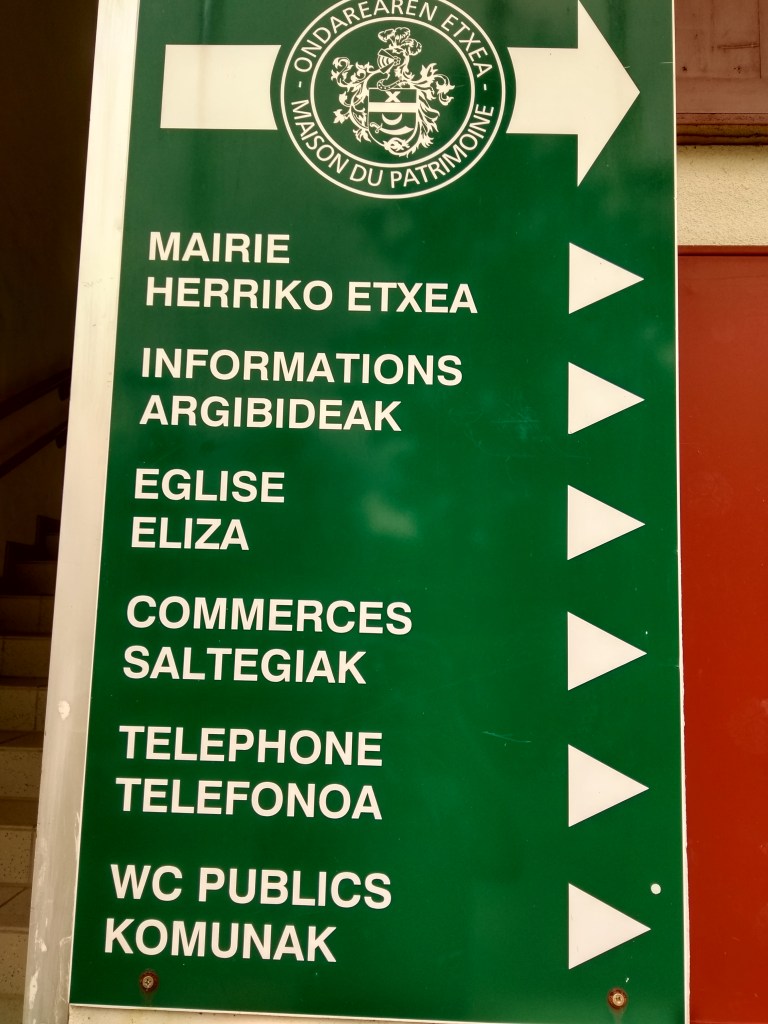
Epilogue

Thank you for four weeks of great weather, I feel so lucky;

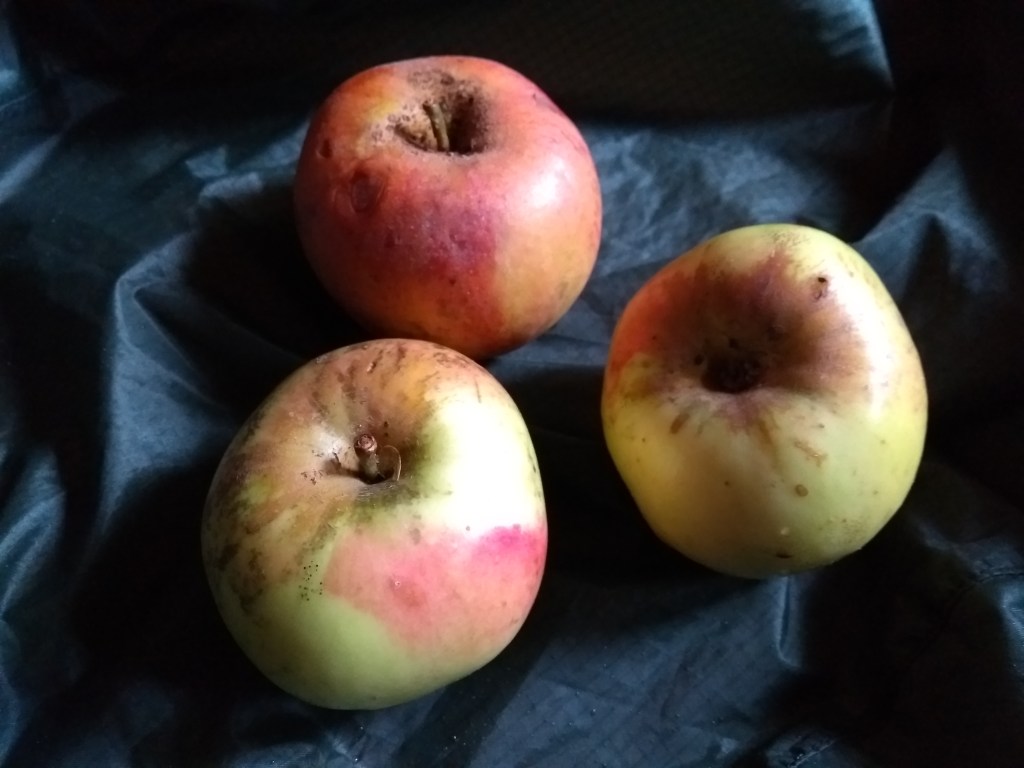
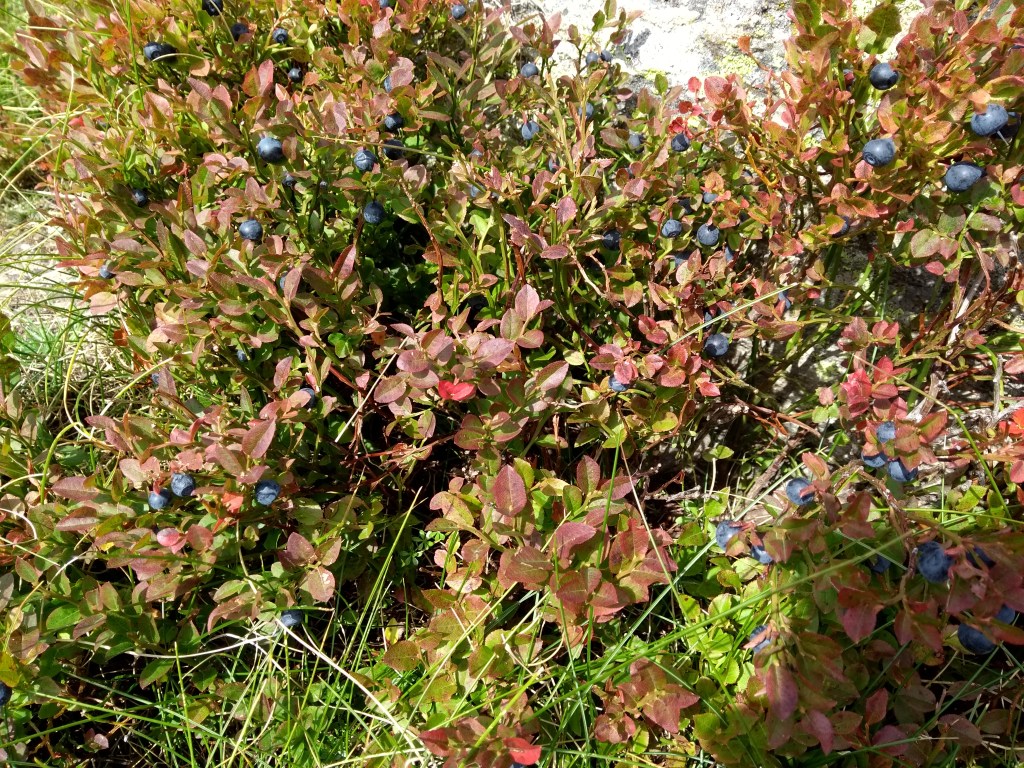
Thank you for the fruits found along the path: apples, pears, peaches, hazelnuts, chestnuts, blackberries, and blueberries;

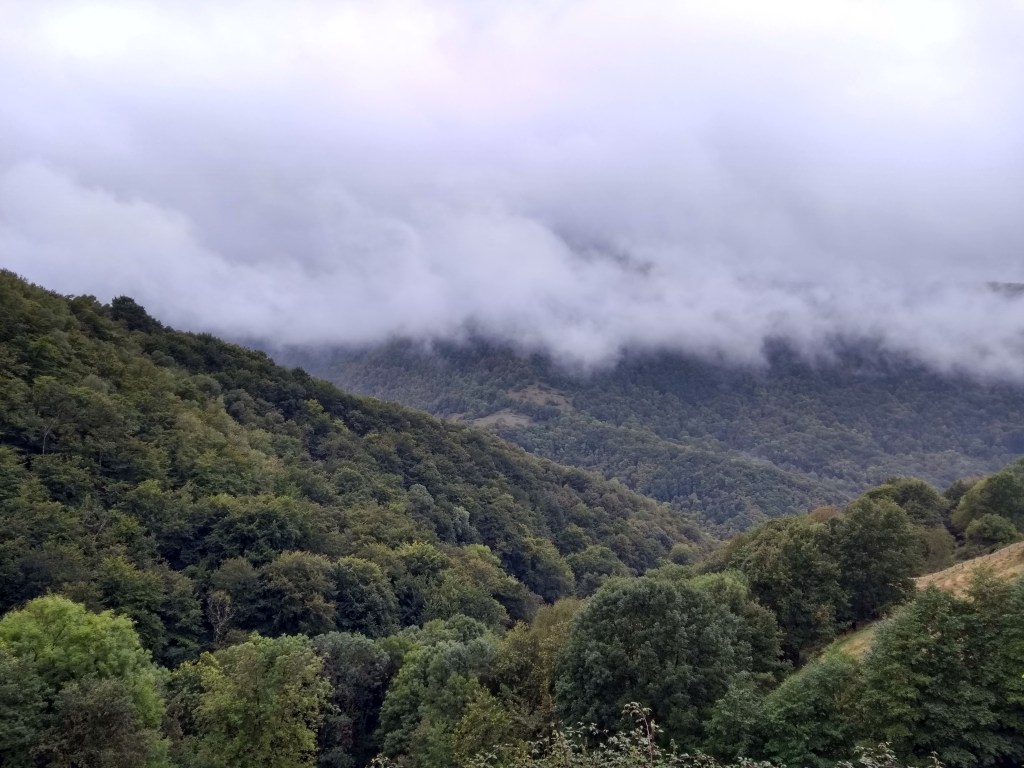
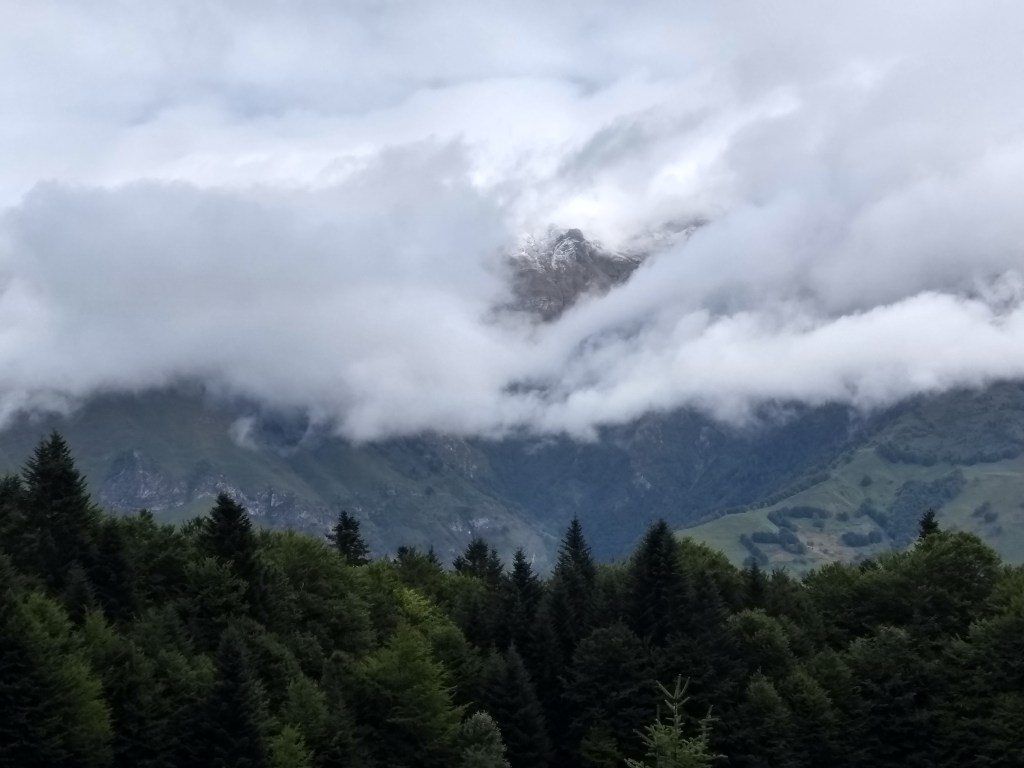
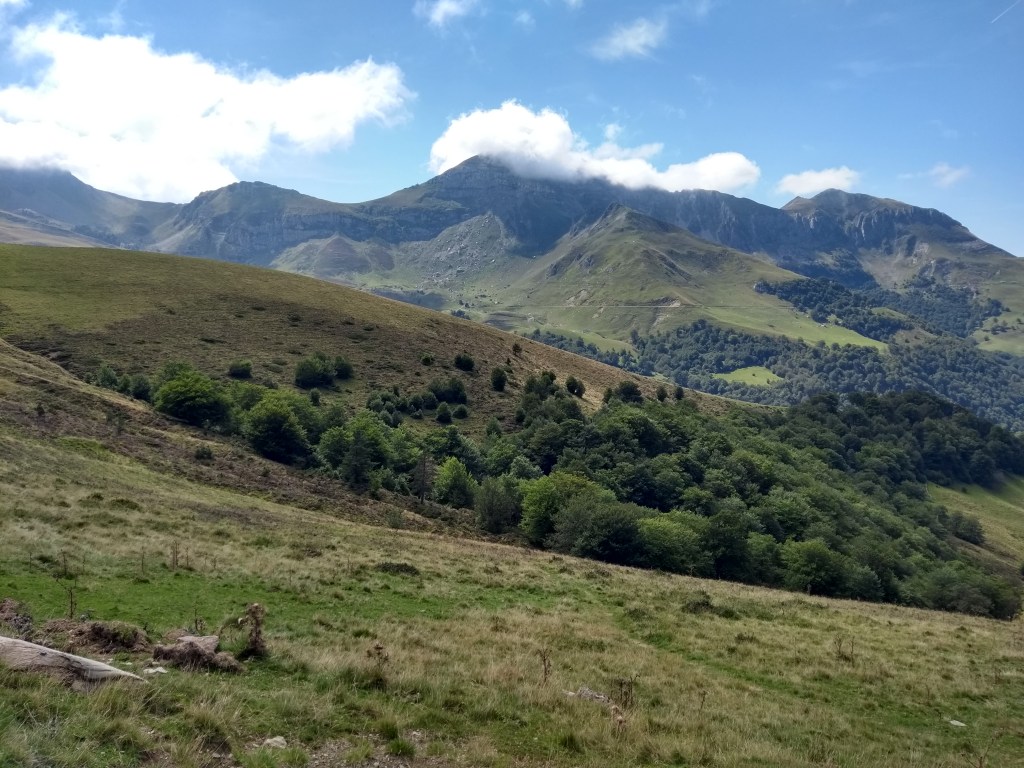
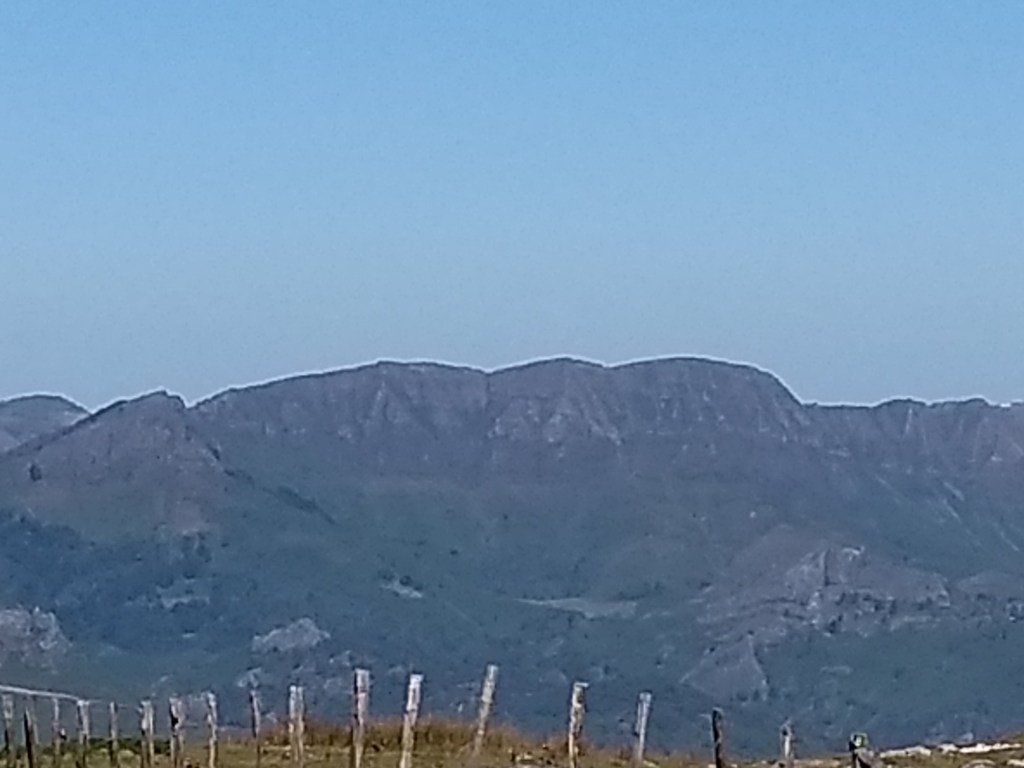
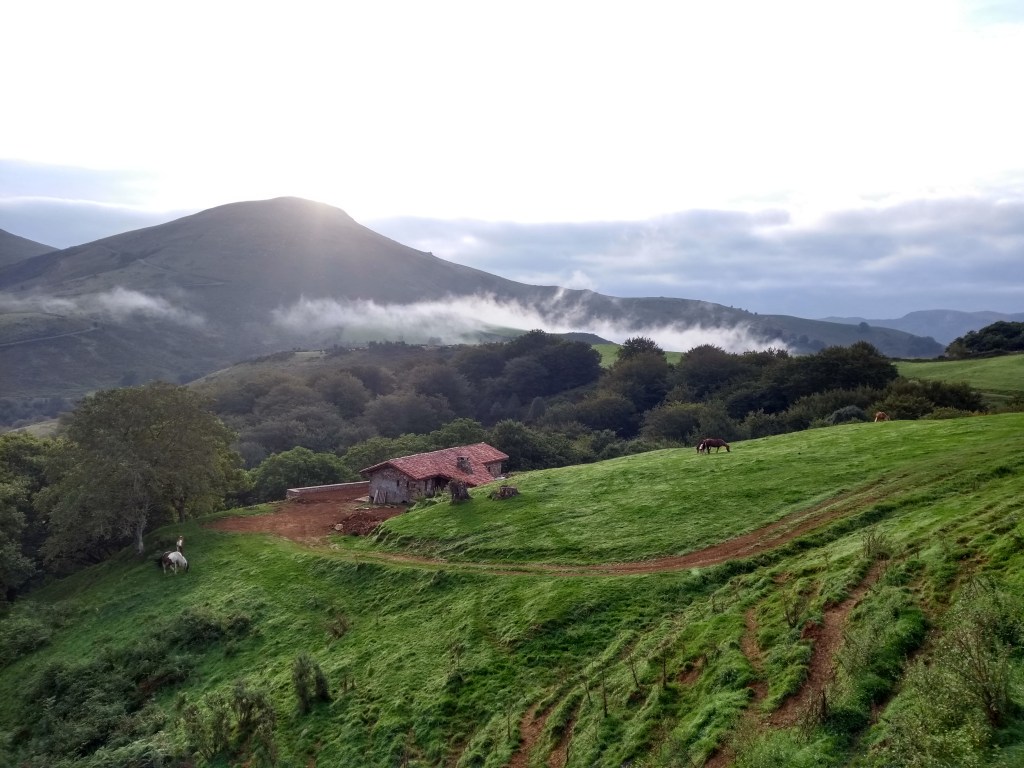
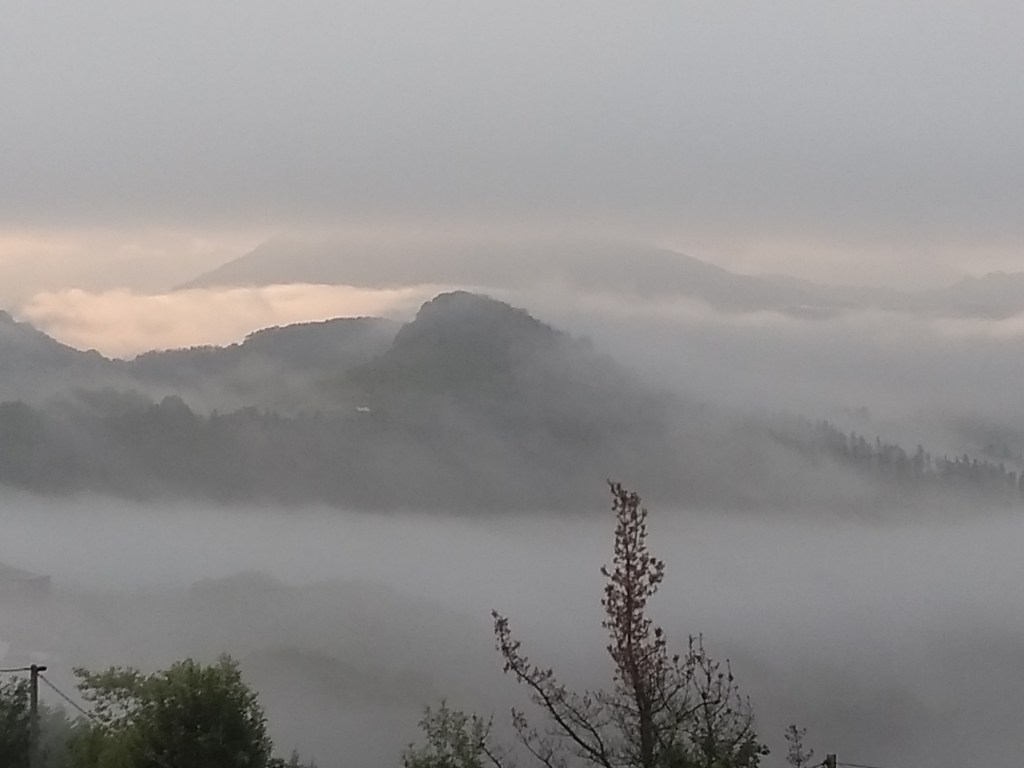
Thank you for the clouds hanging low on the side of mountains;

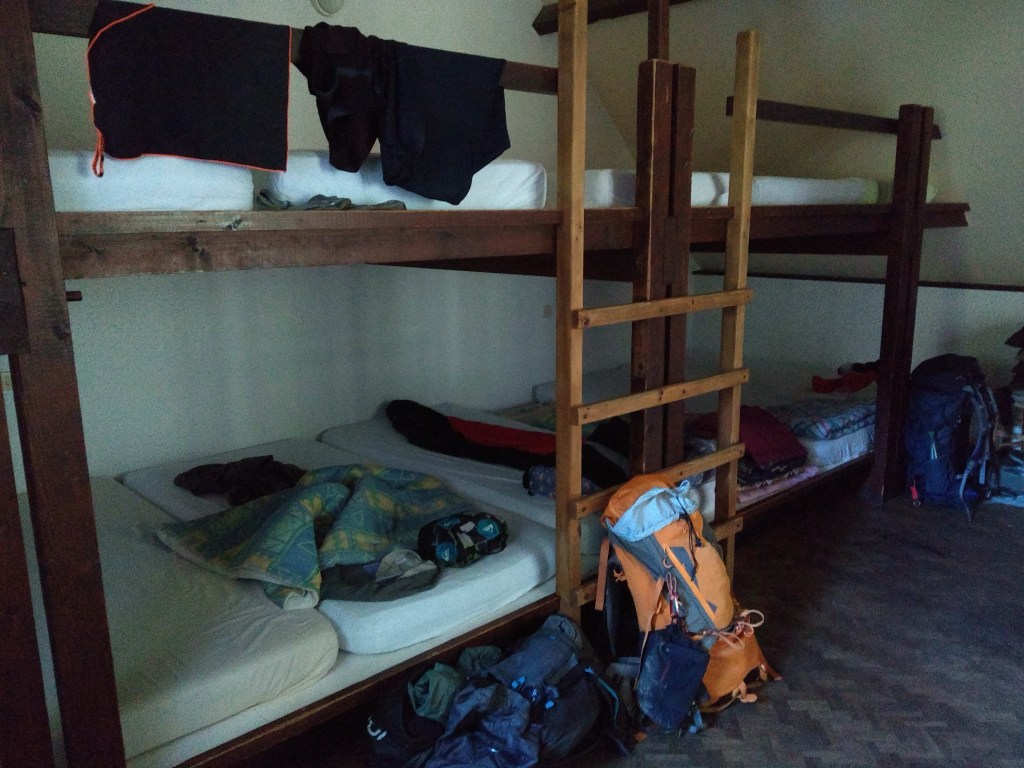
Thank you for the inns, the people I met there, and the kindness of innkeepers;

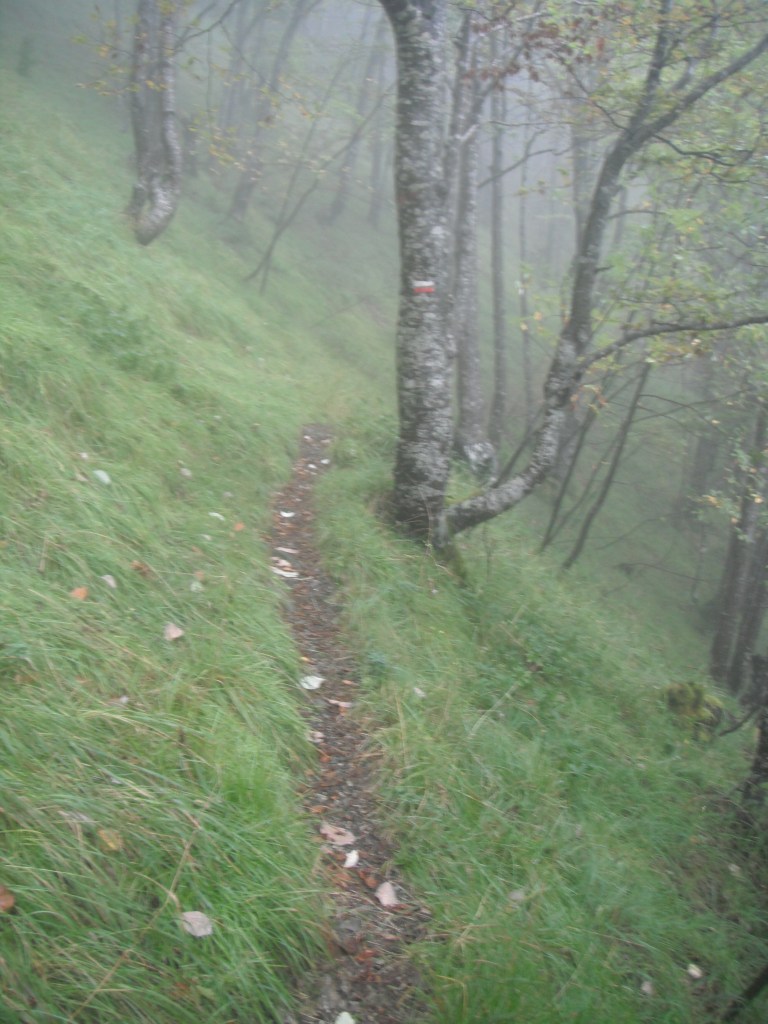
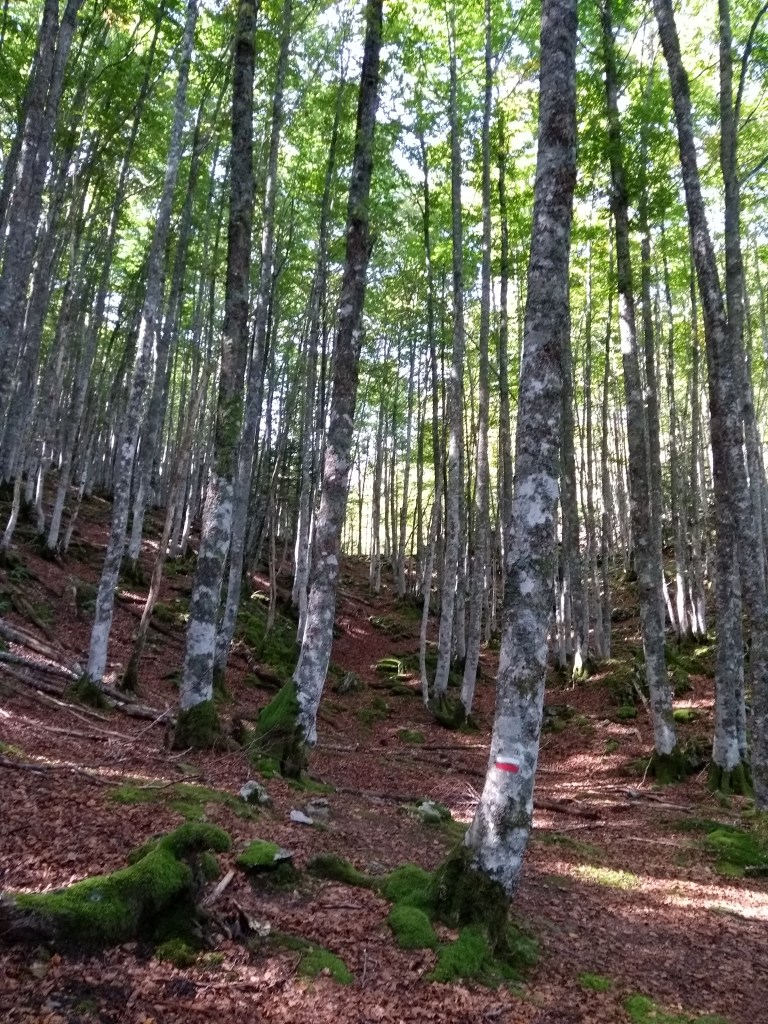
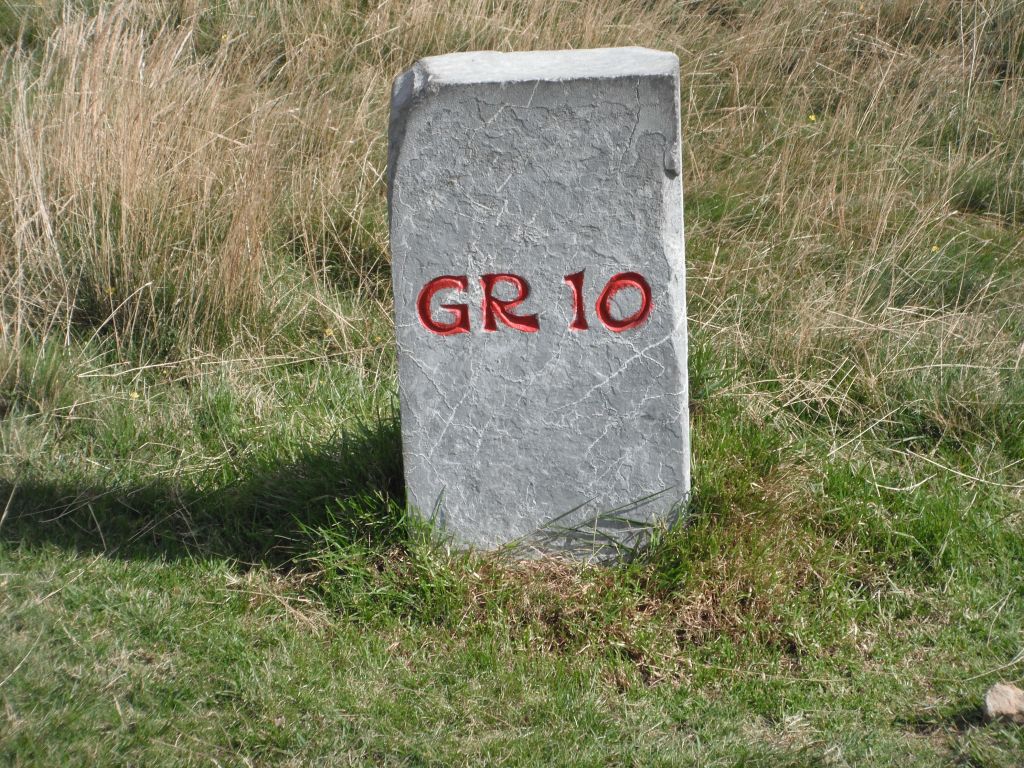
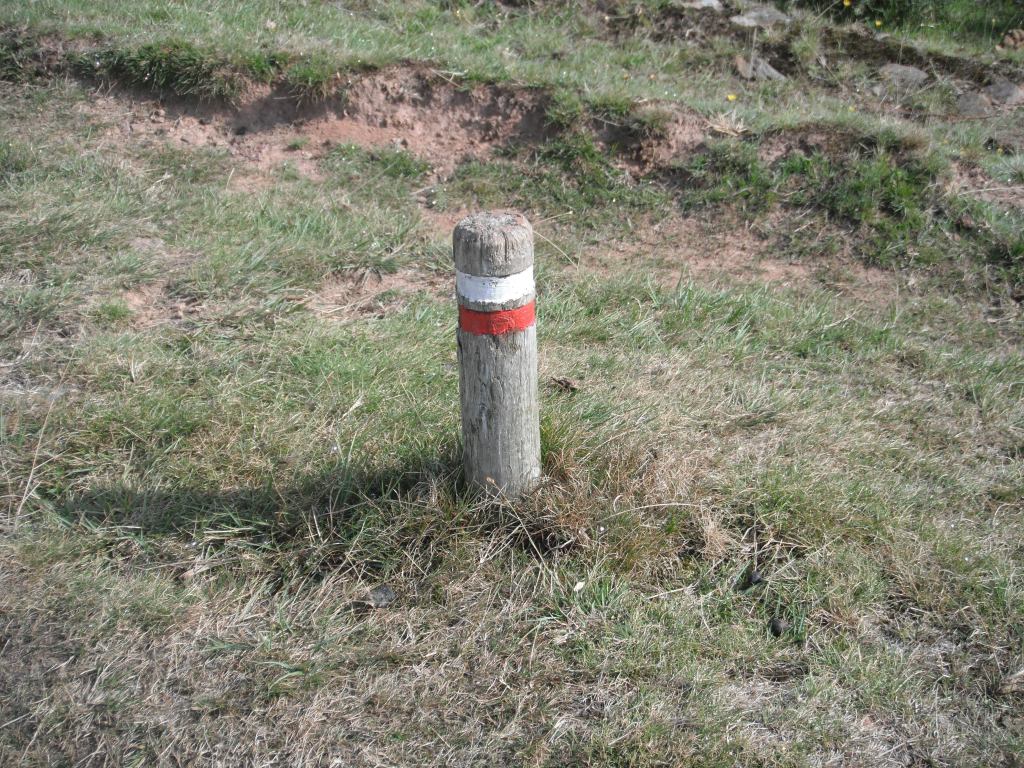
Thank you for the red and white blazes that were guiding my steps;

Thank you for the strangers who pointed me to the right direction when I was lost;

Thank you for feeling good in my body, and for avoiding falls and injuries;

Thank you for feeling good in my mind, and for my happiness;

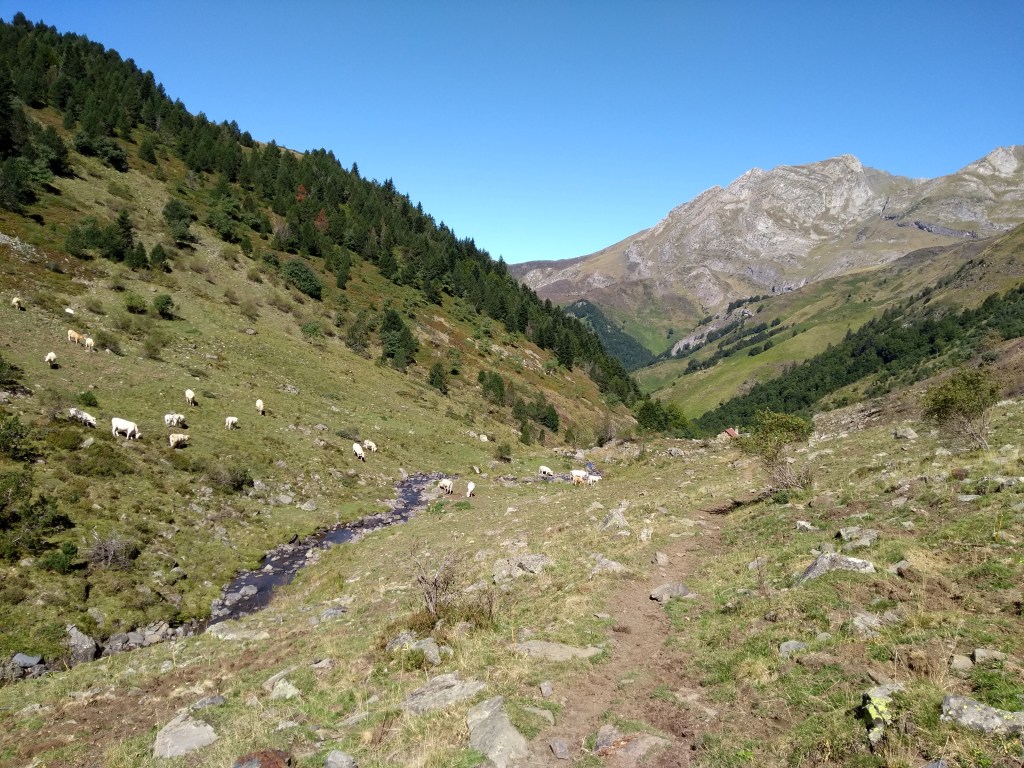
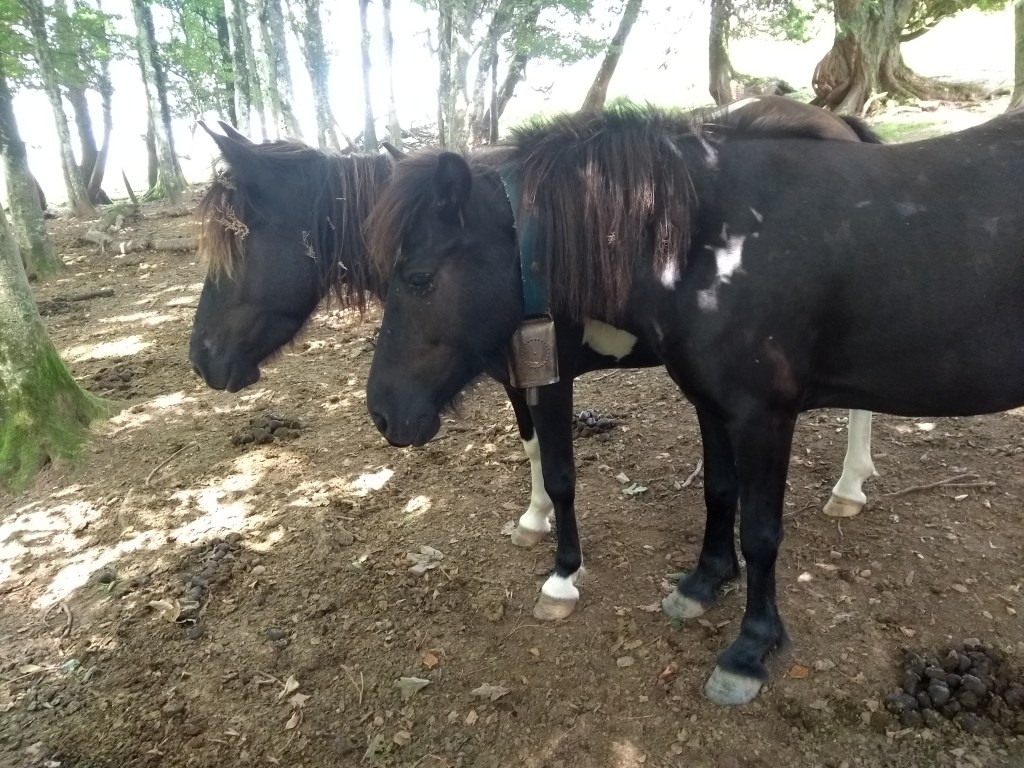
Thank you for the horses, the cows, and the sheep, and their bells that I could hear so often in the mountains;

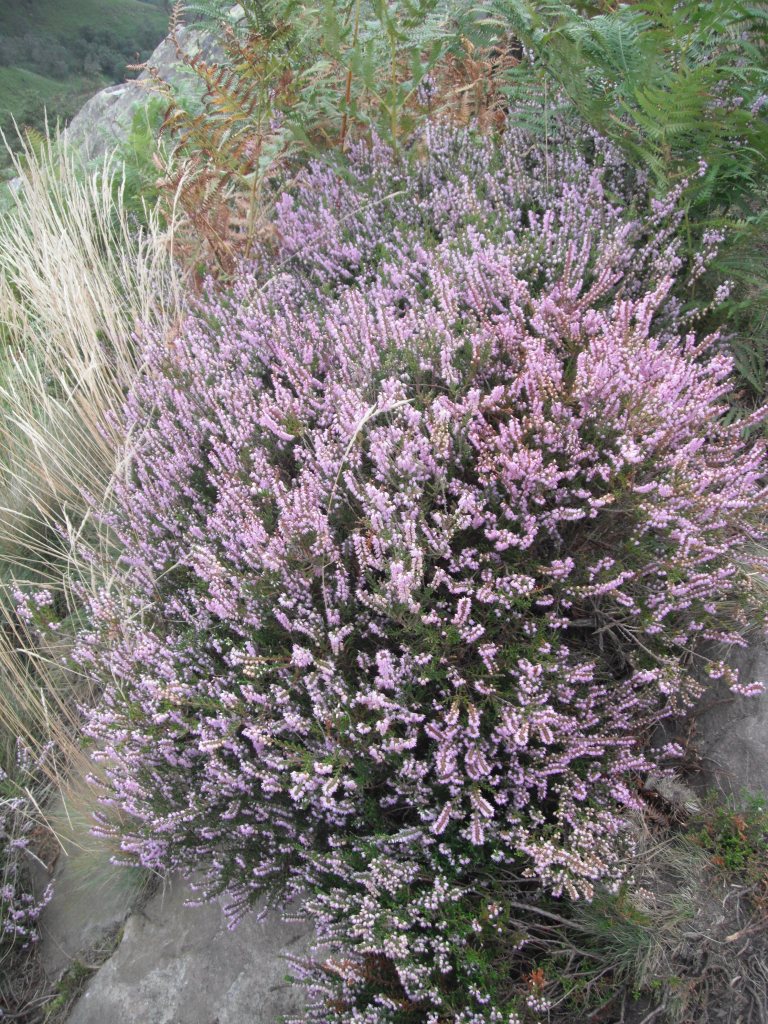
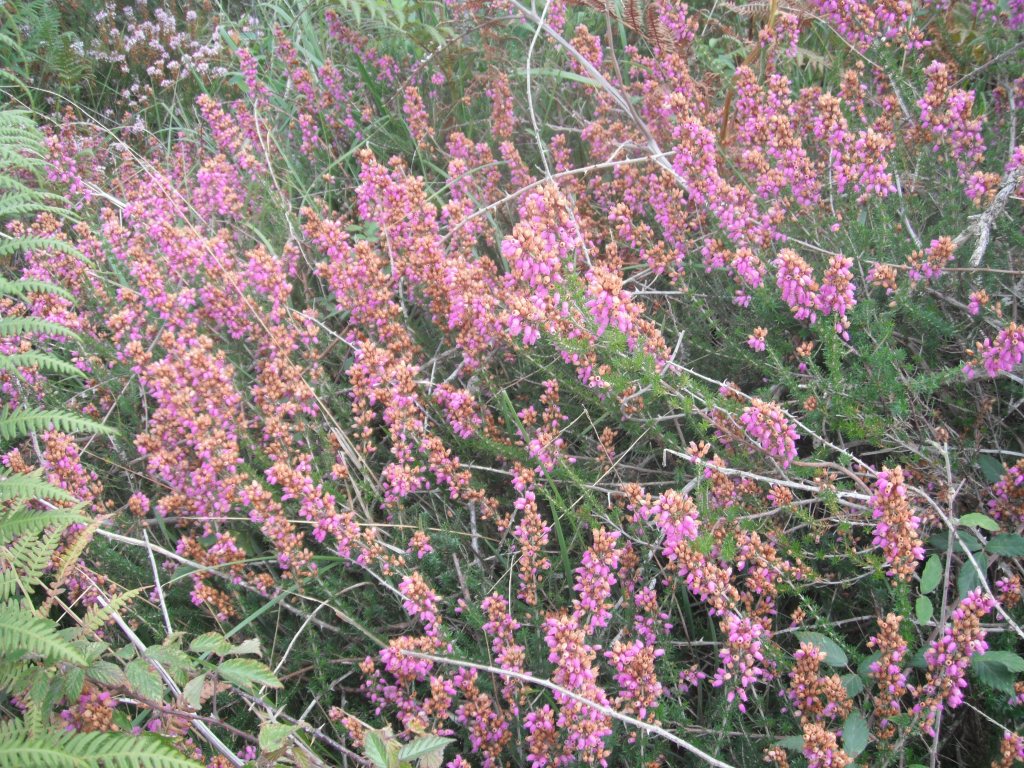
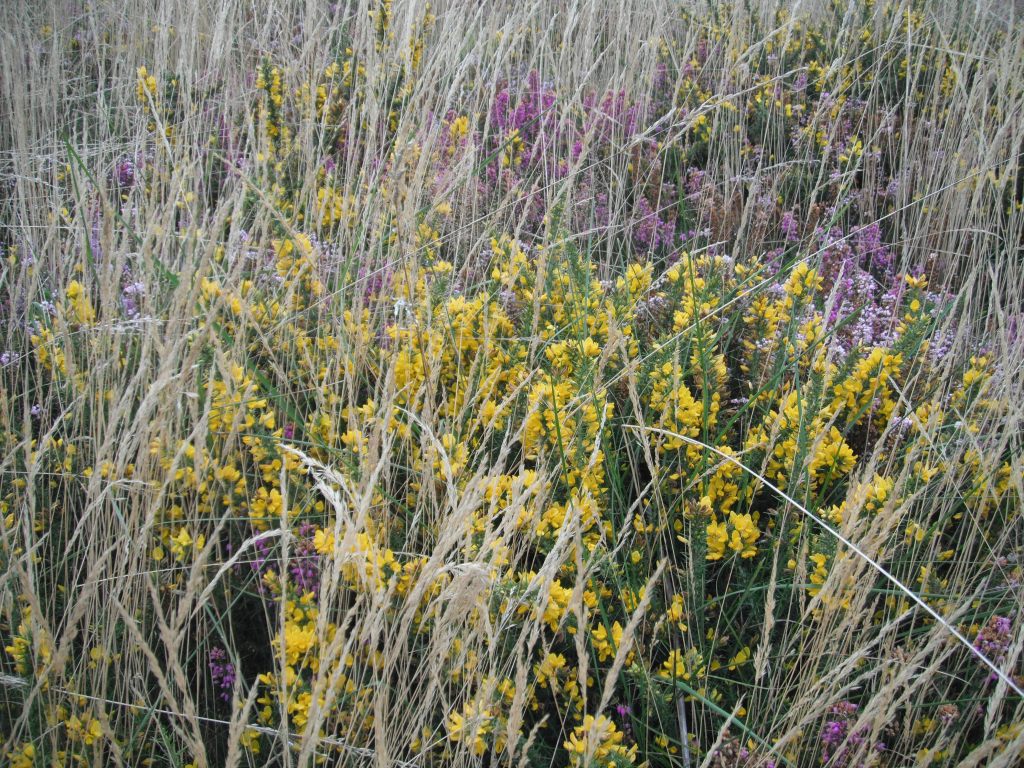
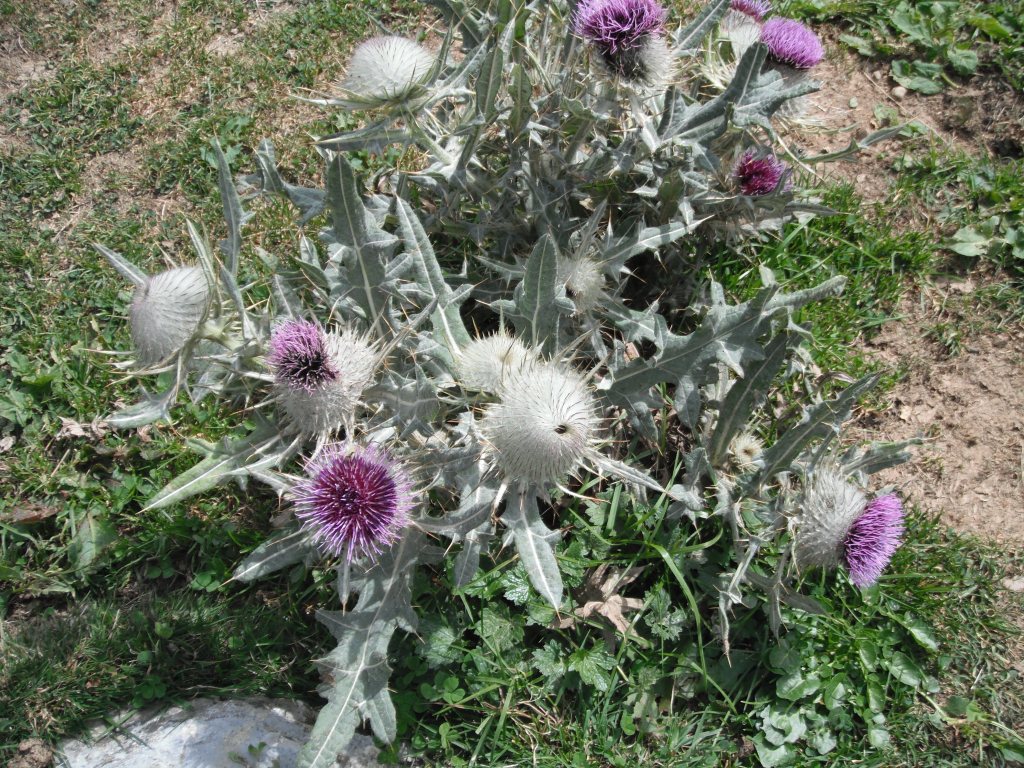
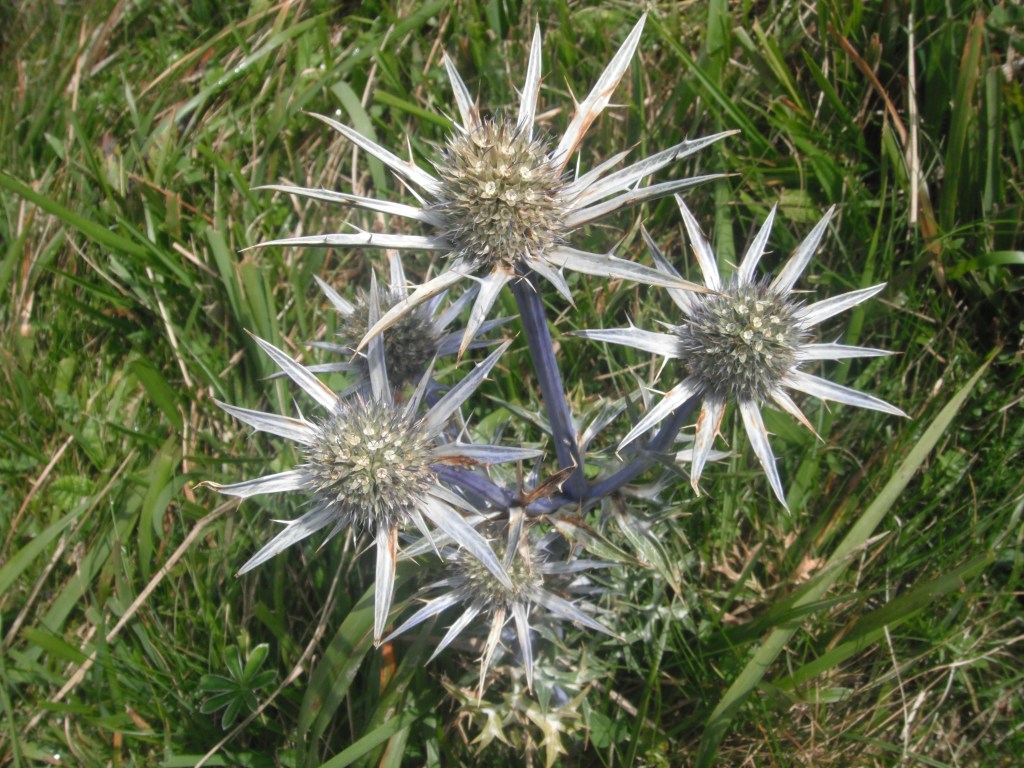
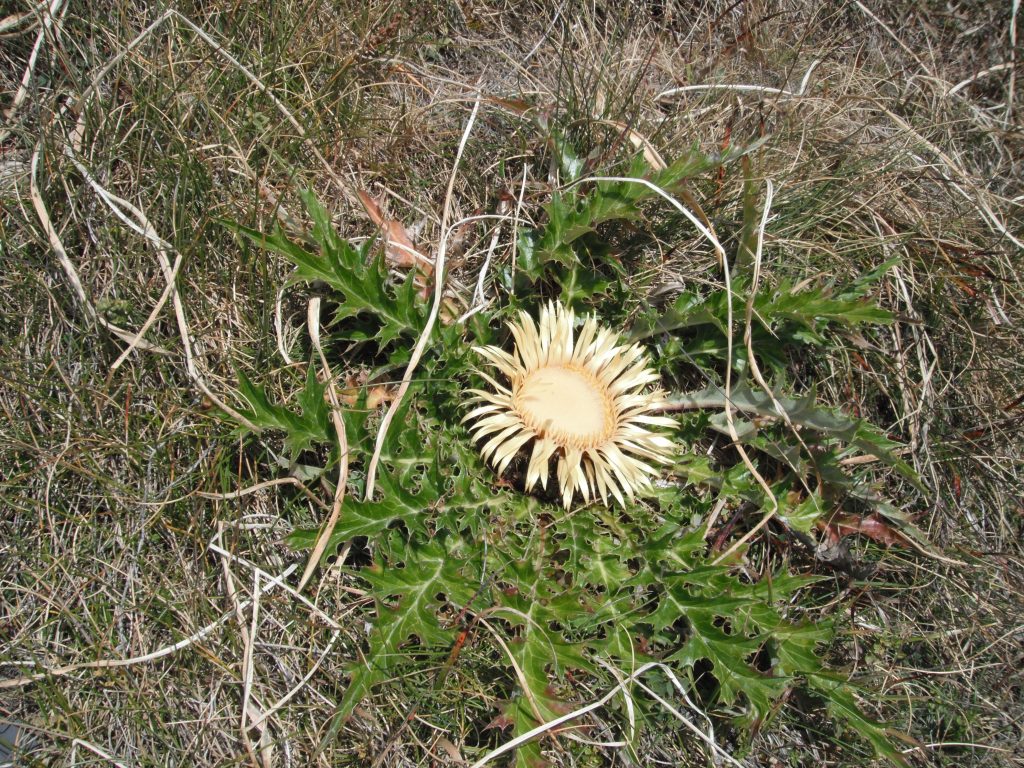
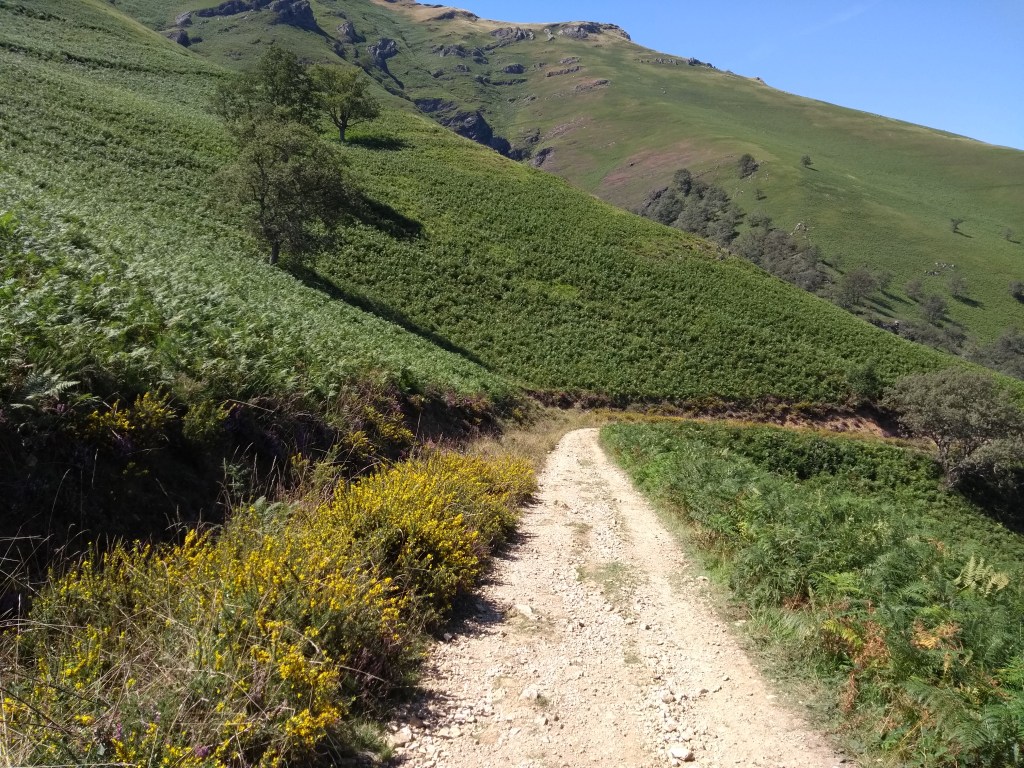
Thank you for the flowers along the path;

Thank you for the people I met on the trail, for the experiences shared, for the tips exchanged;

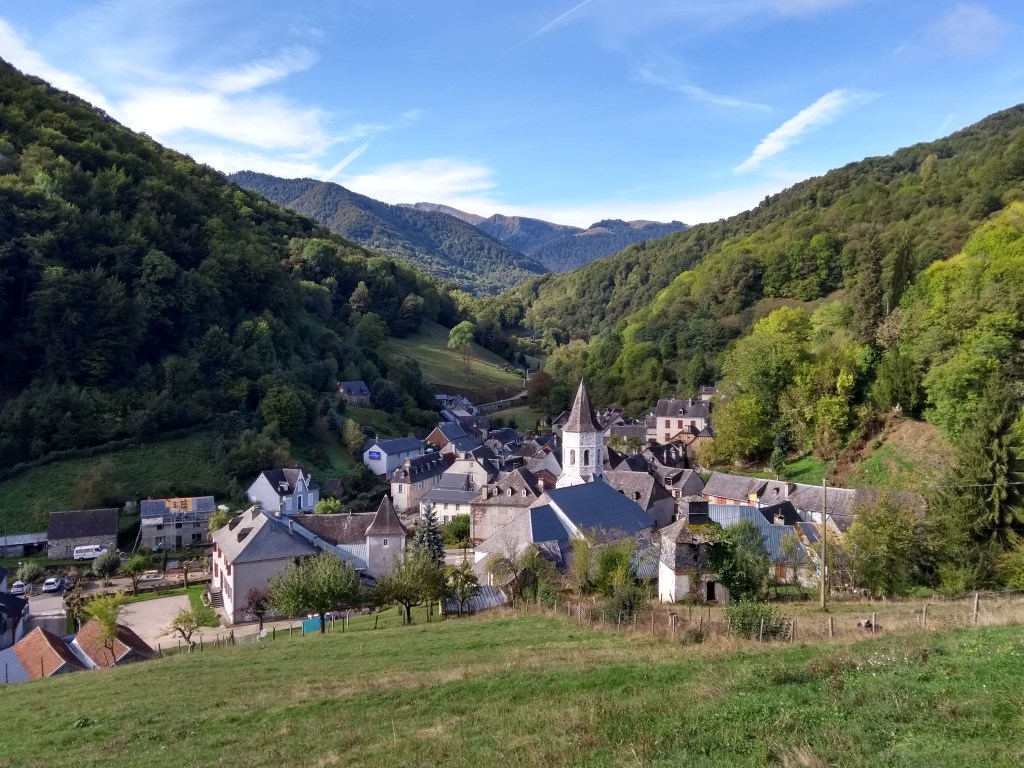
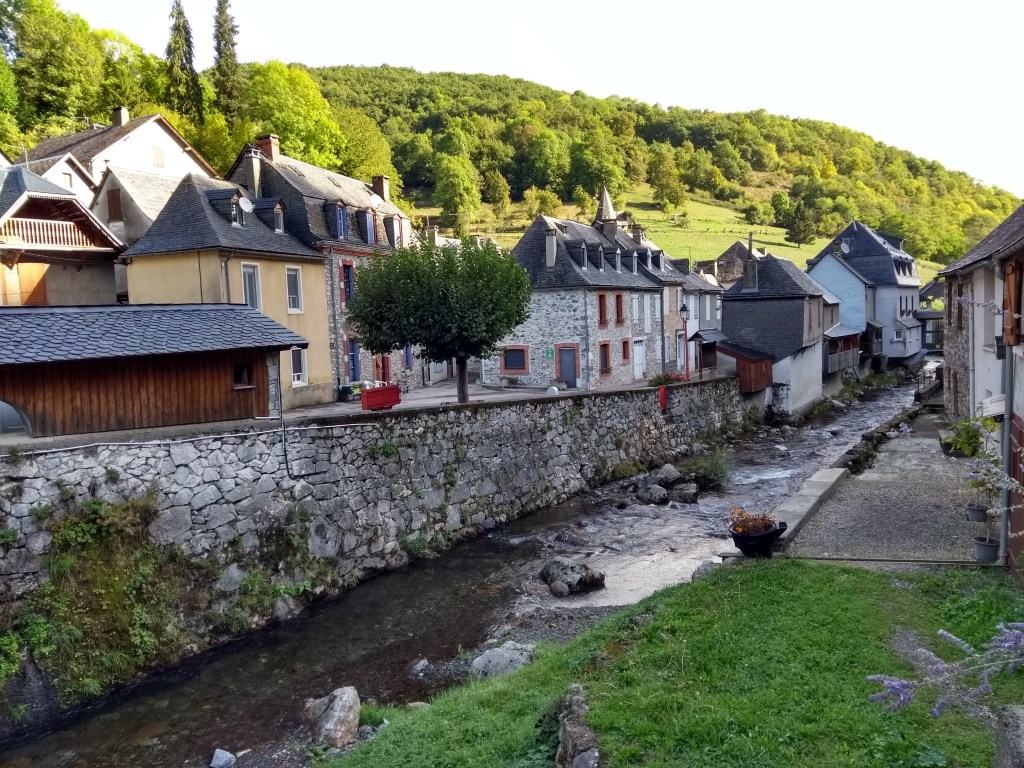
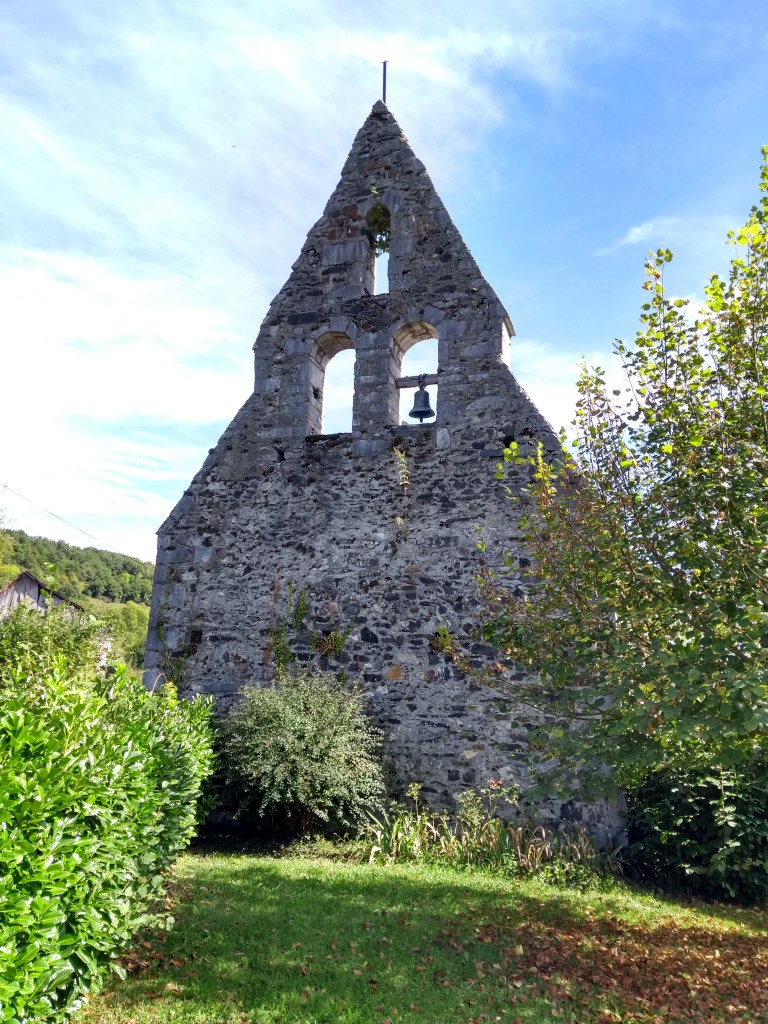
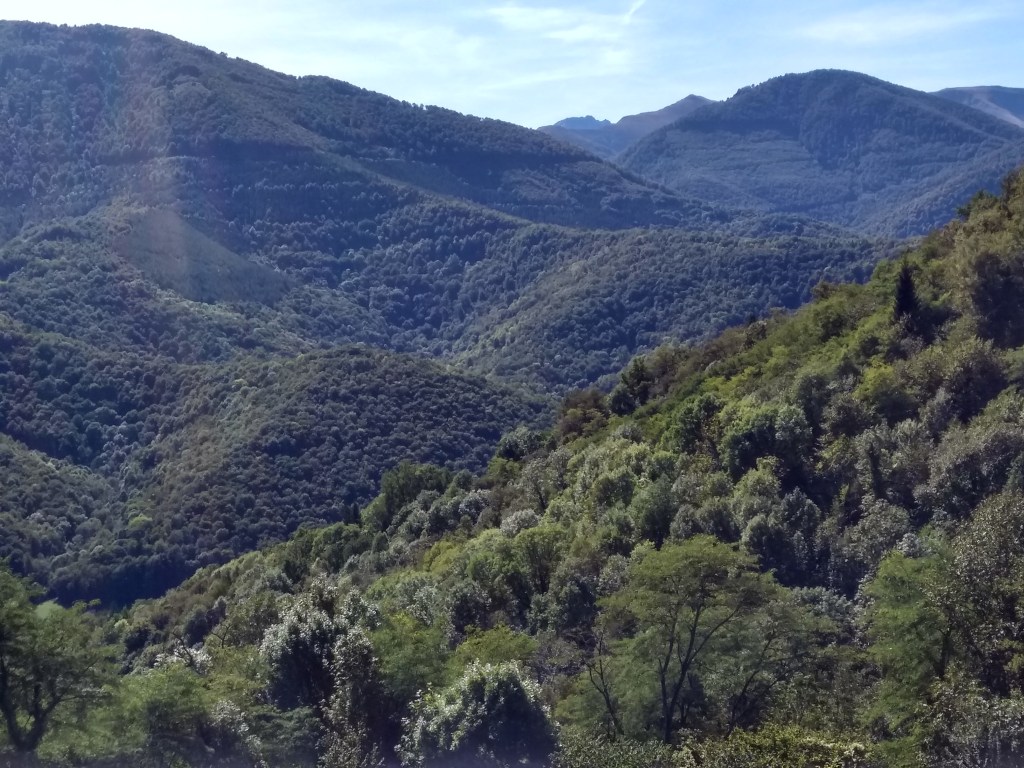
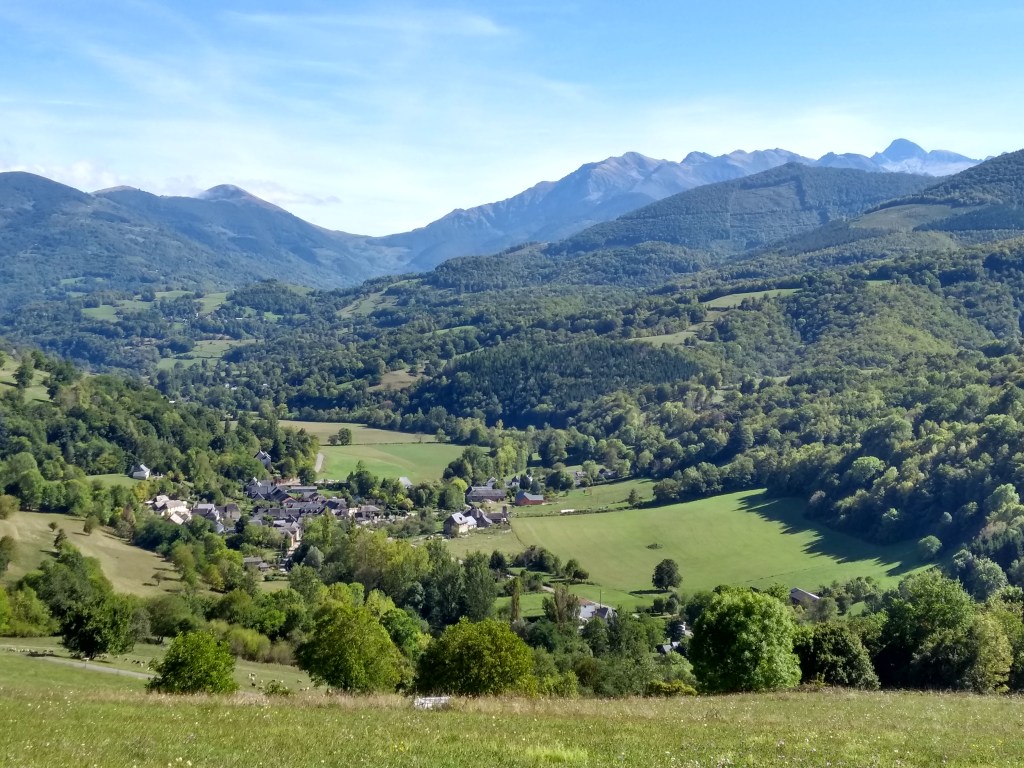
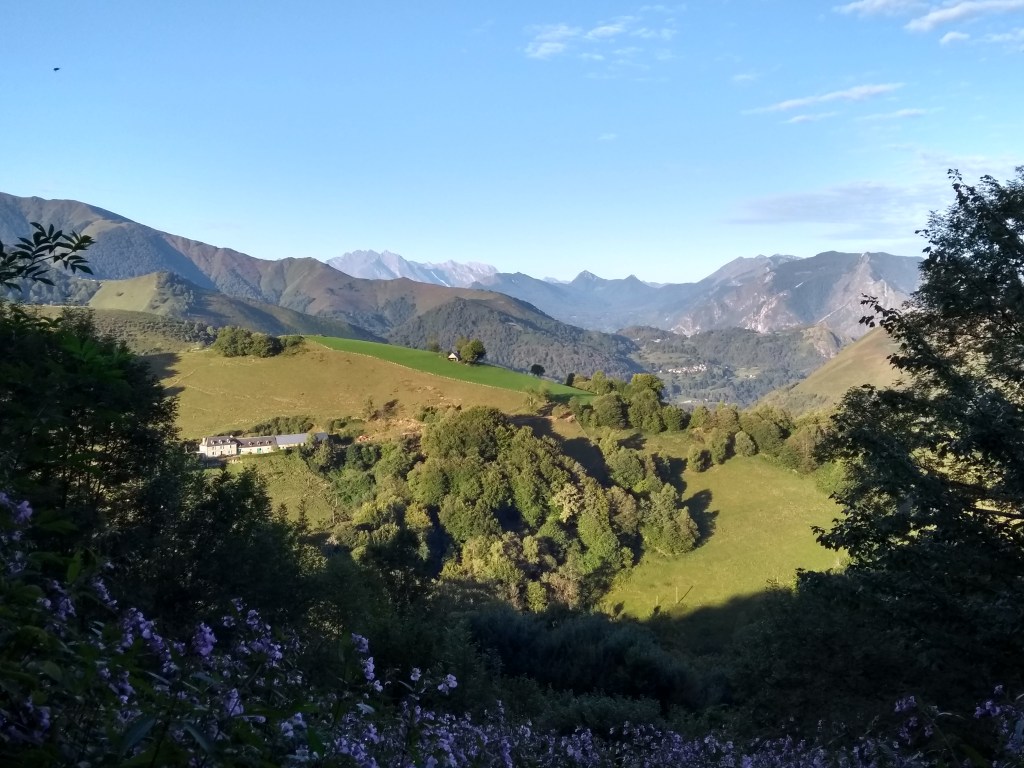
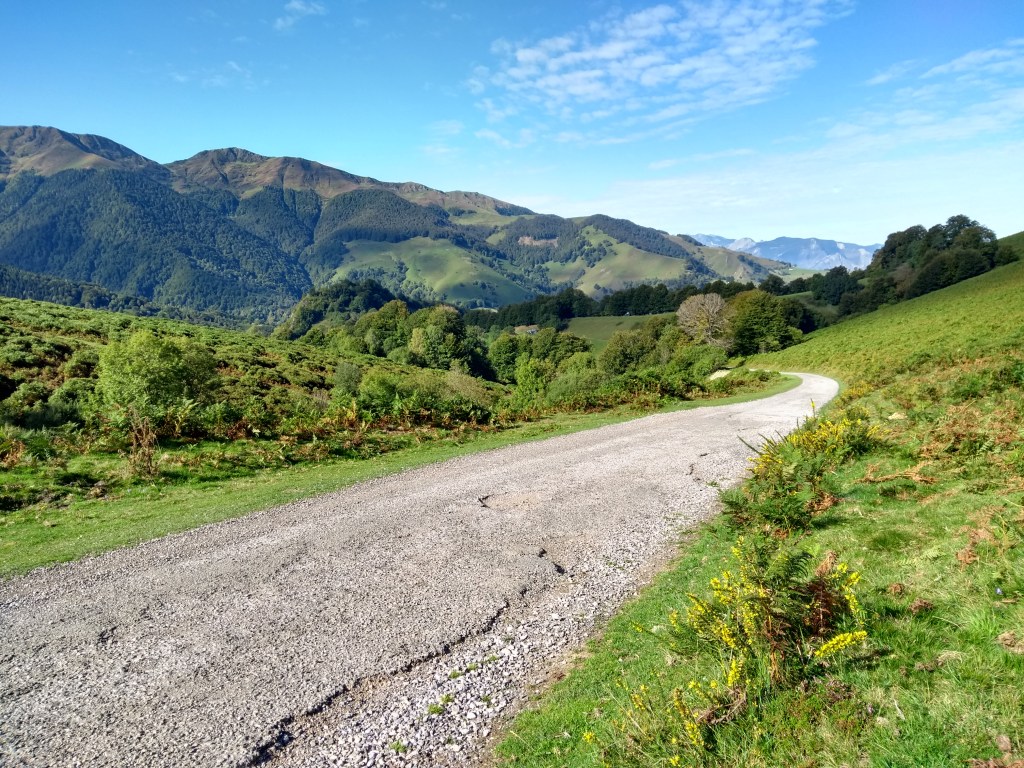
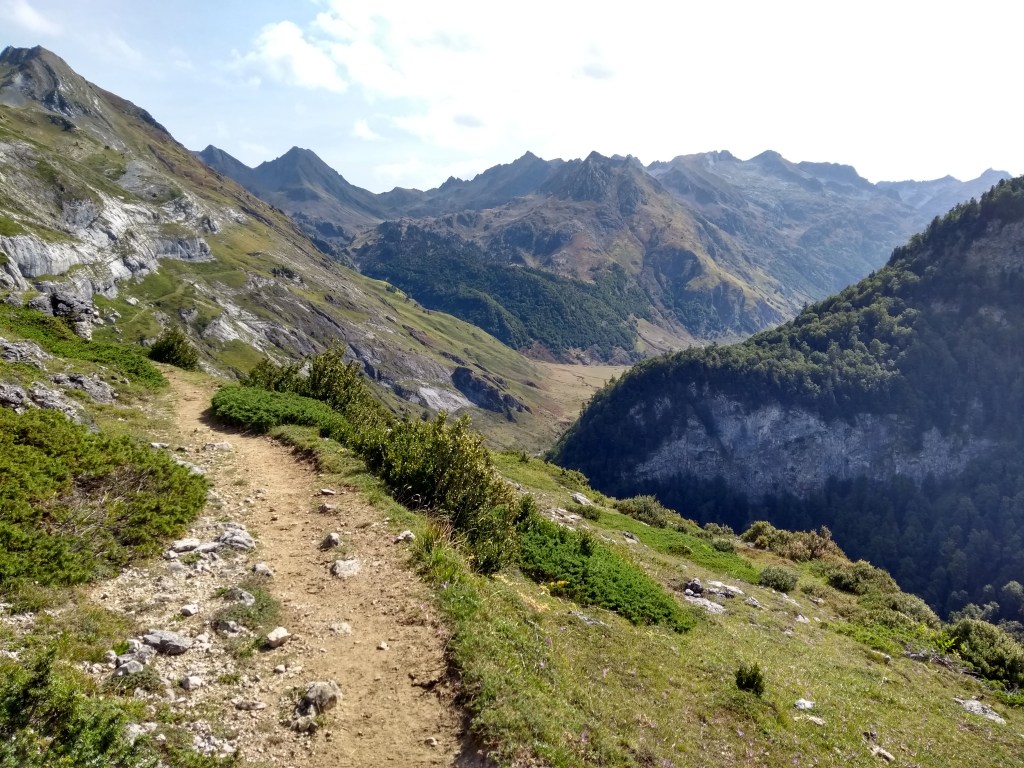
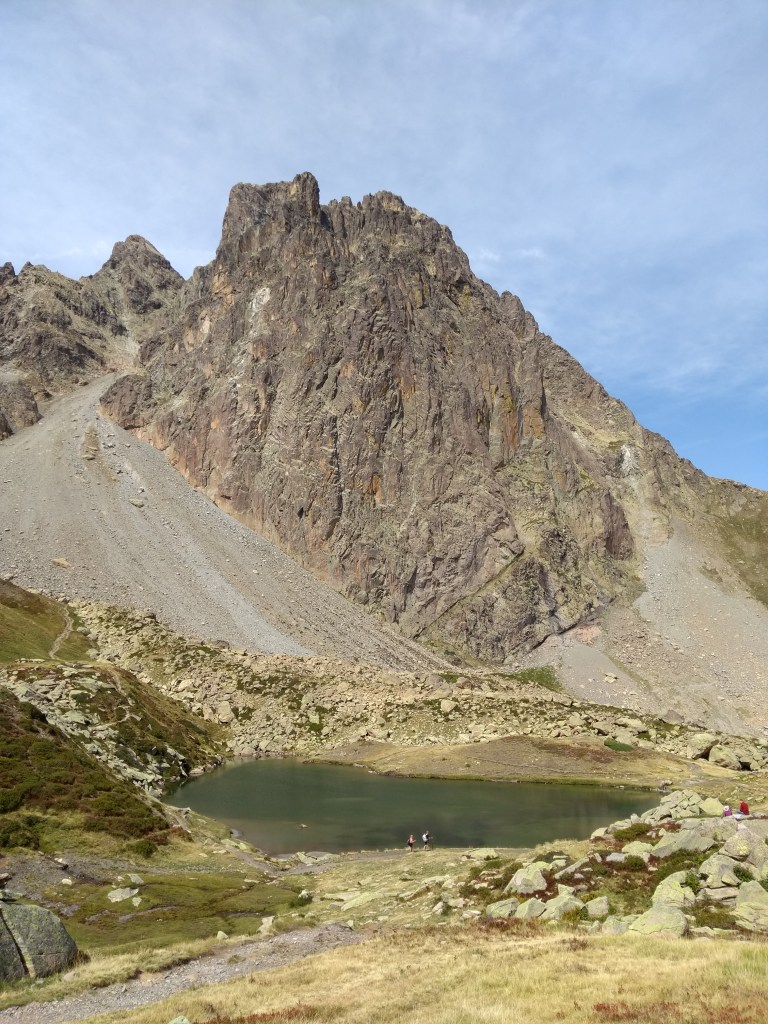
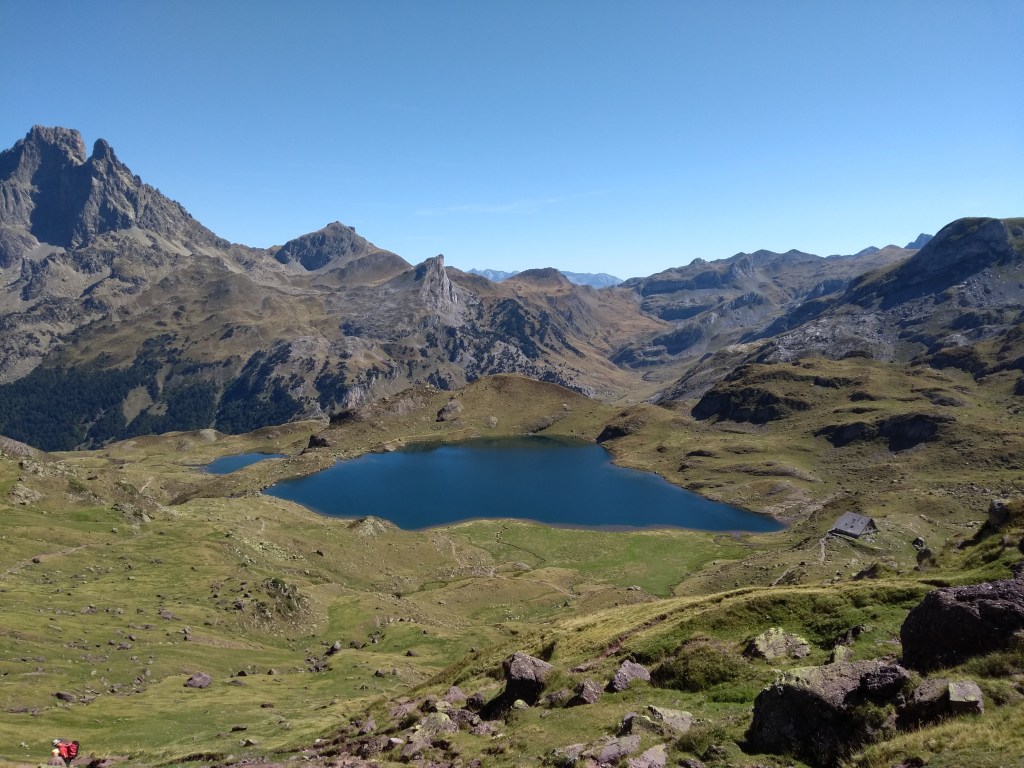
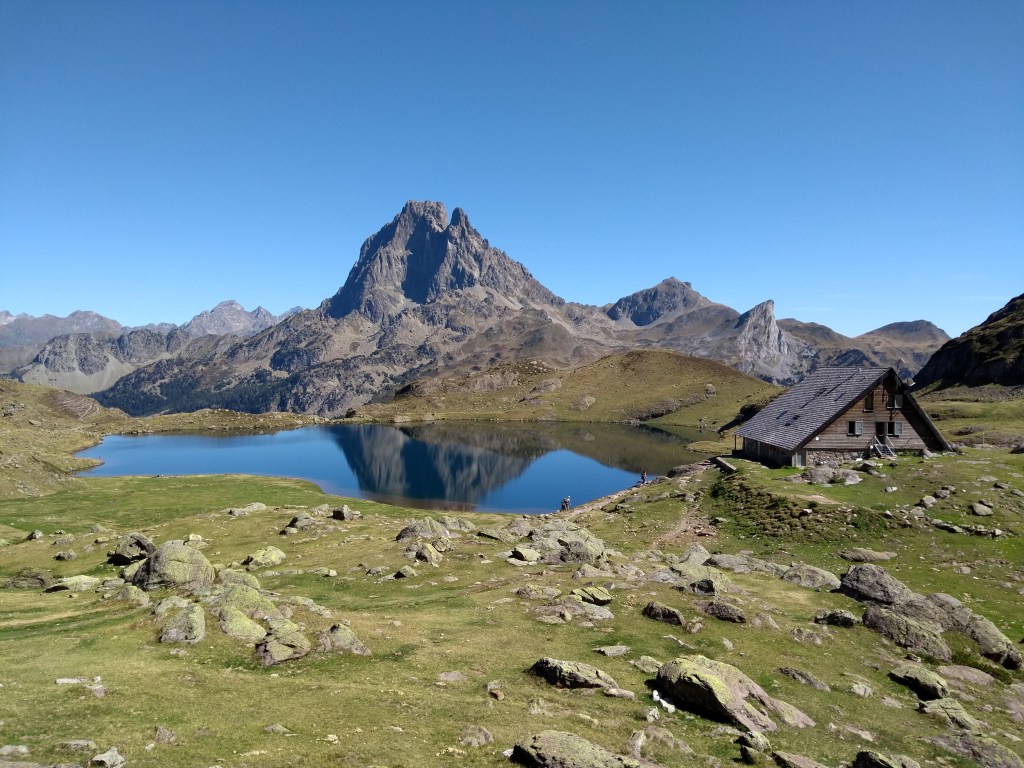
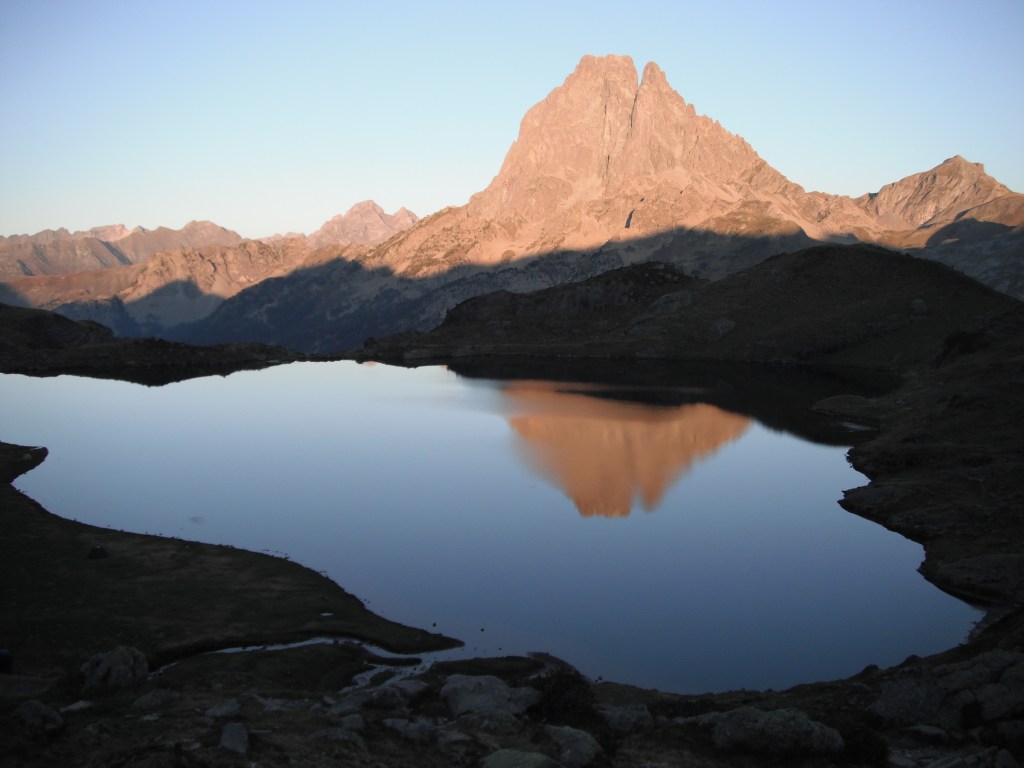
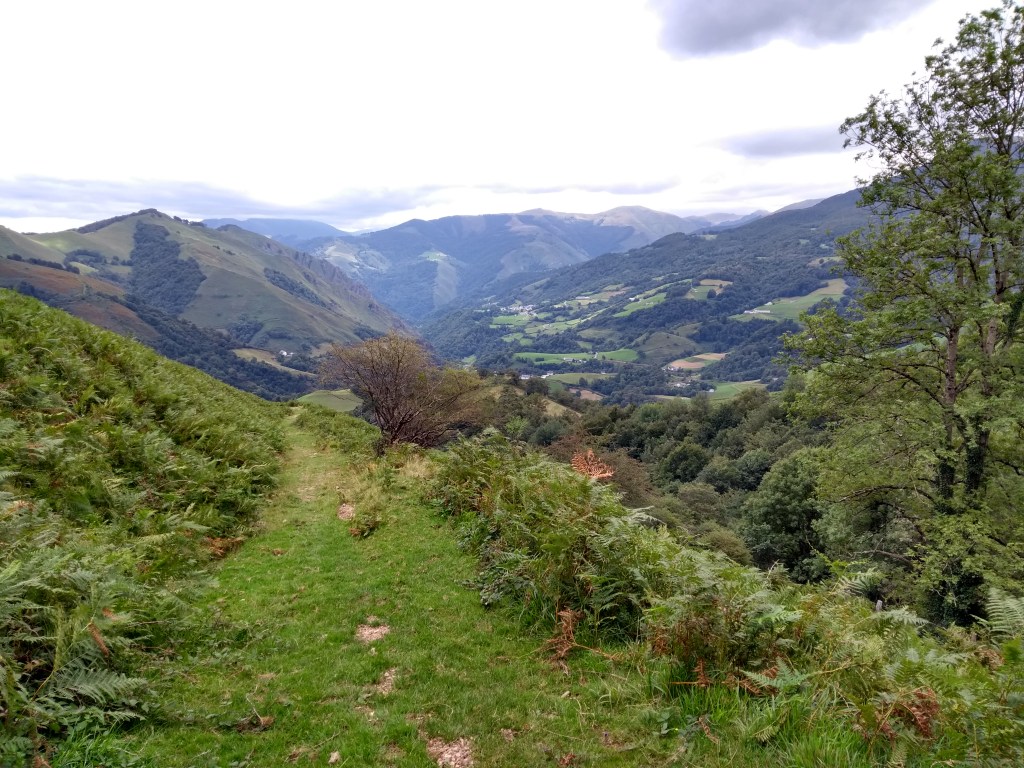
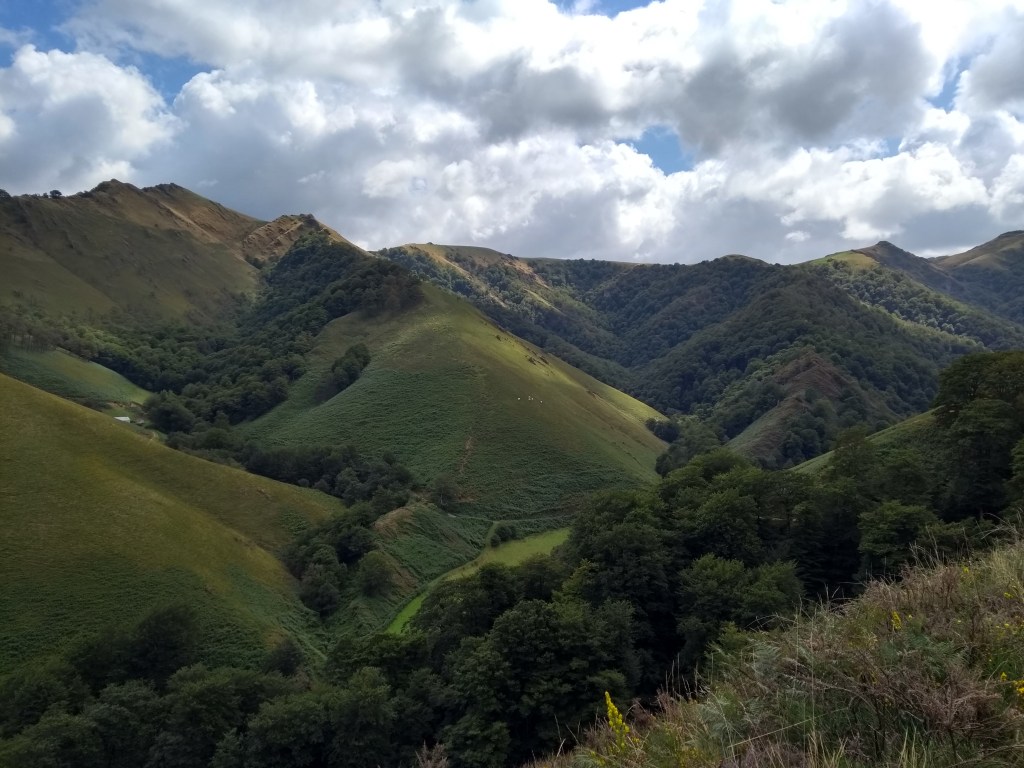
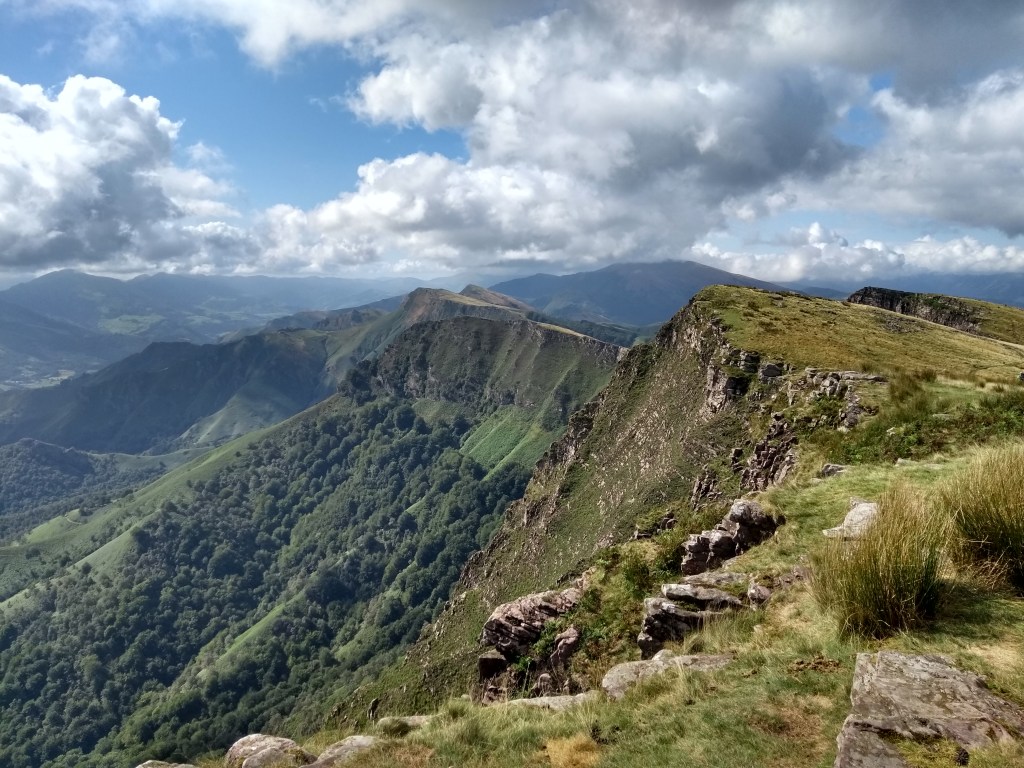
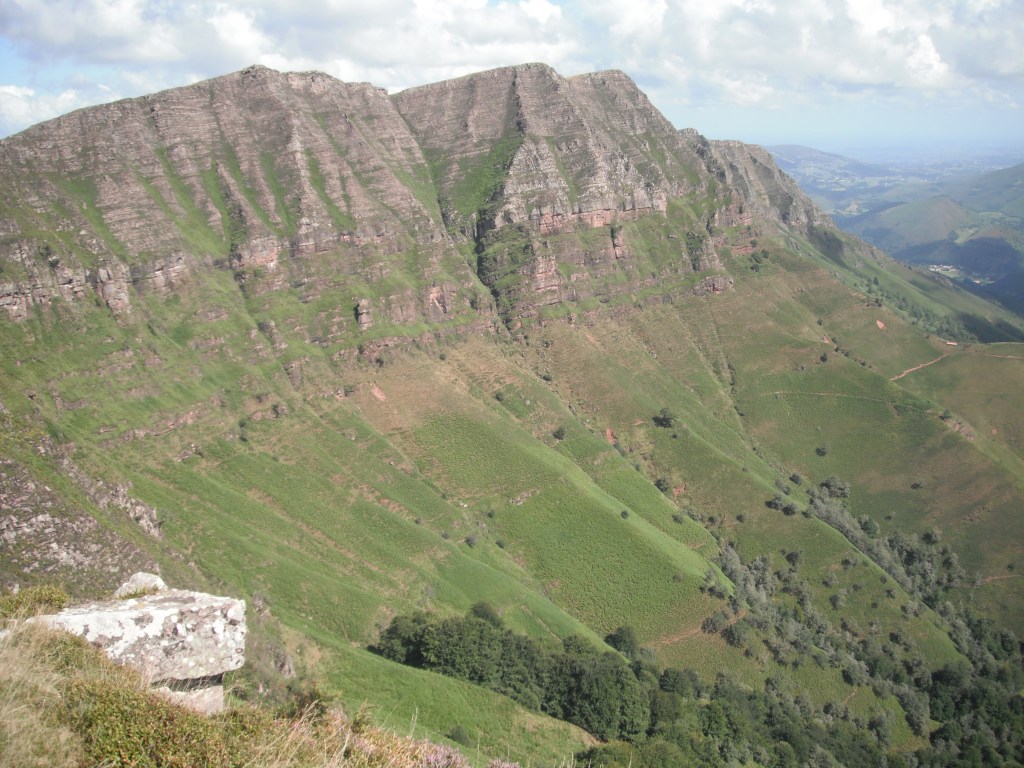
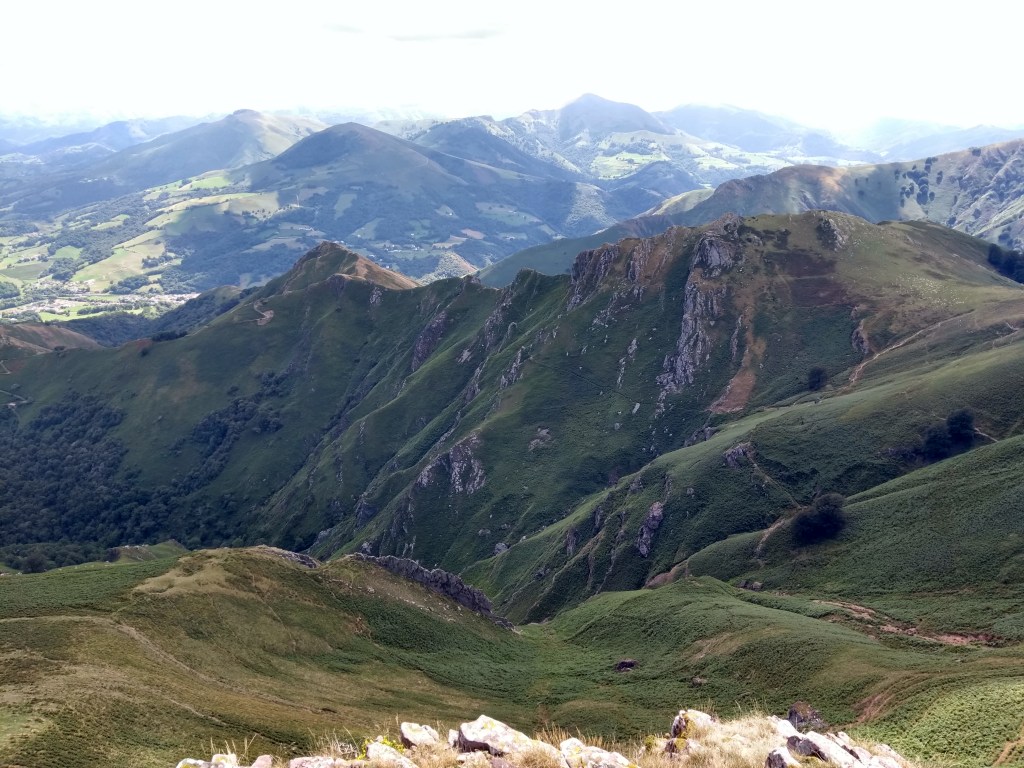
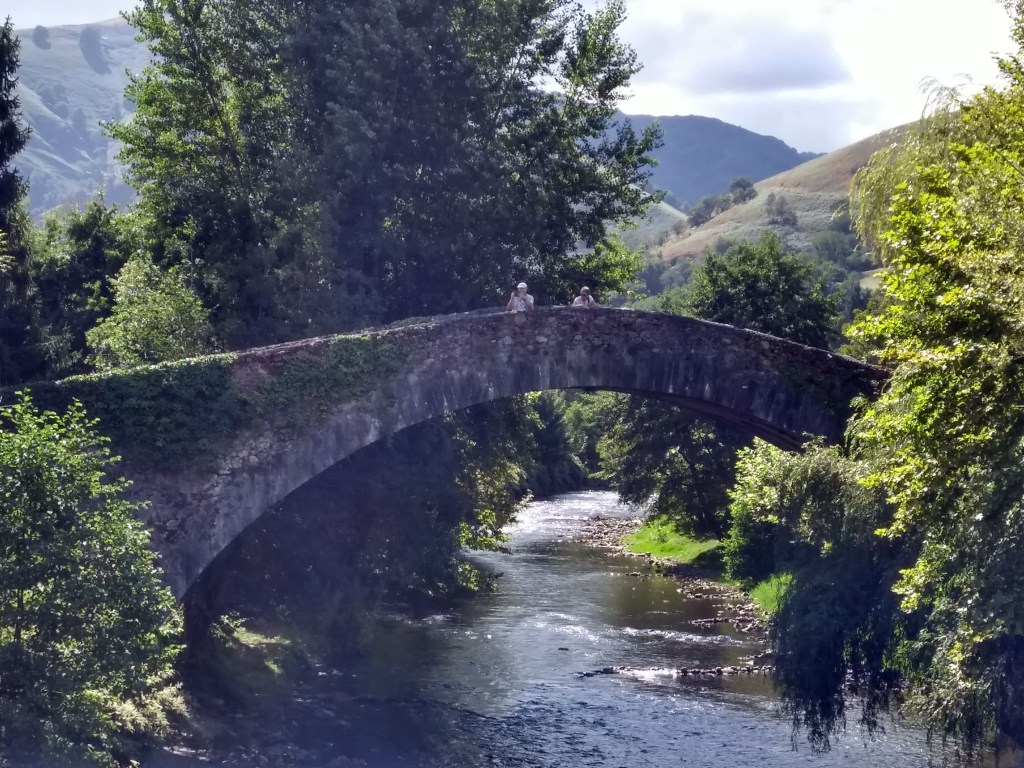
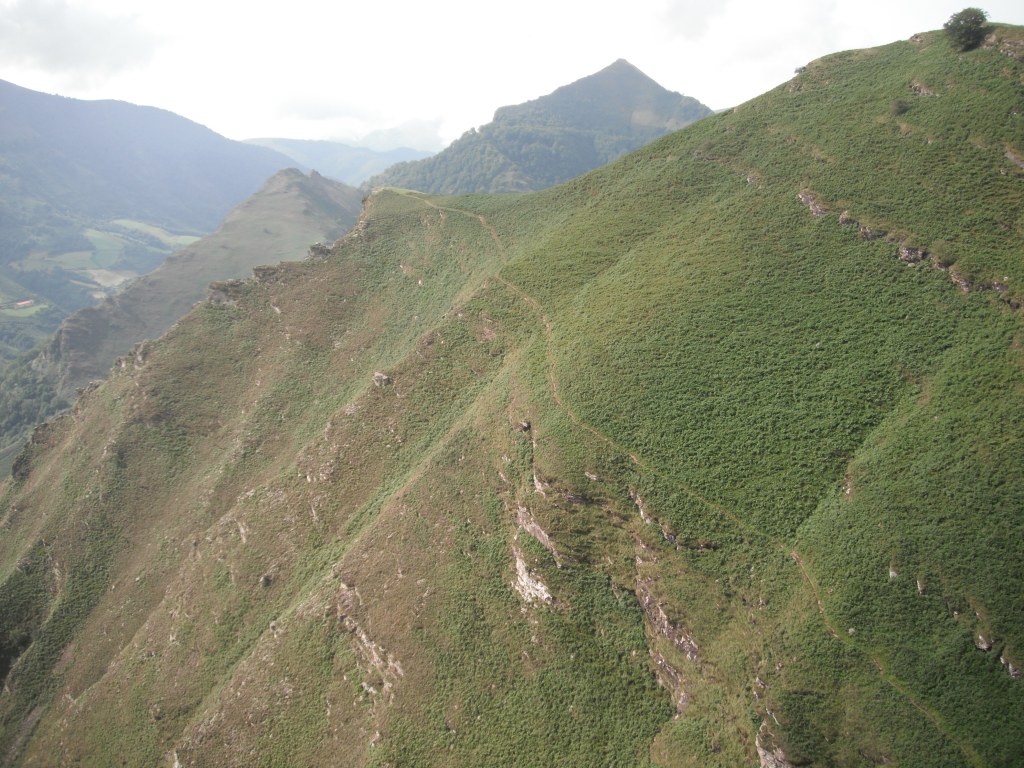
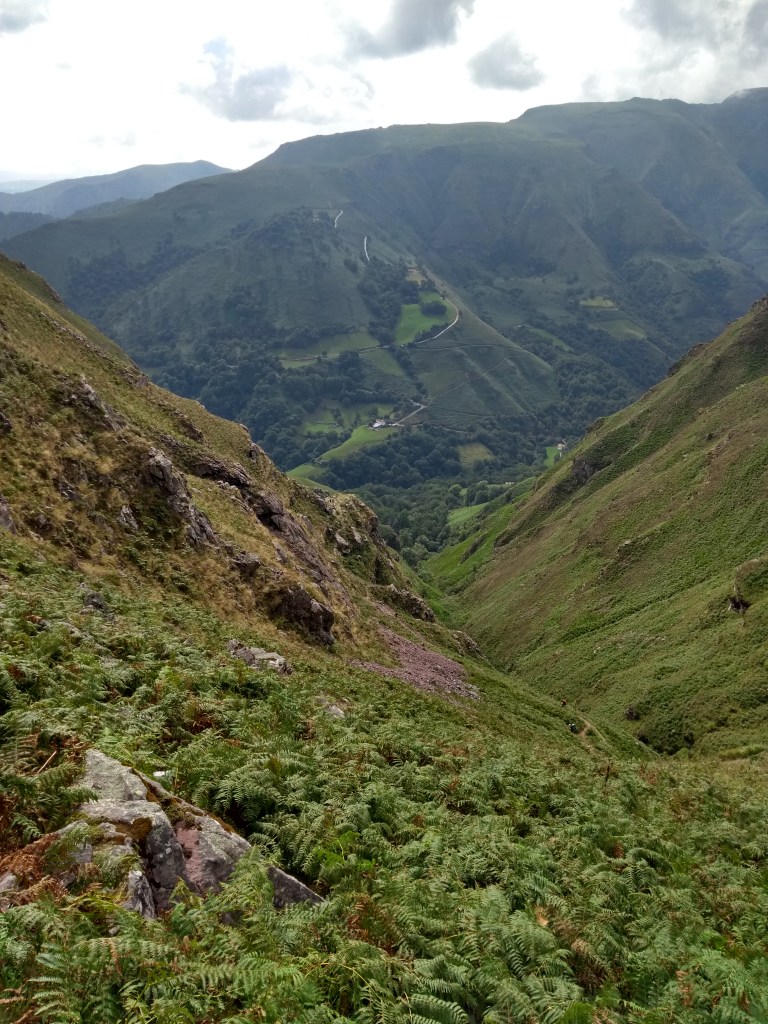
Thank you for the beauty of the landscapes, and for these awe-inspiring moments along the way.

Reflection

I spent just over four weeks on the trail, and during these four weeks I was genuinely happy. Why?

I must first acknowledge that there is no merit in being happy under such circumstances. After all I was in a situation where I had no responsibilities, no worries. I had selfishly disconnected myself from work, houses, and to a large extent even family. All my basic needs were taken care of – food, a shower at the end of the day, a bed, wifi in most places – and for four weeks that was enough. Money, although accommodation and food were generally inexpensive, was never an issue either. But there was more to my happiness than the absence of worries. Likely, staying at home in a similar set of circumstances would not have left me as happy. I sense that my happiness had to do with being on the path, but also that some of it came from within.

Part of it was a very deliberate effort I made from the start not let my mind be distracted by anything not related to the hike itself. My mind was free of the obsessions, idées fixes, wants, often born out of boredom or distraction, that so easily plague it in ordinary life, and that I sometimes cannot get rid of during hikes that last only for the day. But the conscious effort is only part of the explanation, although I don’t necessarily have a better one. It just happened; it was probably helped by the circumstances in which I had placed myself.

Being in silence helped. I was alone most of the time, except for the few occasions when I encountered fellow hikers (and I never shied away from discussion then), and of course in evenings and mornings at the inn. But the rest of the time, I could focus on the path (with limited success, as I missed so many turns!) and on my surroundings. Being alone was not a goal in itself – in fact, I usually fare better in a social structure (family, work). But there was a noticeable difference with group hikes, where discussions with fellow hikers often distract from what is around the trail. Hiking alone, all that could distract my mind, apart from itself, was nature.

The physical effort also helped – during climbs I was very focused on my energy and the alternating periods of walking and resting that followed a cycle lasting one minute or so. My body itself was responding well to the effort and feeling good – although not letting me sleep as I had hoped for (I had a surprising large number of bad nights).

I am sure that some days there was also a sense of accomplishment, specially when looking back and seeing in the distance peaks where I had been a day or two ago.

Being in a different setting was also very beneficial. I did not have all the things that can distract me so easily in regular life – no fridge stuffed with food; no internet stuffed with everything. I was only superficially aware of world events, and although I did check my email every day, I hardly spent any time responding to it.

My days were structured, had a rhythm of their own: getting up relatively early, having breakfast, walking, arriving, taking a shower, writing my blog, having dinner, reading a bit, going to bed early. Structure without stress, clearly. Writing the blog was very beneficial, too. It forced me to go over what had happened during the day and gave me a way to share what I had experienced, despite doing this hike alone. During the hiking periods themselves it also forced me to think about what was worth the effort to take a picture to include in the day’s blog (the cell phone was stored in the top part of my backpack, so to take a picture I had to take the backpack off and then back on, which was a significant undertaking).

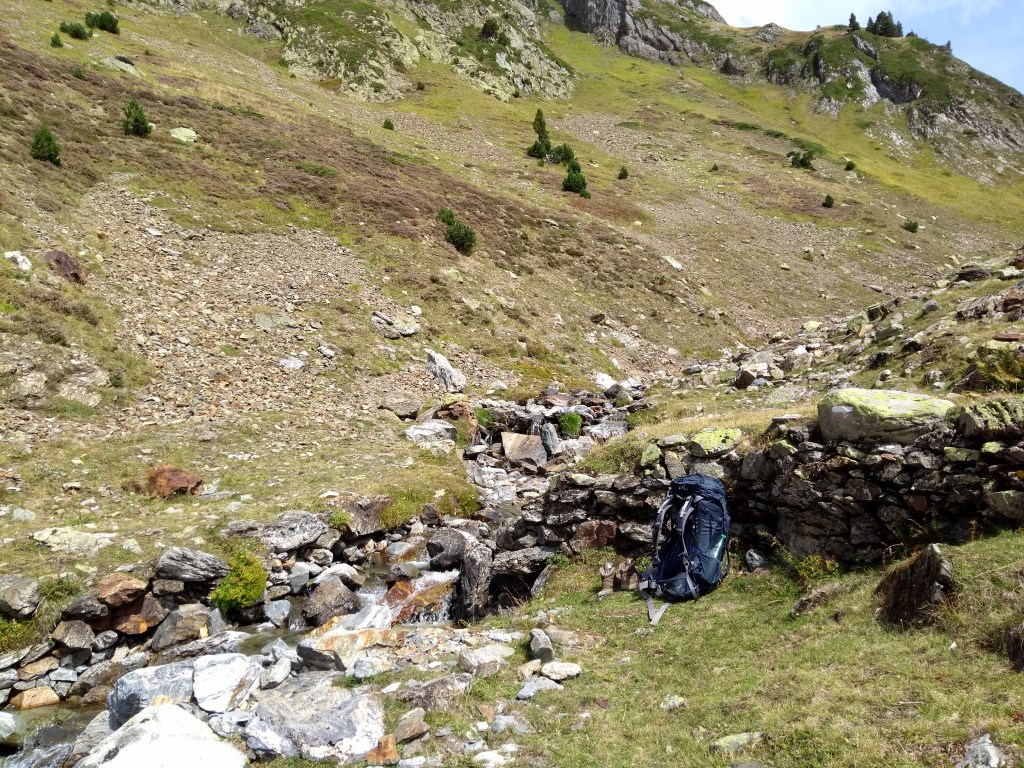
My backpack also had its own discipline: there was space for everything I had, and everything had a place. I had very little in terms of possessions – it all fit in the backpack. Nothing was superfluous (I used every single item, except for the first aid stuff). Carrying all my possessions on my back gave me an incredible sense of freedom – it made me realize how few, of all the things I have or want, are truly necessary.

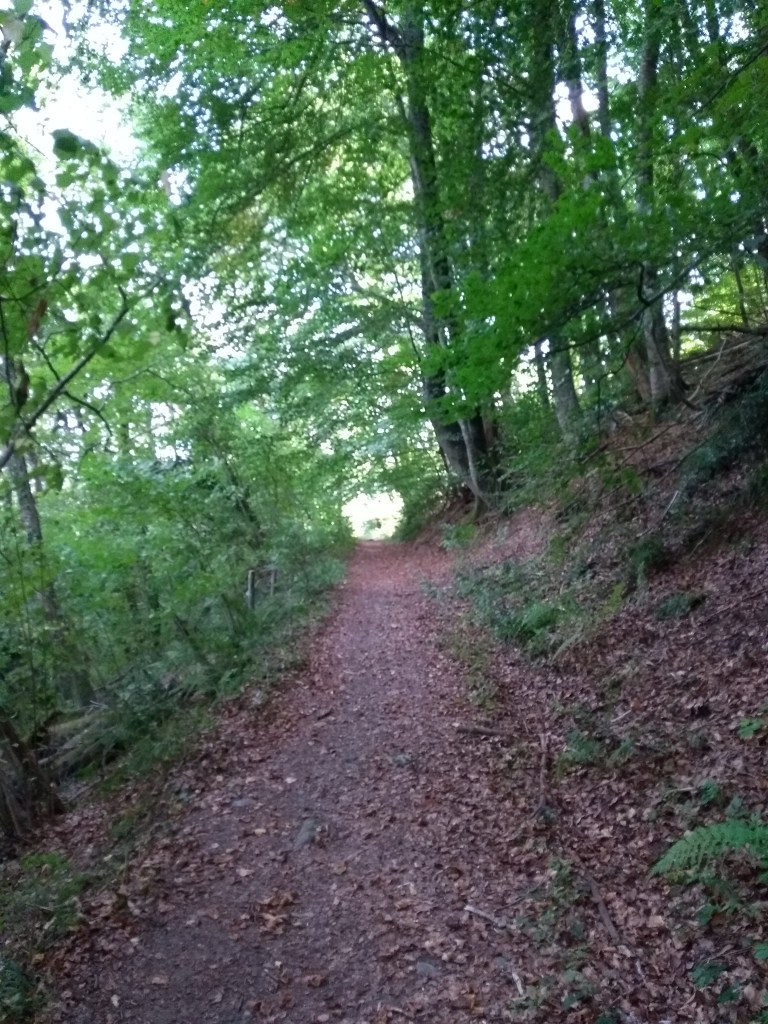
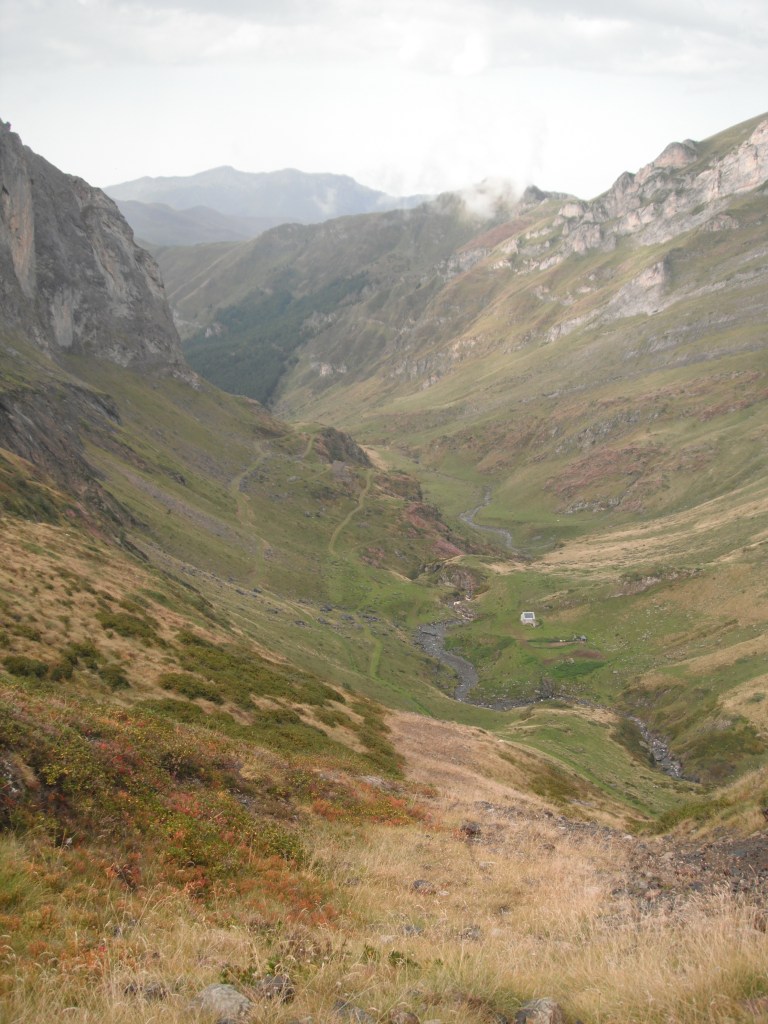
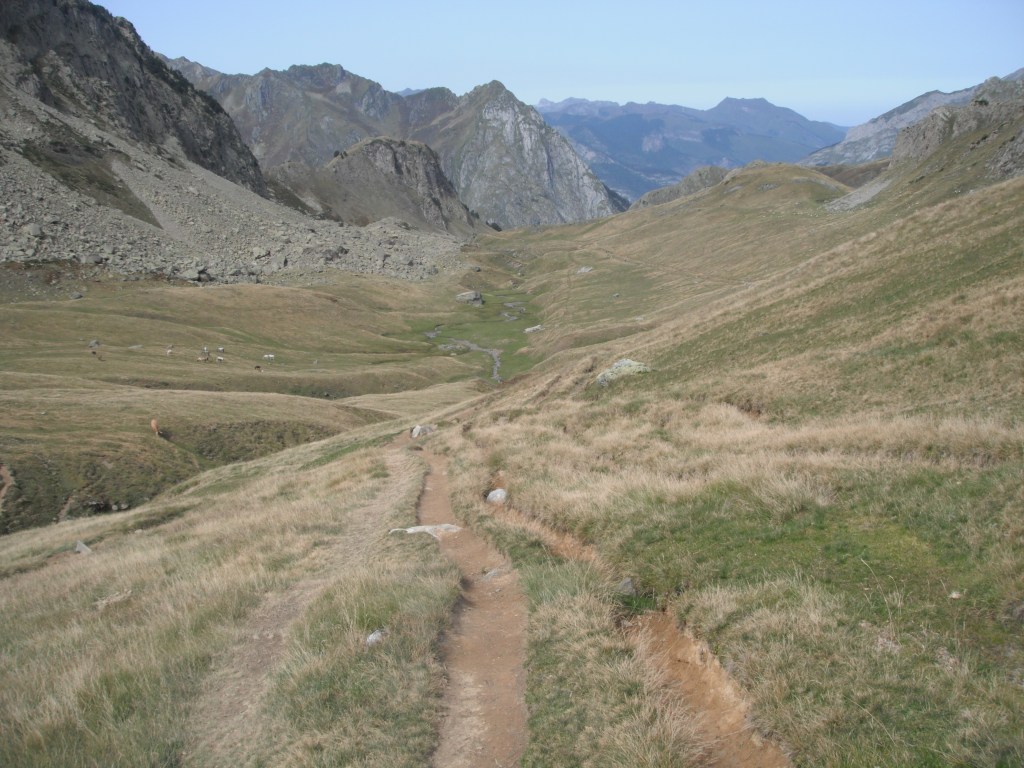
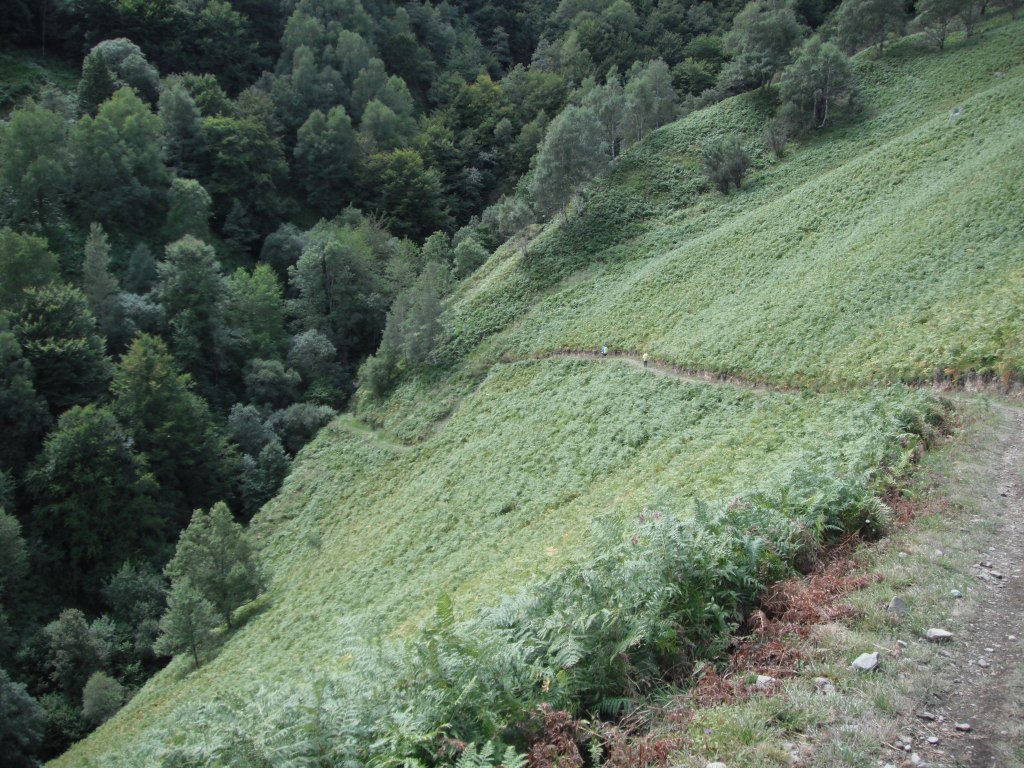
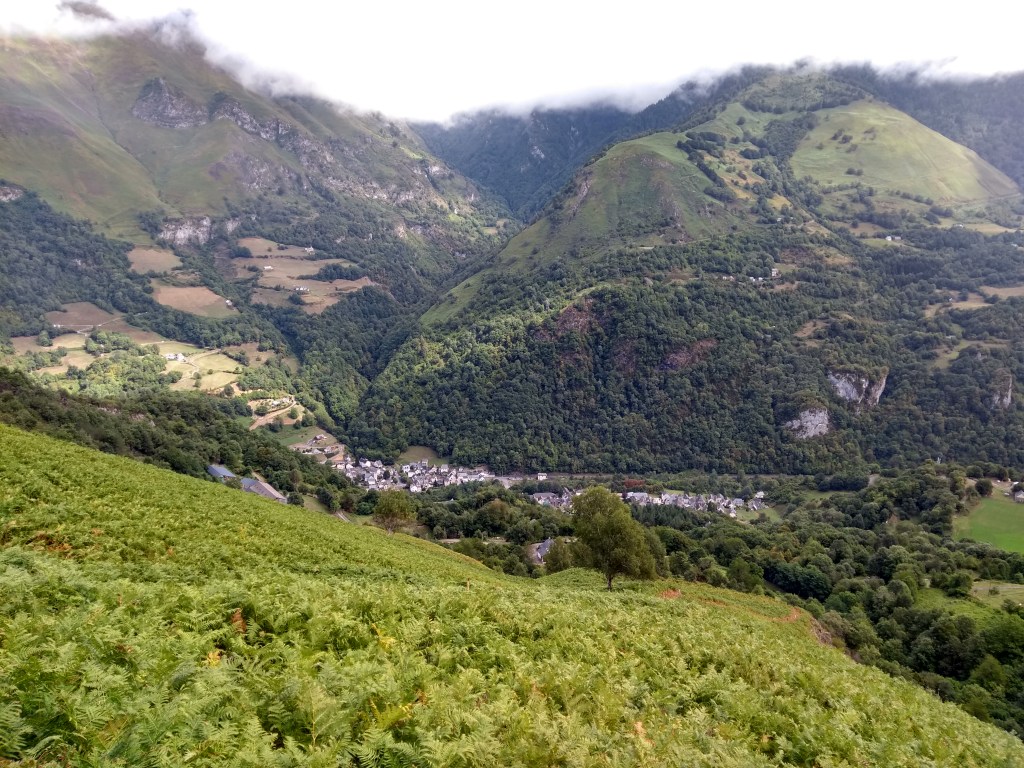
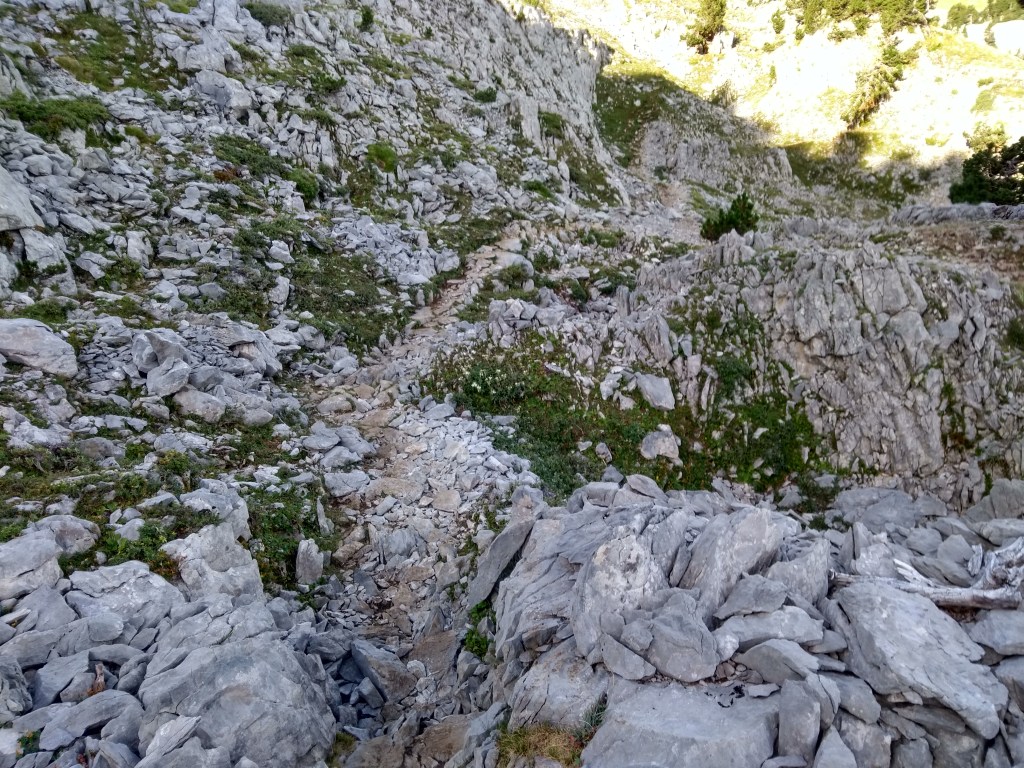
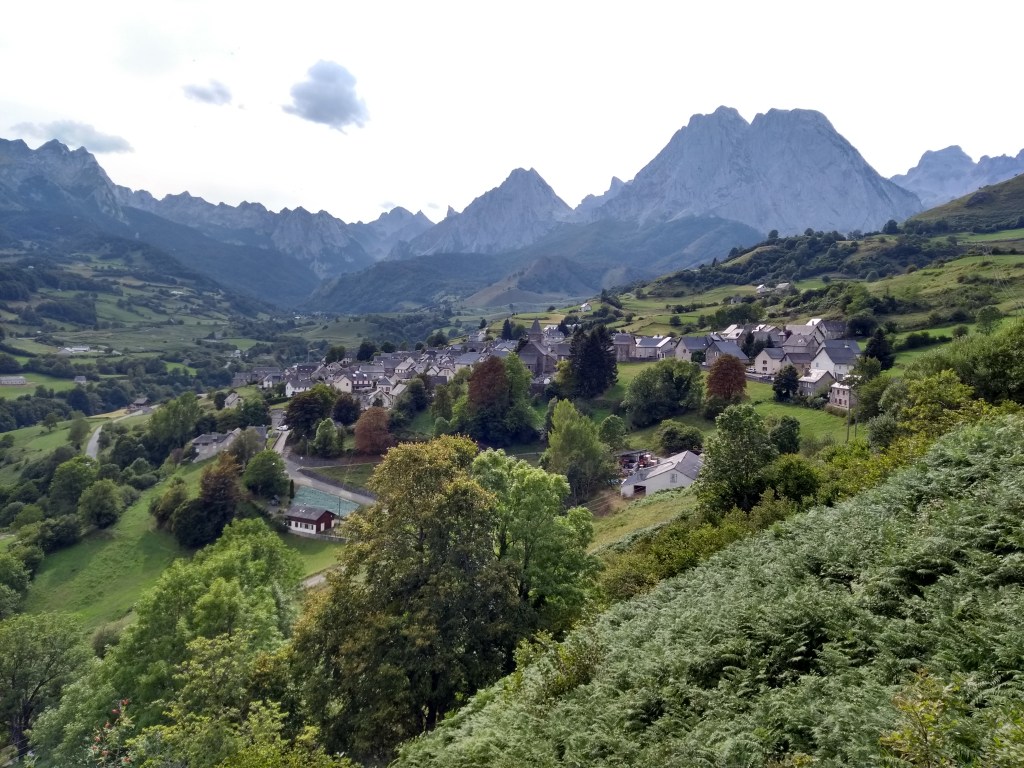
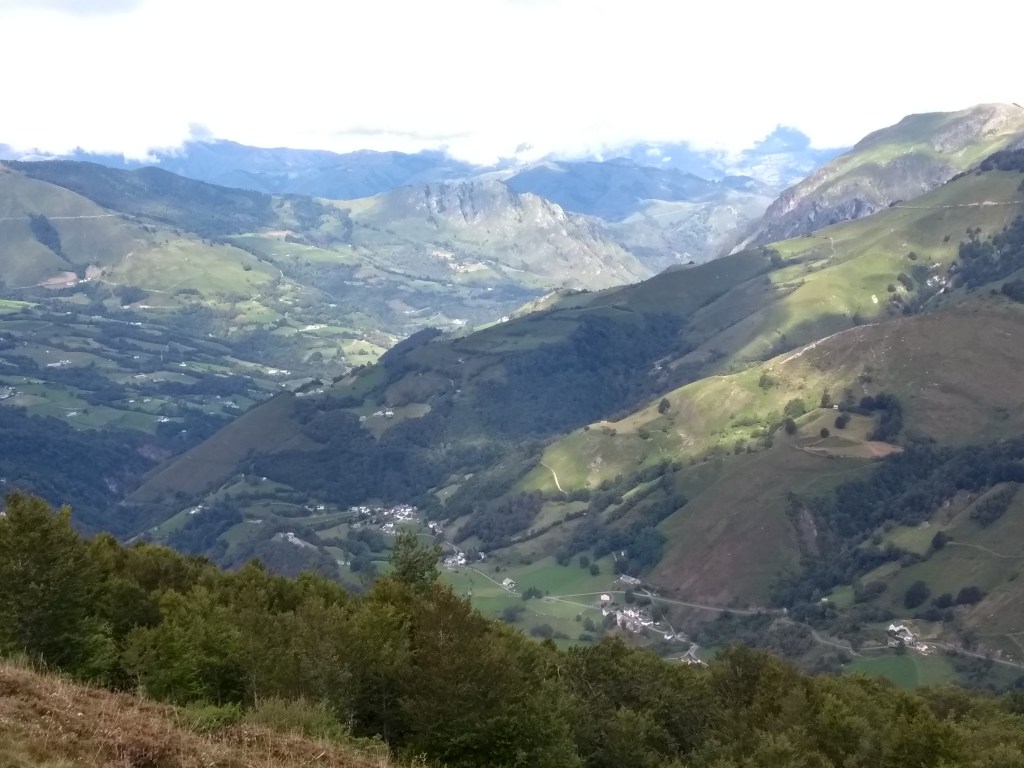
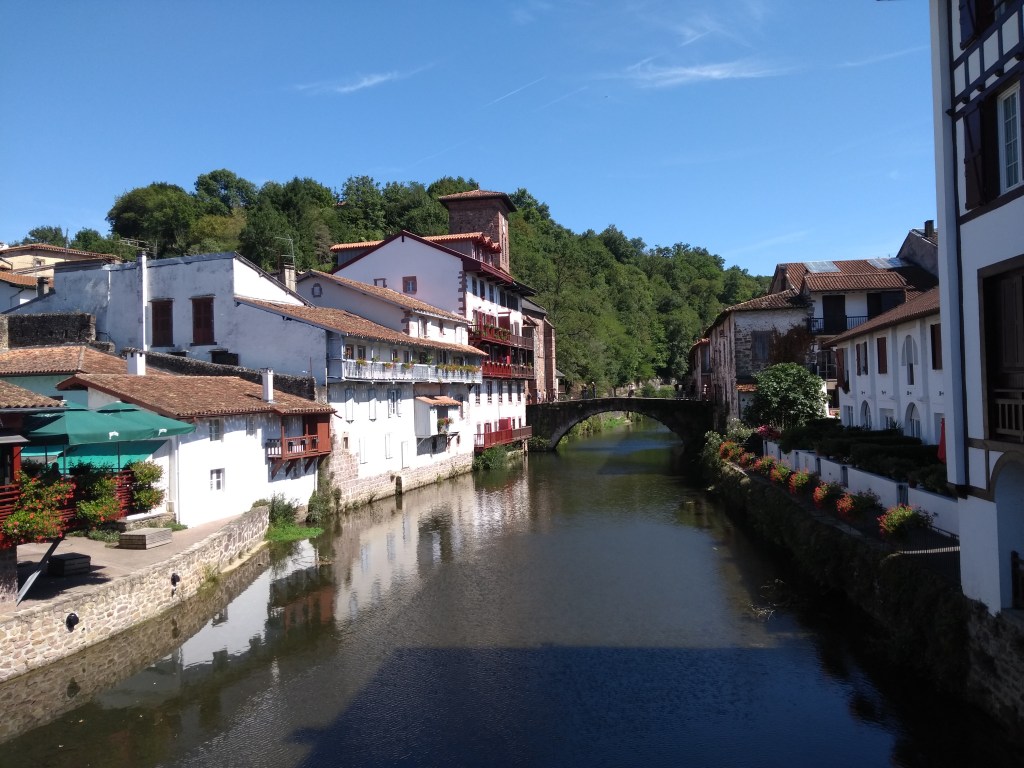
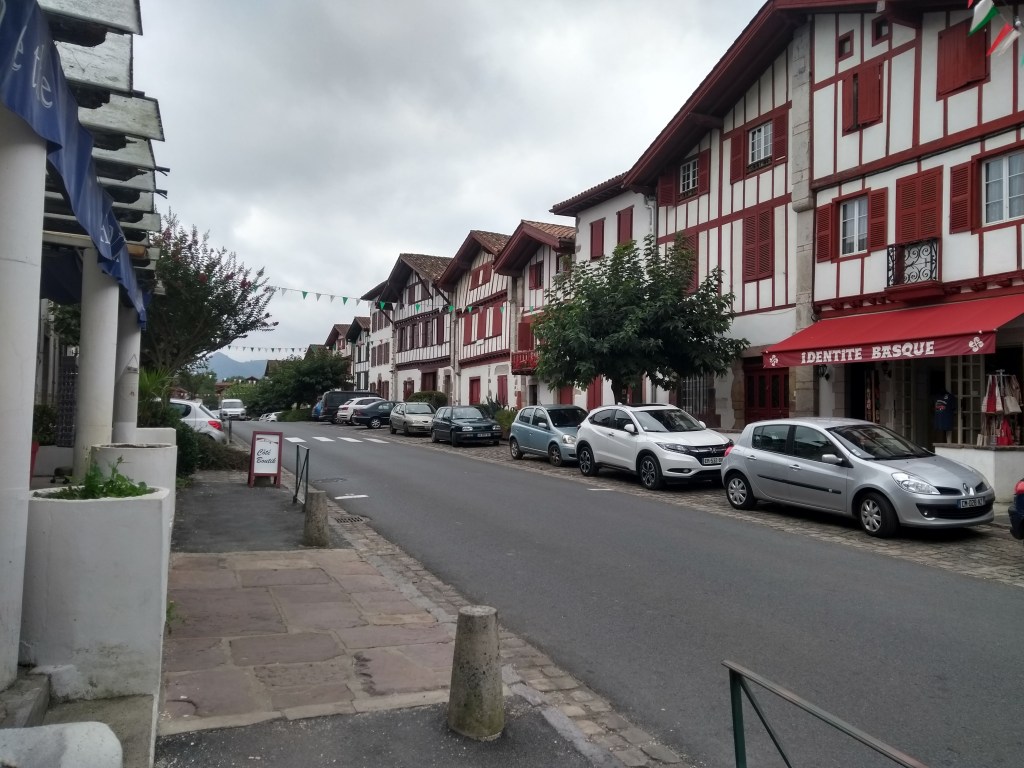
The beauty of the path must take some credit too. The landscapes, the buildings, and the trail itself were beautiful. Some of the landscapes were very calming, some were more dramatic. The view of the path itself had a soothing effect. A path through a forest, or meandering through flowers, is very beautiful indeed.

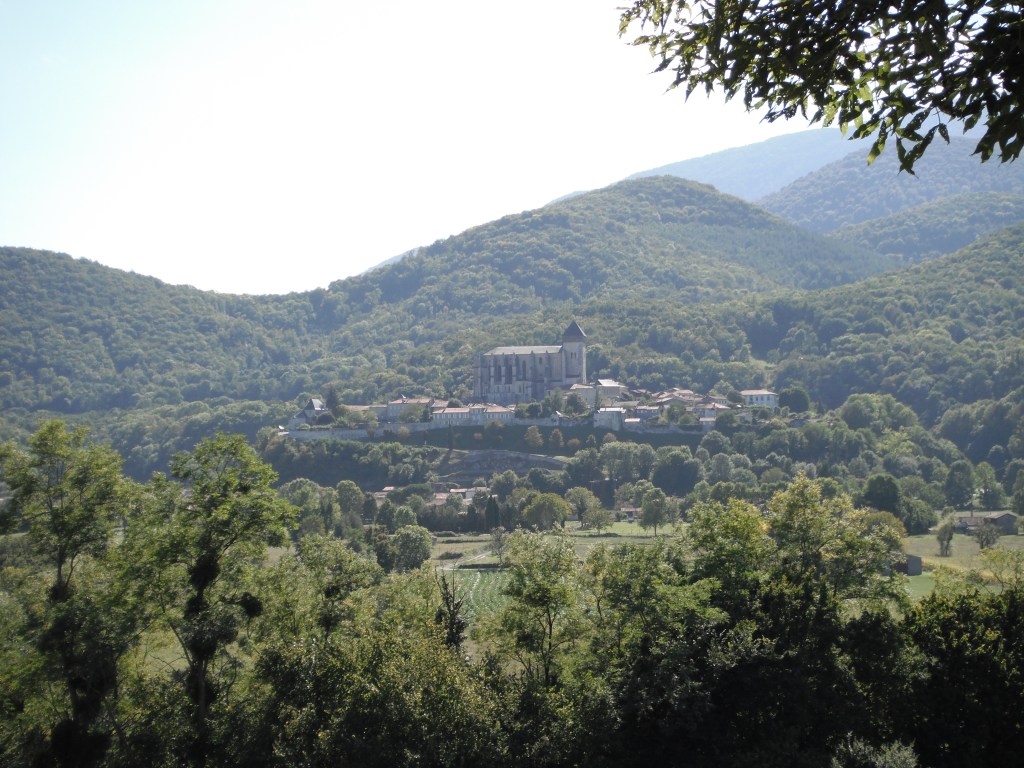
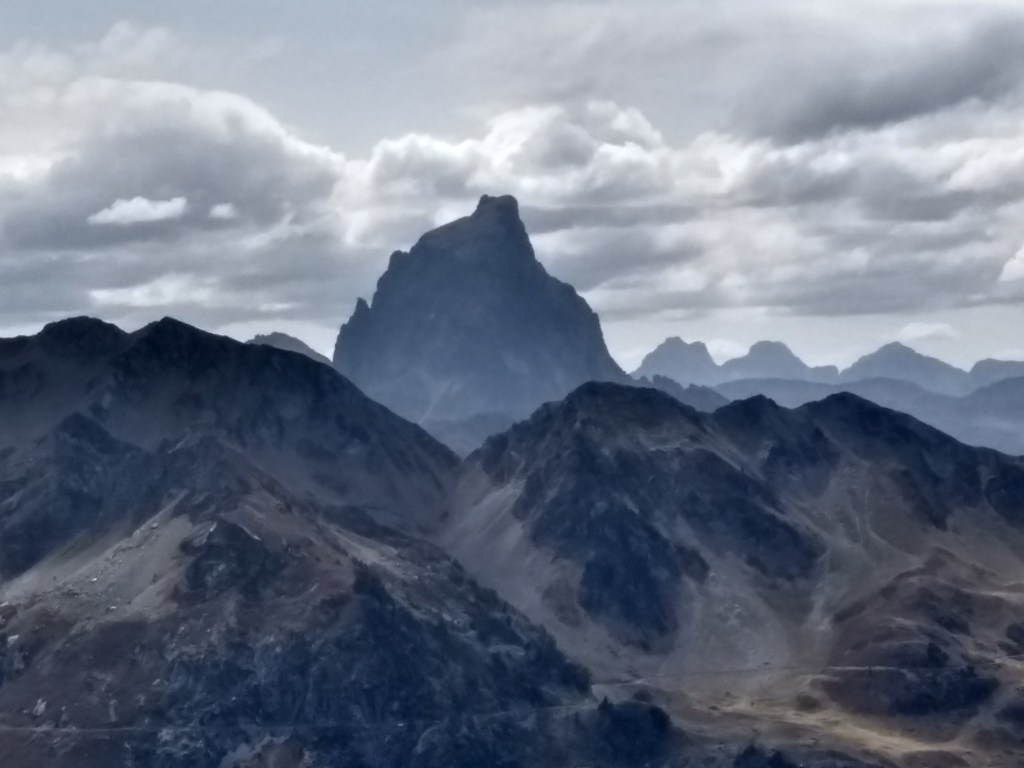
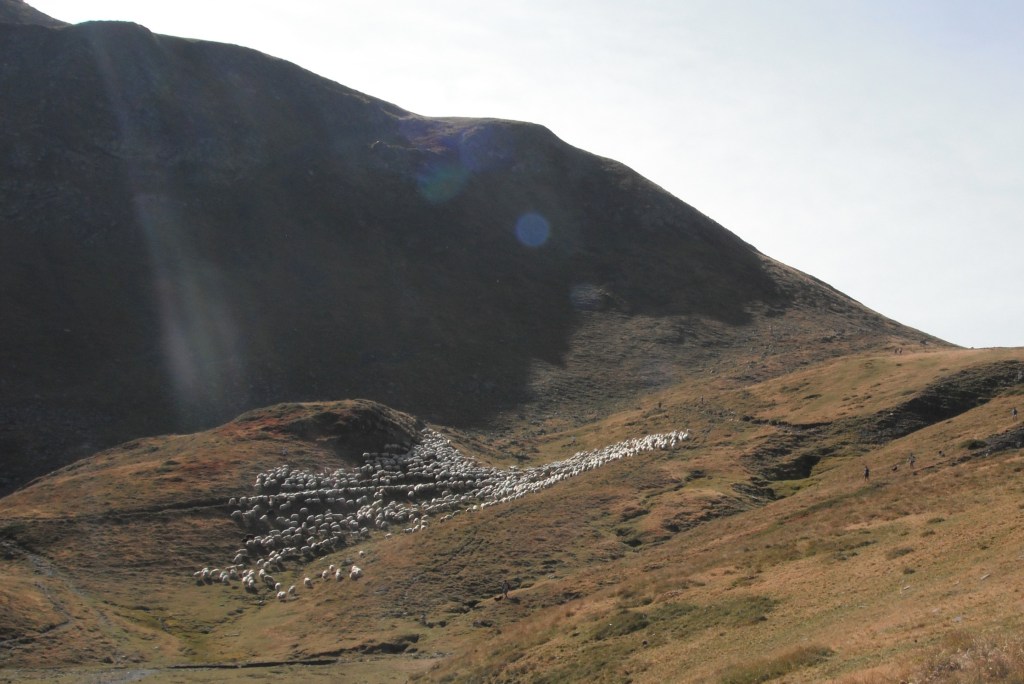
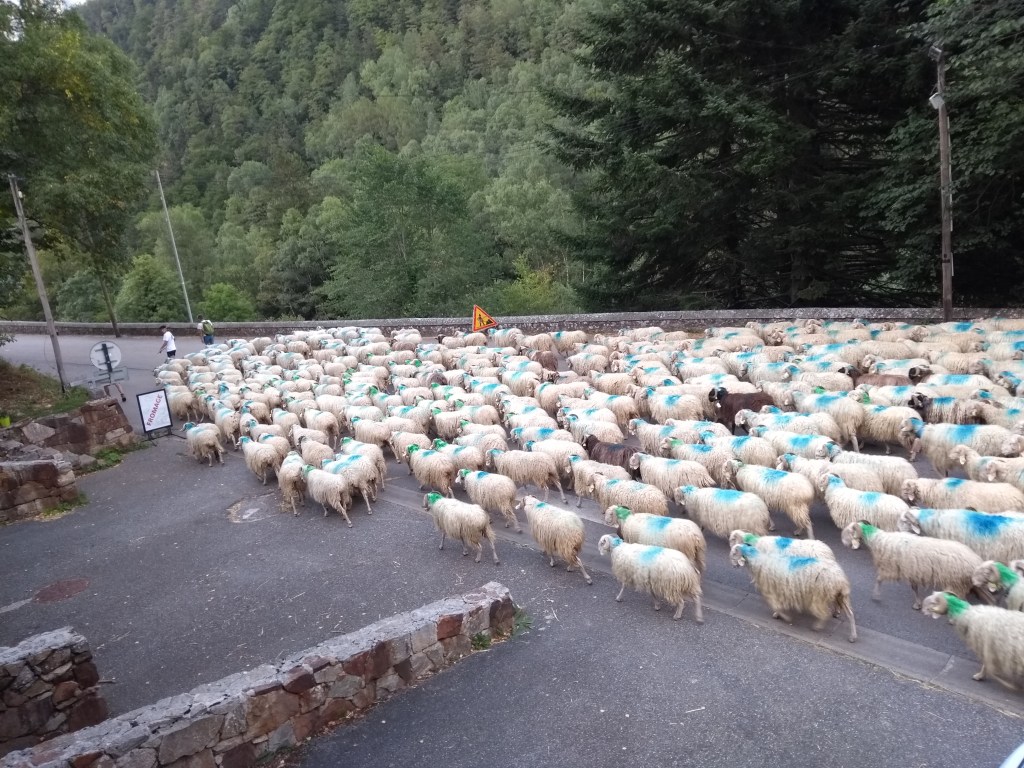
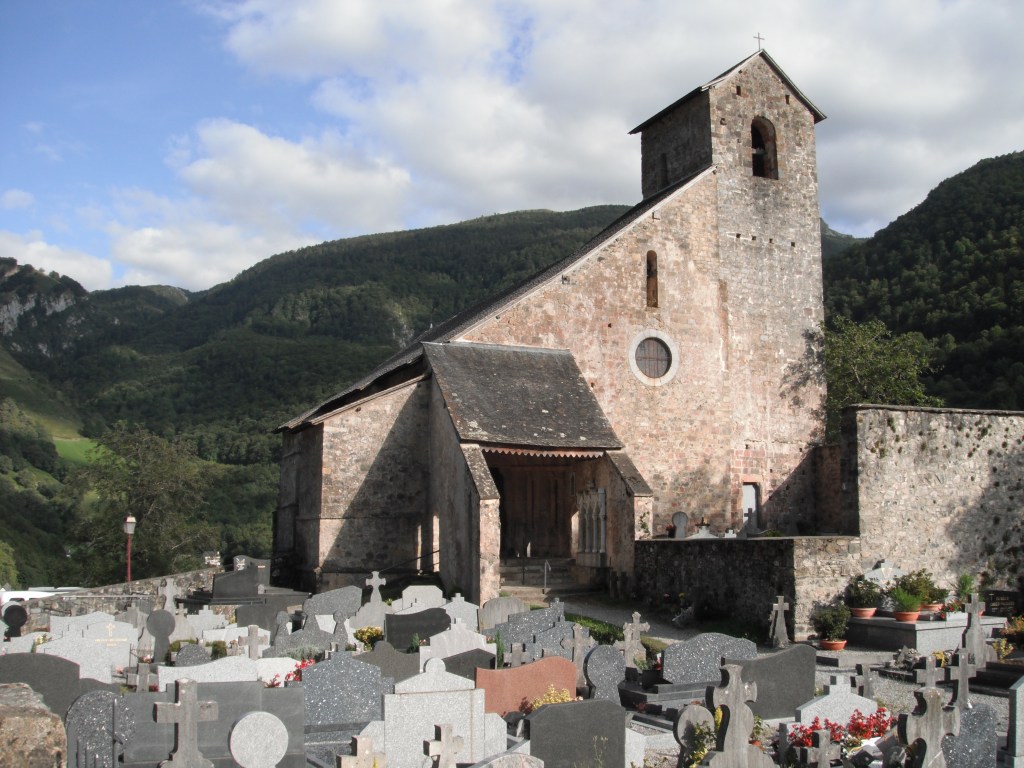
There were also some moments of awe, particularly during the first part of the hike: being on the Pic d’Iparla and enjoying the view and the vultures gliding below; attending mass in Basque in Saint-Engrâce; reaching the Col d’Ayous and encountering the Pic du Midi d’Ossau for the first time; witnessing the sheep leaving their estive through the village of Gabas; seeing the cathedral in Saint-Bertrand-de-Comminges emerge suddenly in the distance. These moments illuminate the days and have an incredible effect on the mind.

Discovering new places, traditions, etc. and meeting new people was also great.    My interactions with others were always free of conflict. Fellow hikers were always kind, and so were the innkeepers. I witnessed many times the kindness of people – whether it was the volunteers organizing accommodation for pilgrims, or innkeepers going the extra step to make me feel comfortable, or perfect strangers pointing me to the right direction without even being asked (I must have looked really lost!)

In short, there is not just one single compelling reason for my happiness. It was because of the trail, because of me, because of the people I met; it was because of the newness of the situation, because of the beauty of the surroundings, because I had so few possessions; it was because of the physical effort and my body’s response to it, and because of the rhythm of the path and the structure of the days. It was because of all these reasons, and their complex interactions, that I was happy.
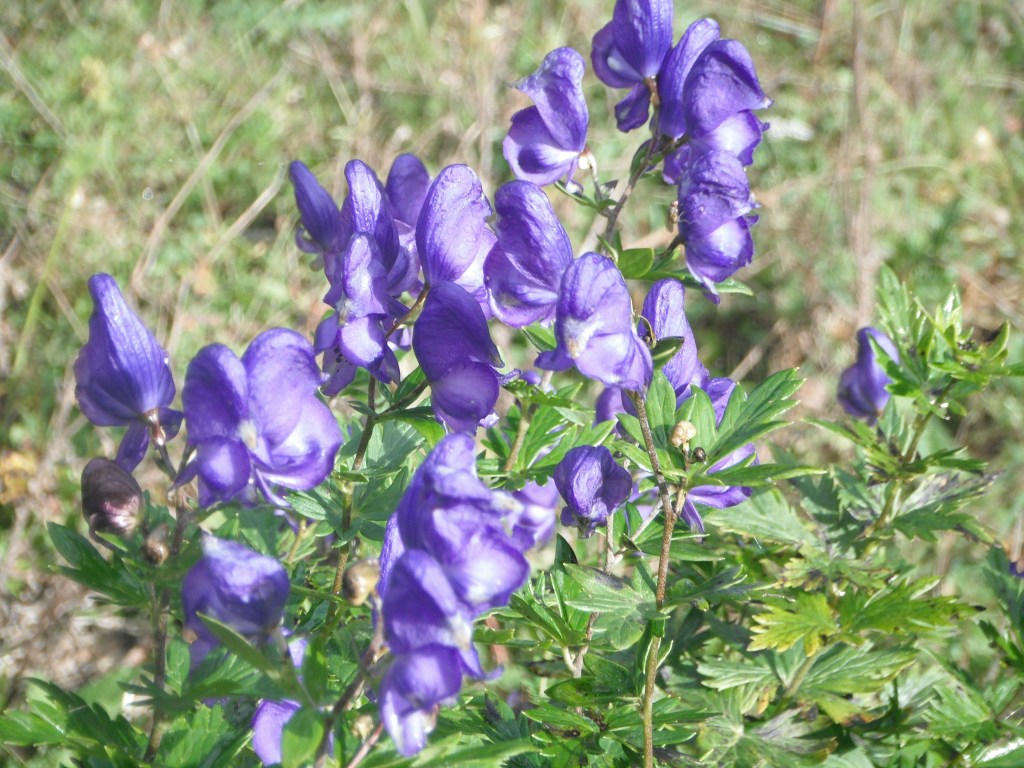
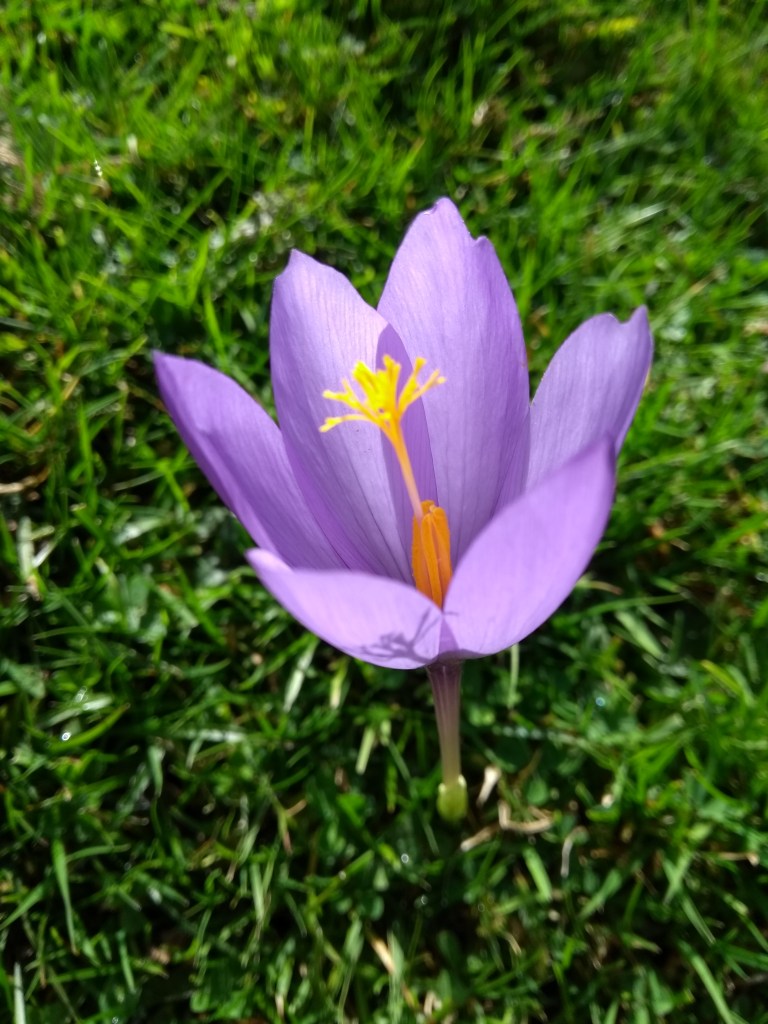
Day 29: Argein to Saint-Girons

October 4, 2019 – Departed 8:20 – Arrived 13:15

Continuing from Argein the GR78 followed more or less the Lez river. As it did yesterday it went in the hills on either side, but today it tended to stay closer to the bottom of the valley, which made for a slightly more direct route but also left the path at times more exposed to the noise of the busy road below.

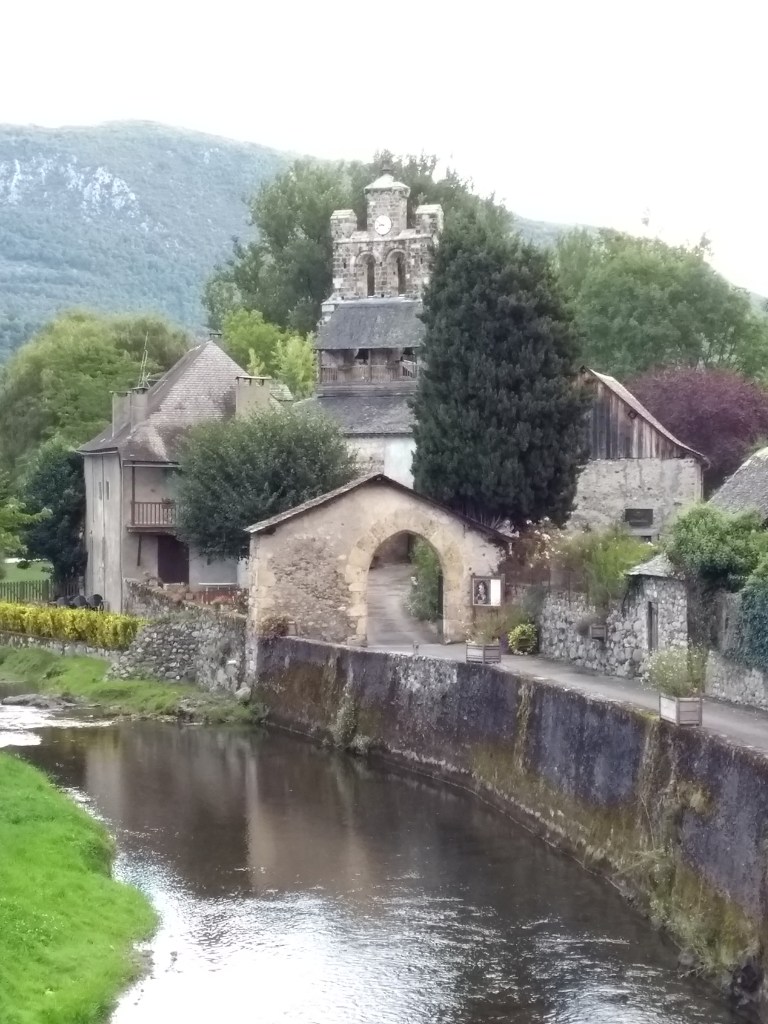
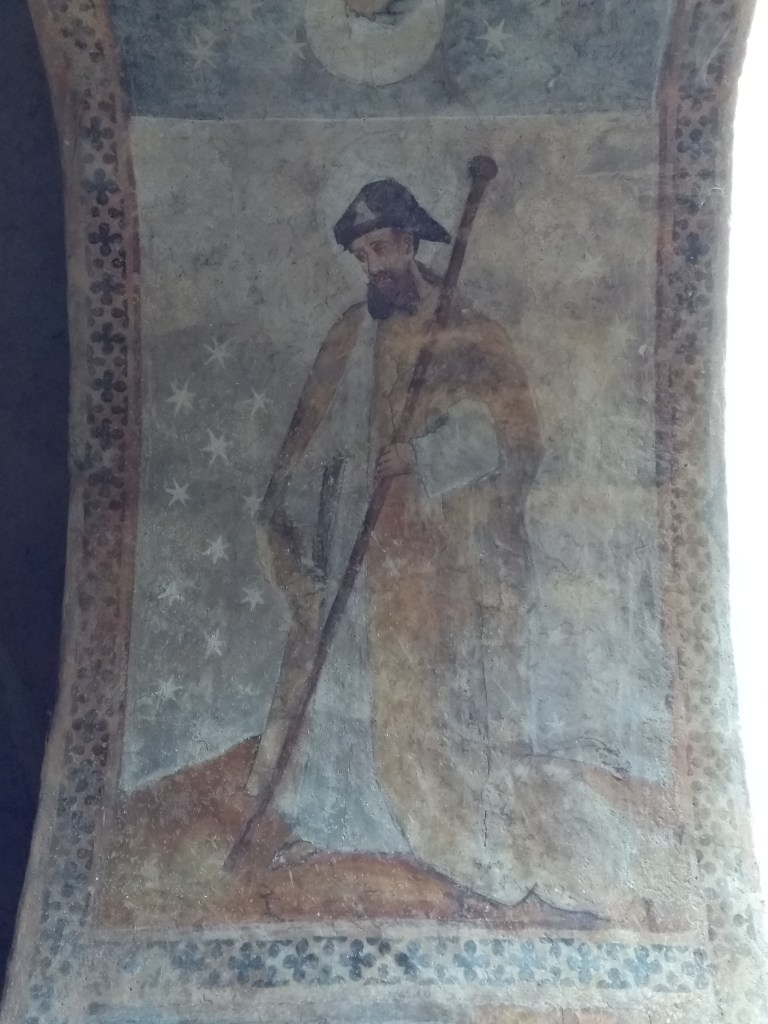
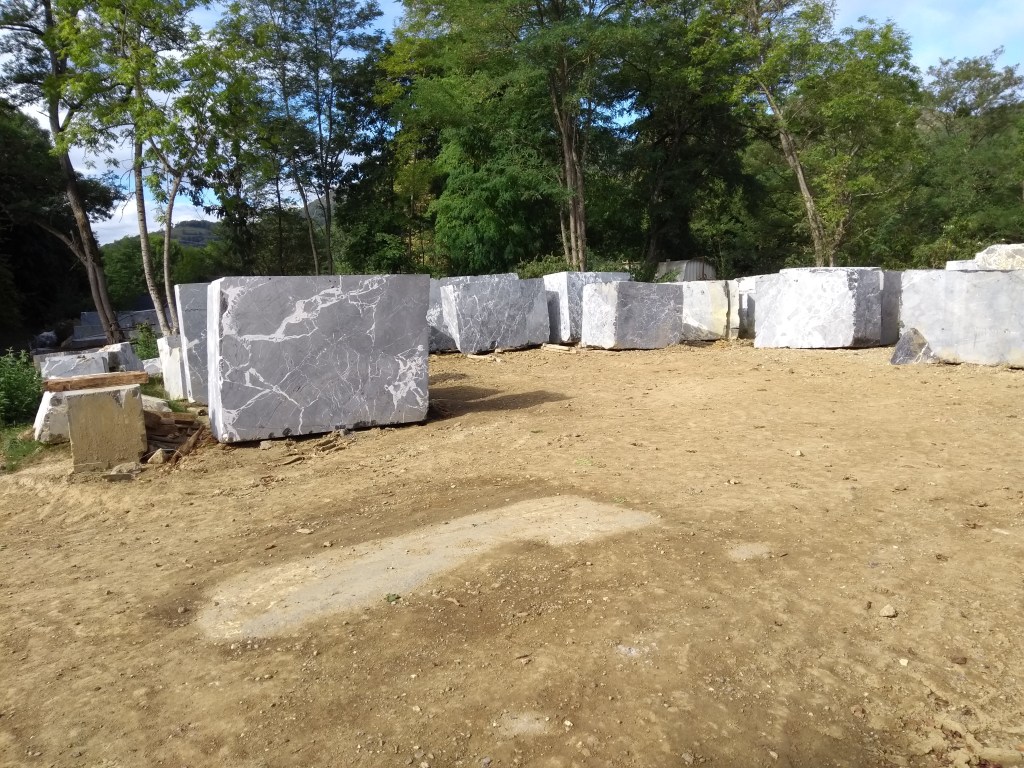
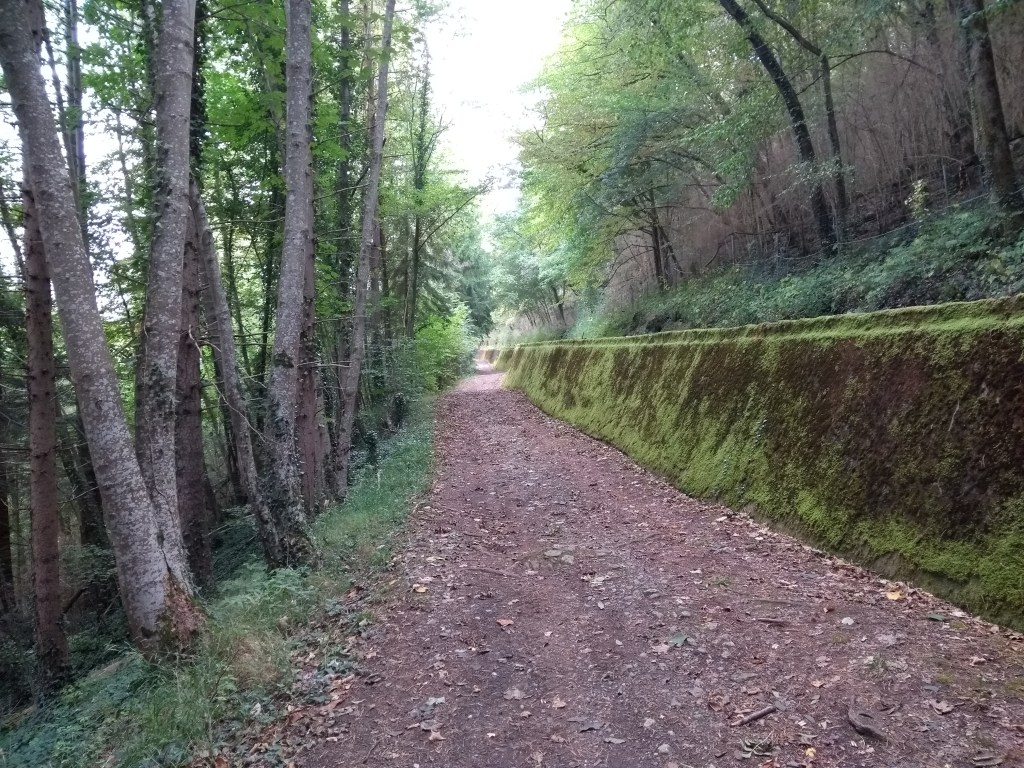
There were some interesting sights along the way, in particular Notre-Dame de Tramesaygues in Audressein, with a fresco representing a Camino pilgrim. Some industrial sites too, with the marble quarry in Aubert (the columns of St Peter’s in Rome come from here) and the Canal de la Papeterie (a canal built for paper mills) just before Saint-Girons.

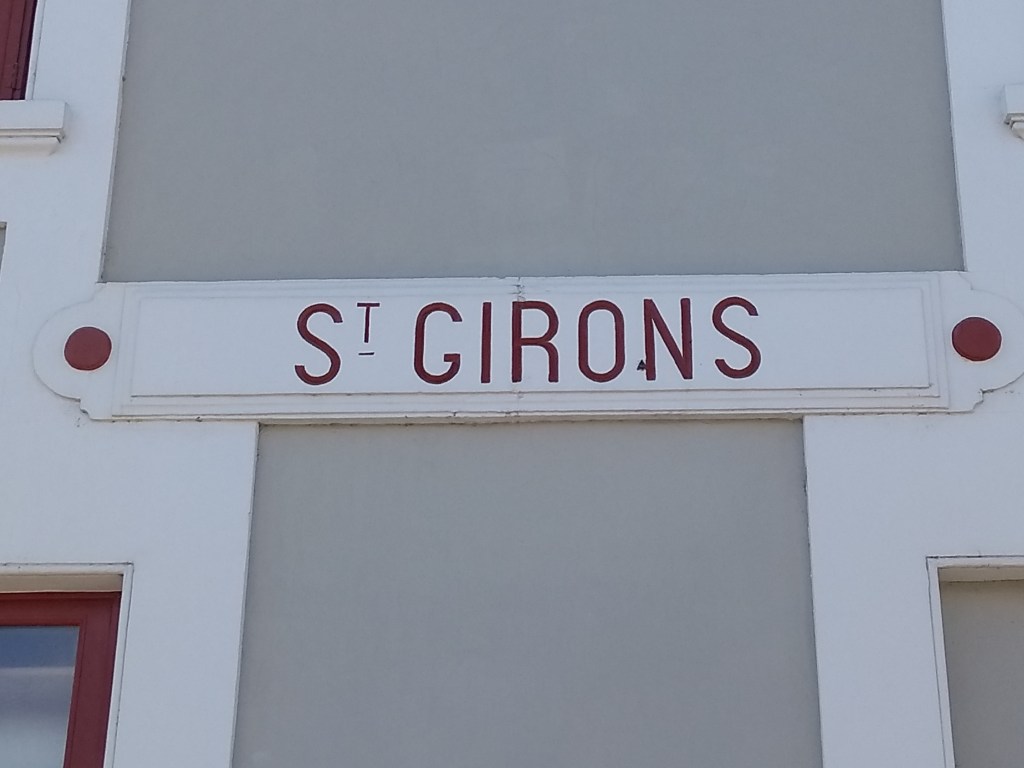
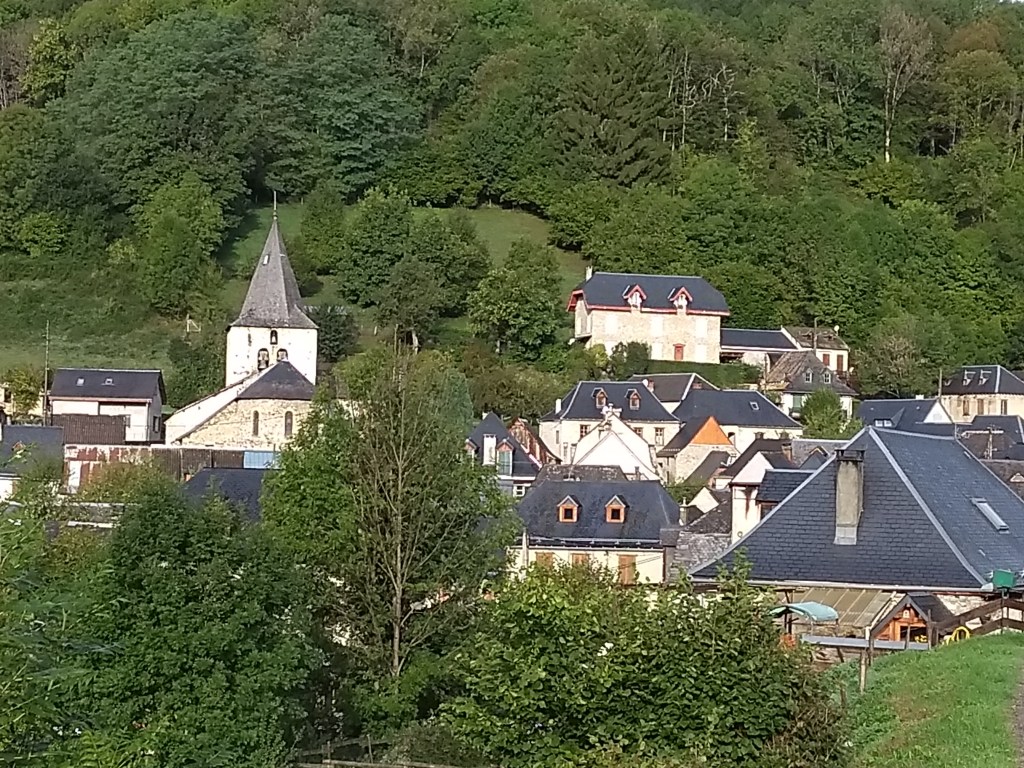
I reached Saint-Girons in the early afternoon. This will be the end of my journey – for this time at least. It’s been an absolutely fantastic four weeks, and I would love to continue. But other projects are calling as well and they too require my time. I have the feeling that this is not an adieu, though, just an au-revoir. The path is too beautiful, and I have loved it so much, that I cannot imagine not coming back some day.
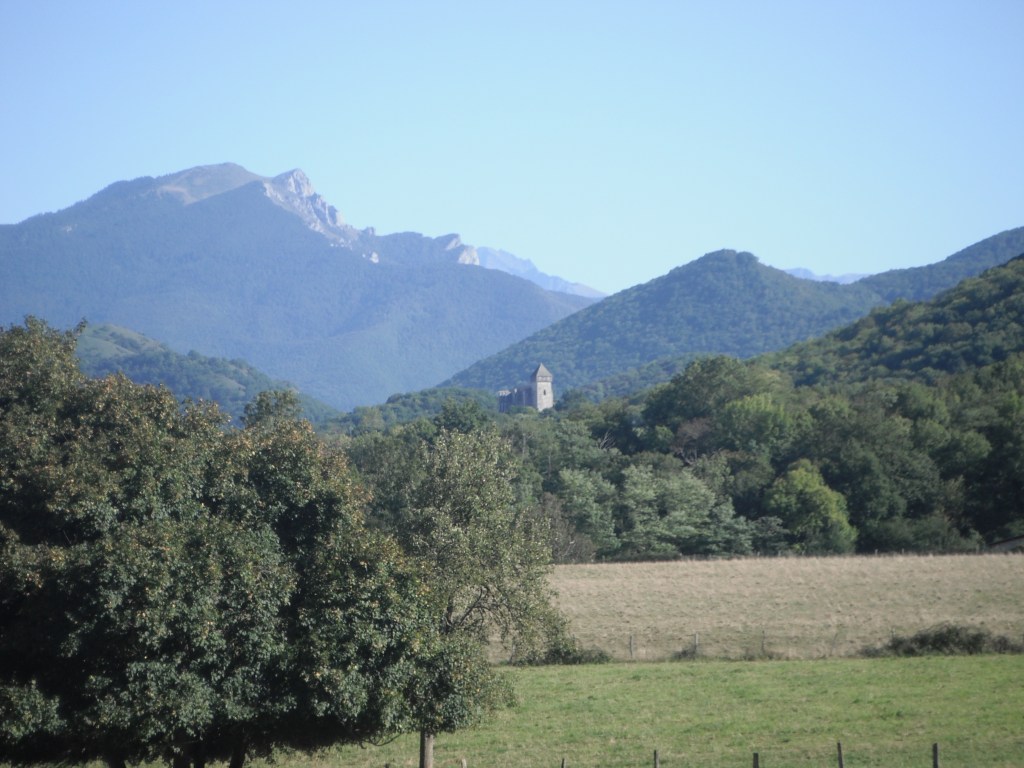
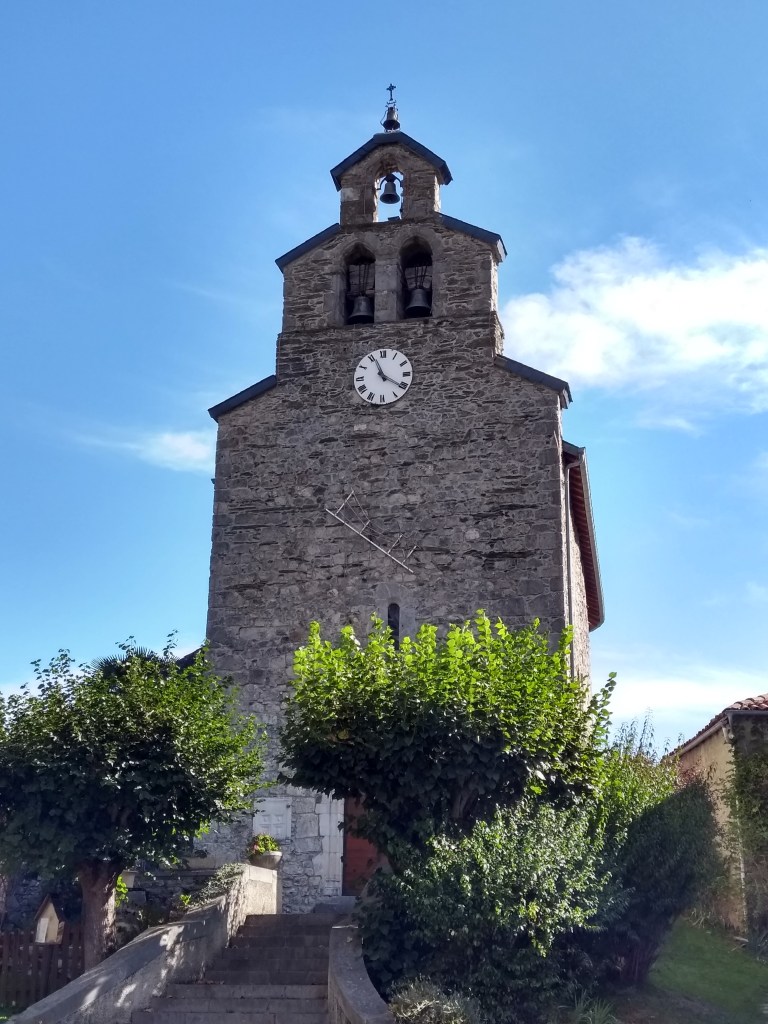
The church in Audressein.
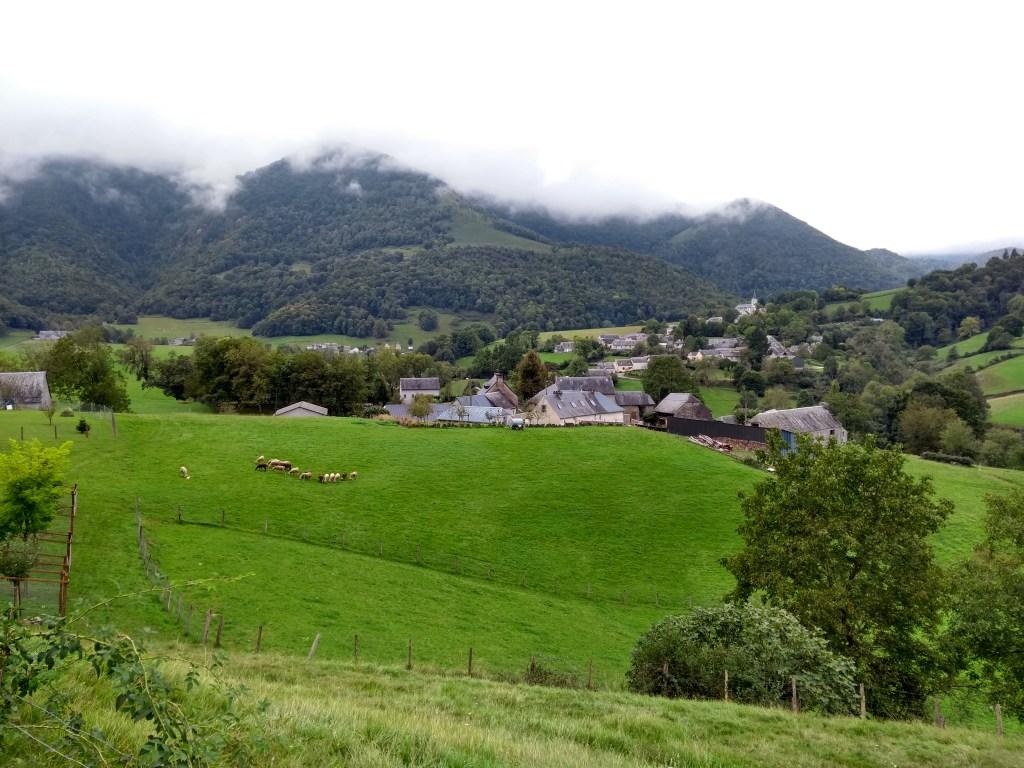
Fresco of the Camino pilgrim.
The marble quarry in Aubert.
Path along Canal de la Papeterie.
The endpoint of my journey: the old railway station in Saint-Girons.

Day 28: Portet-d’Aspet to Argein

October 3, 2019 – Departed 9:00 – Arrived 16:30

Back to sunny weather today. Everything more or less dried overnight, except for the boots – but this is a minor inconvenience.
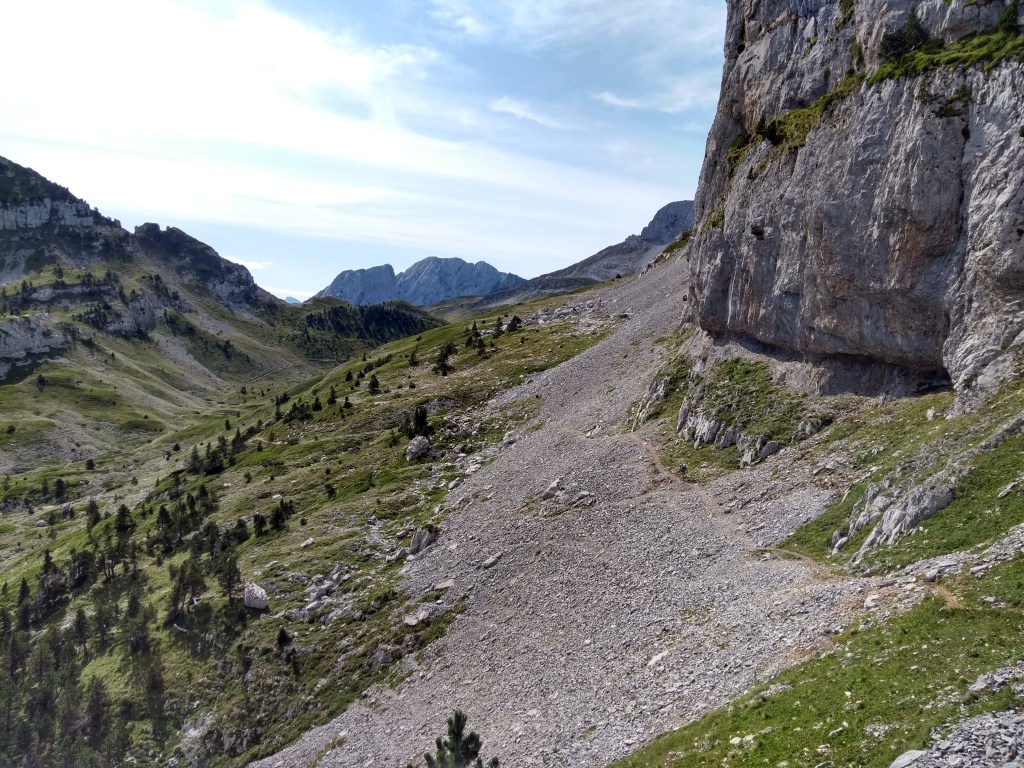
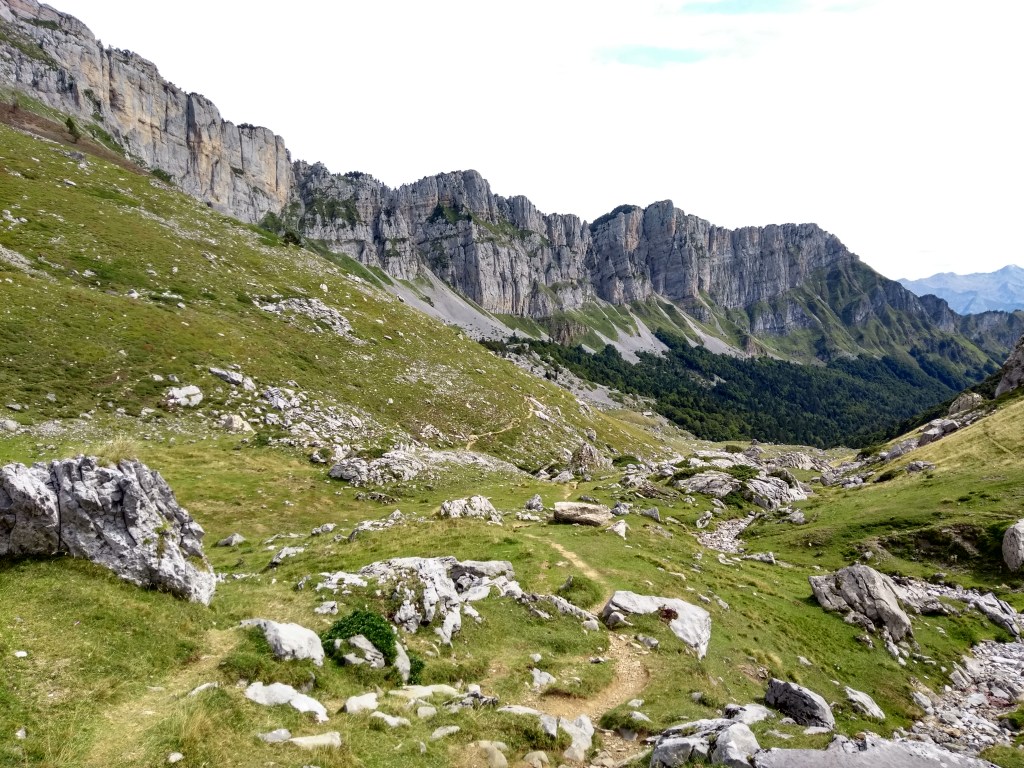
The GR78 went through a string of villages today – Portet-d’Aspet, Saint-Lary, Augirein, Saint-Jean-du-Castillonnais, Buzan, Aucazein, Argein – basically all in the same valley. But the path doesn’t follow the road, it goes up in the mountains on each side, in the process making some substantial detours. A bit more tiring, but with friendlier surroundings.

So for most of the day I was again in the forests that make up the bulk of the Parc Régional des Pyrénées Ariégeoises. Nice paths, nice views. For some reason I was a bit tired (despite sleeping okay), so I was a bit slower than usual. I just took my time.

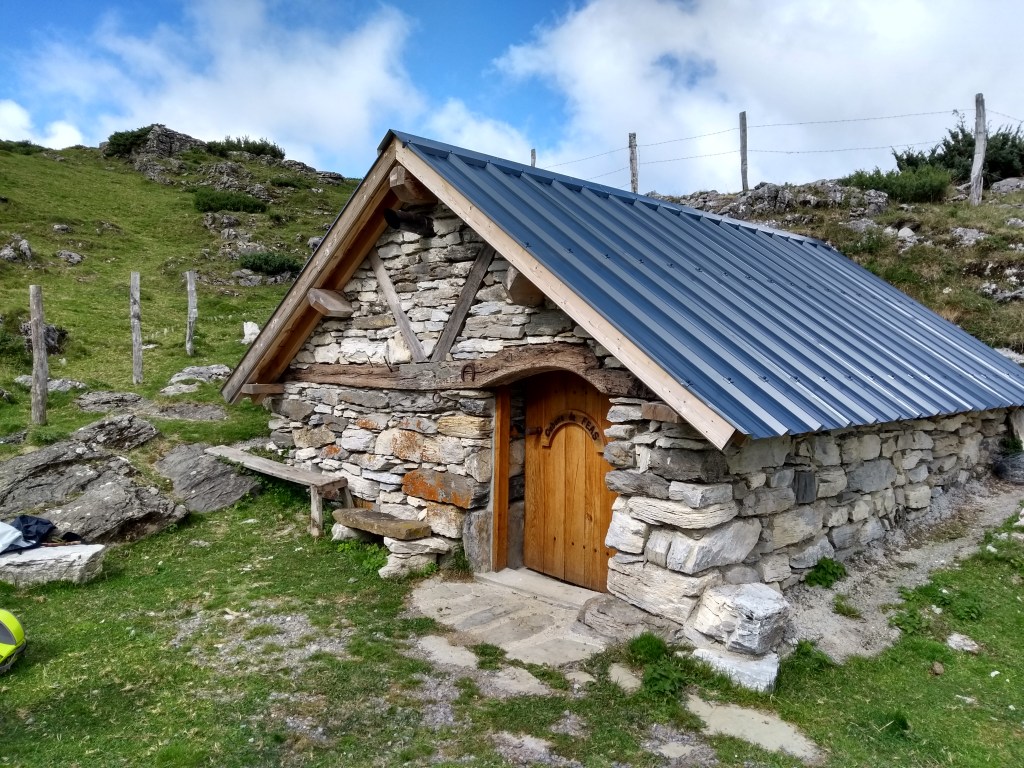
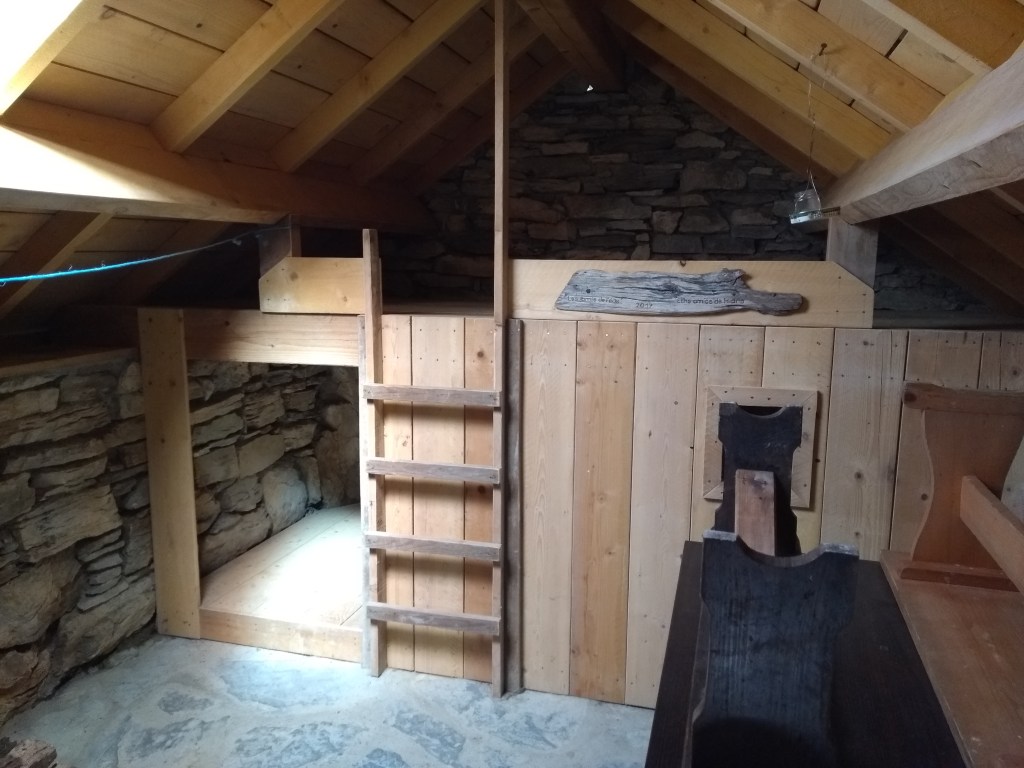
I am now resting at a gîte between Argein and Audressein. The place is halfway up the mountain, and off-grid. They put me up in a tiny stone shed that they turned into rough housing – a couch on the first floor, a ladder to the loft and a bed there. That’s about it. A rudimentary shower and kitchen are in another building nearby. Not great luxury but that will do for the night.

Portet-d’Aspet.
Saint-Lary viewed from the path.
Saint-Lary.
Slate tiles.
The church in Saint-Jean-du-Castillonnais
Can you count the trees?
Aucazein with the backdrop of Pyrénées Ariégeoises.

Day 27: Juzet d’Izaut to Portet-d’Aspet

October 2, 2019 – Departed 8:45 – Arrived: 13:30

The rain that started yesterday afternoon continued overnight. Although it had stopped when I left, it started again one hour into my hike and kept me company for most of the day. It wasn’t unpleasant though, despite raining quite hard at times. My backpack stayed dry (that’s the most important) but my clothes and boots got all soggy, and everything is now drying on a rack at the gîte where I am staying.

As for the path, it started on easy roads for the first hour, but then climbed quite quickly into the forest, on a narrow path on the hillside, with a steep slope up to the left and equally steep down to the right. At the top it continued along the edge of the plateau, then descended to the Col de Portet-d’Aspet and then down to the village itself. The elevation difference today was significant, with the highest point in the hike around 1,200 m, whereas the villages at both end were in the 500 to 700 m range.

I didn’t take many pictures today. At first I could see the mountains with clouds clinging from their sides, but once the rain had started all I could see beyond the nearest trees was a white wall. I’ll try snapping a picture of the village tomorrow – we are back in slate roofs territory, with some slate tiles rounded at the end, it’s quite pretty.

The place where I am staying is the Bar Chez Jo. The dorm is a loft directly above the bar, with half a dozen beds. A Canadian flag hangs above one of the beds – a gift from pilgrims, I was told – so that’s naturally the one I selected. As for the shower it’s outside, half in the open, kind of weird but the water is hot. I am sharing the place with three hikers going the other way, and who gave me tips about where to stay tomorrow.

Before the rain started.
Walking through the forest.
Gifts from the path, near a village.

Day 26: Refuge Saint-Martin to Juzet d’Izaut

October 1, 2019 – Departed 9:10 – Arrived 15:00

An easy stage, mostly through forests, on nice paths with very few difficulties. The geography has changed again, where I am now is mostly forest-covered hills, as far as one can see. This morning as I was leaving the Refuge I could hear forestry workers nearby, falling trees with their chainsaws.

I also went through a few pretty villages, but contrary to my previous days I didn’t play tourist today, as there were no landmarks to visit. Instead I arrived in Juzet d’Izaut early, before the weather turned nasty (it is now pouring, and the forecast is for more rain tomorrow). This will let me have a quiet end of afternoon, and do a bit of reading (I managed to finish Dostoievski’s Crime and Punishment and went through Shaw’s Pygmalion while in Lourdes. At the moment it’s An Ideal Husband, by Oscar Wilde).

A nice path in the forest.
The church in Génos.
The village of Saint-Pé-d’Ardet, nested between forested hills.
Chapelle Sainte-Anne near Col des Ares.

Day 25: Saint-Bertrand-de-Comminges to Refuge Saint-Martin

September 30, 2019 – Departed 14:00 – Arrived 19:20

Today I took a half day of rest. I decided I would do only a short stage in the afternoon, and use the morning to visit Saint-Bertrand.

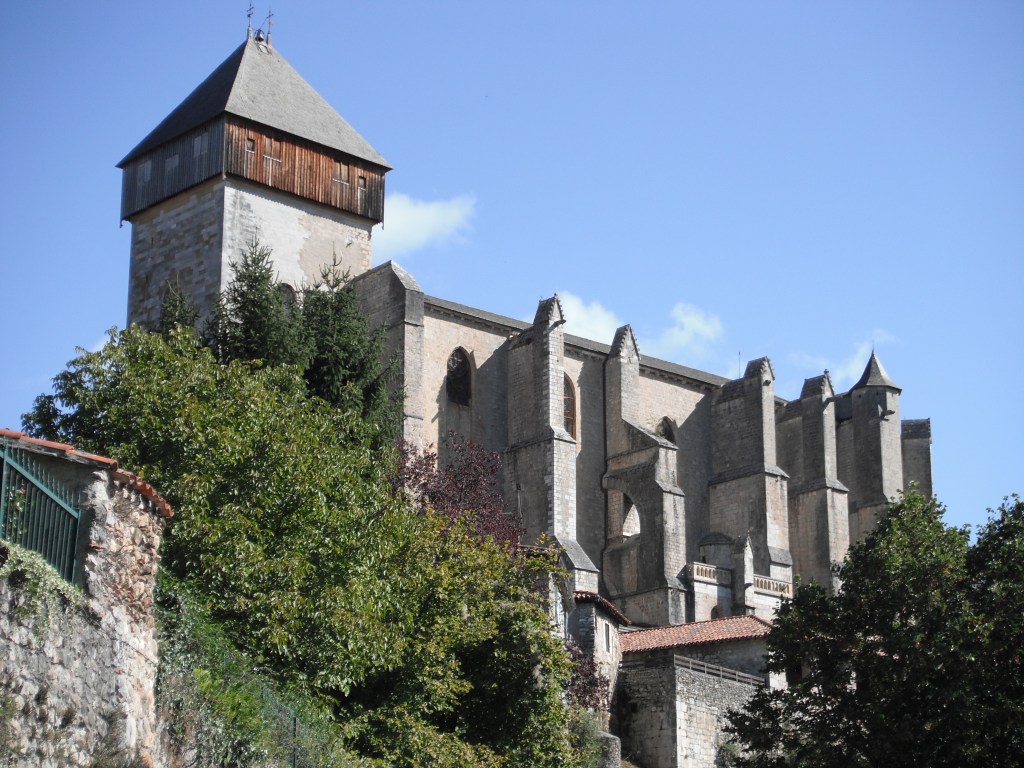
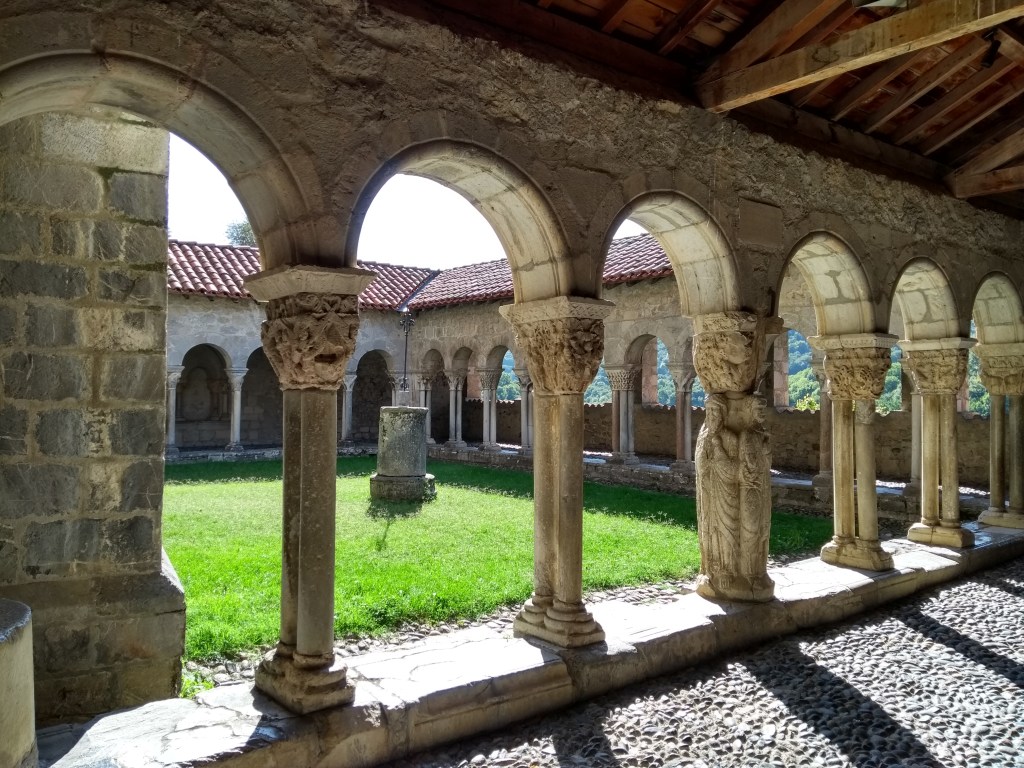
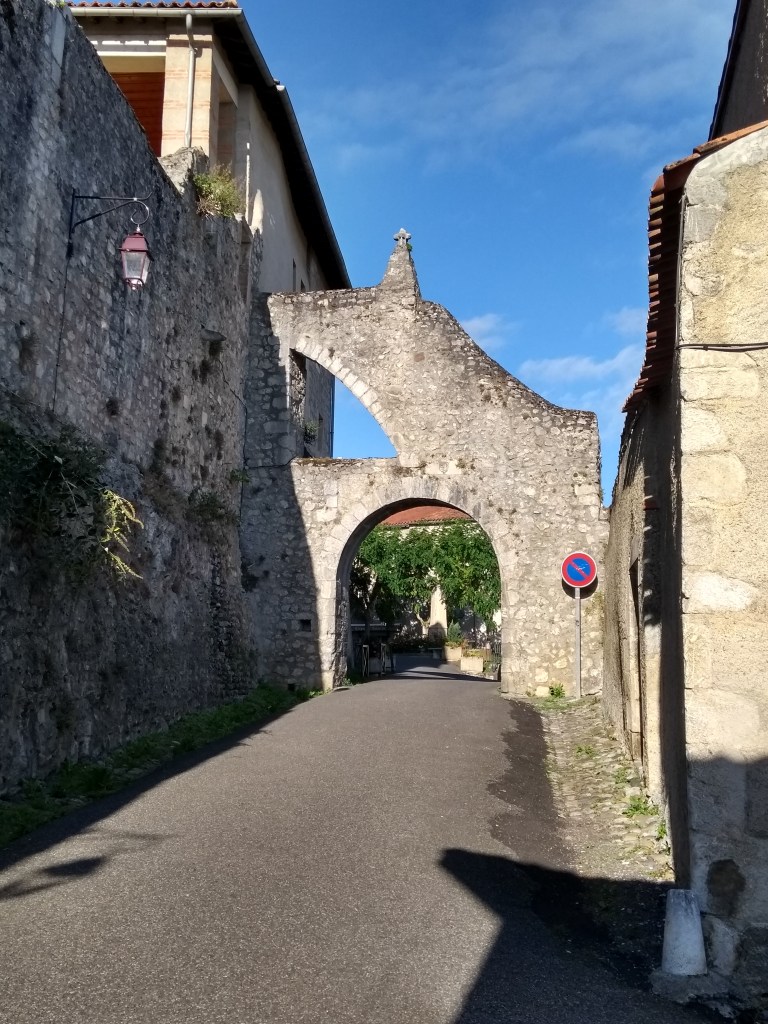
I thought Saint-Bertrand was a city but it’s really a village, with maybe 200 souls. It’s a very cute village though, with narrow streets, pretty houses – some of which going back to the middle ages. The entire village is dwarfed by the church, which in earlier times was actually a cathedral. It is quite unique and beautiful, a mixture of Roman and Gothic styles with parts built in successive periods. The cloister, which on one side has been opened to give a view of the lower Pyrénées to the South, is magnificent.

Before we leave Saint-Bertrand-de-Comminges, I have to say a word about where I stayed last night. There is a Halte Jacquaire (simple accommodation where pilgrims can find a bed and a place to cook) at the presbytery by the church. When it is full – as was the case yesterday – Marie Uchan opens her house and lets pilgrims use a self-contained unit she has there. When I arrived she made sure I wasn’t in need of anything. I mentioned I needed to do laundry (my hopes of finding a laundromat being dashed by the size of the village) and she offered to do it for me. She keeps the cupboards stocked with essentials (and more) for the pilgrims. There is no fixed price for the stay – it works according to the donativo (donation) system. It is just amazing. When I asked Marie why she is doing this, her response was: “J’ai la chance d’avoir une grande maison” (I am fortunate enough to have a large house).

I left Saint-Bertrand at 14:00, and stopped by the Saint-Just church in Valcabrère 15 minutes later – this is a church which is quite striking because during construction in the 12th century they reused stones from a nearby Roman necropolis, so some walls have inscriptions or motifs from earlier times.

After that I continued on my way, got lost – I seem to be doing this often; this time it was entirely my fault, there was a crossing of two GR’s and I didn’t pay attention (all GR’s have the same red and white blazes, so it’s important to pay attention when they cross). After some backtracking and some grocery shopping I walked for another two hours to Refuge Saint-Martin.

This is an unguarded refuge in the hills halfway between Barbazan and Génos. It’s a very simple house, the lower level has a table, a few benches and a fireplace, the upper level is a barren wooden floor where 10 can sleep After having a light dinner outside, this is where I set up my bed for the night. Like camping, without the tent, and with lots of creeking and noises that I will have to get used to if I have any hope of actually sleeping.

Saint-Bertrand-de-Comminges viewed from a distance (when I got lost).
The cathedral up close.
The cloister.
One of the doors to the village.
A street in the village.
Saint-Just in Valcabrère.
Refuge Saint-Martin.

Day 24: Lortet to Saint-Bertrand-de-Comminges

September 29, 2019 – Departed 8:15 – Arrived: 18:15

I slept so-so but was up at the crack of dawn, or even before, taking the tent down when the day had barely broken. Then I had a quick breakfast and started walking. The sky was spotless and it remained so the entire day. Even at 8:00 I could feel waves of hot wind blowing past me and indeed the day was not only sunny, it was hot too.

The last half hour of yesterday’s hike and the first hour of today’s hike were a mess. There were just no blazes. After a while I was able to distinguish a couple of washed out things that may have been red and white marks in the past, but that was it. I had to rely on my map. An hour into today’s hike I did end up finding blazes, but they were leading in the exact opposite direction of where I wanted to go. I finally walked on the road to the next village where at last a good set of reliable blazes appeared. I am still puzzled by the whole thing though. My best guess is that the GR78 has been rerouted since my guide was printed. I have tried not to let myself be too frustrated by the entire episode.

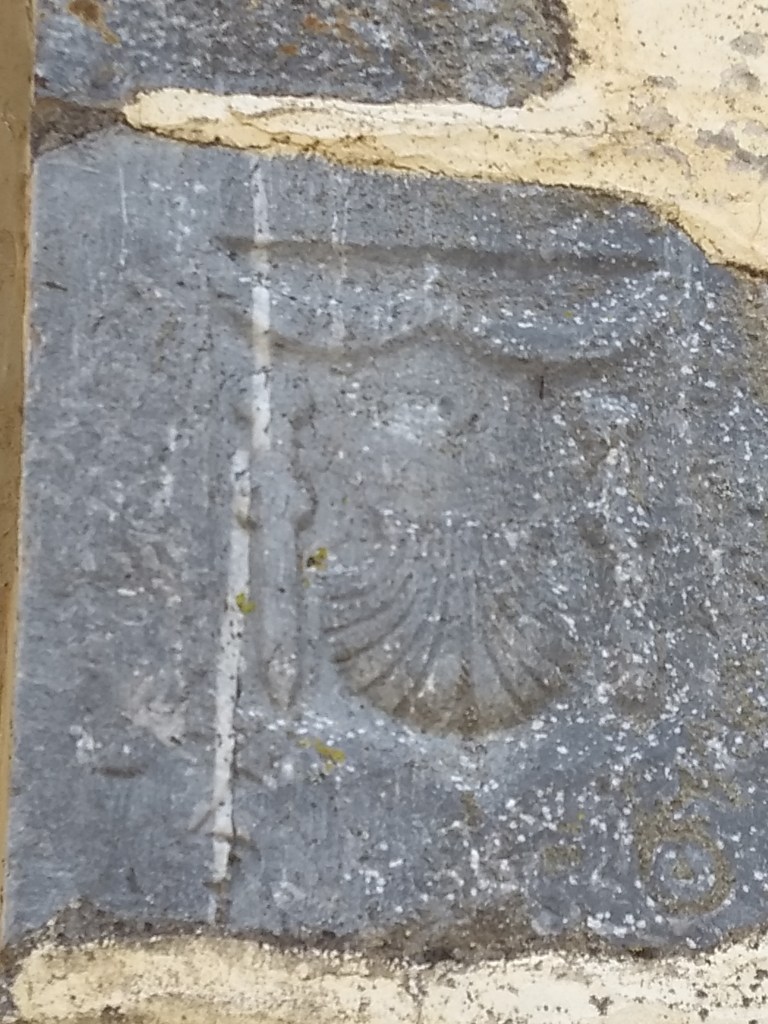
At half past noon I came through a nice village called Nestier and decided to take a break by the church, which had a green lawn and a picnic table. While doing so I got the tent out and laid it on the grass to dry, as it was completely covered in dew when I packed it in the morning. I also proceeded to take a few pictures in the village – including of one of a corner stone of the church which has a carving of a shell, a reminder that the Camino goes through here!

As I am walking through the villages I have noticed a progressive change in the style of the houses. A few roofs with red tiles first appeared along the slate-covered houses. Closer to Saint-Bertrand-de-Comminges, all houses now have round red tiles, and some houses appear to be built with big round stones. It gives villages a totally different character.

Tonight I am staying at a Halte Saint Jacques kept by a woman called Marie Uchan. It’s absolutely wonderful. My hostess has fed me a delicious dinner and she goes to great lengths to make sure I am not missing anything. I feel really spoiled. It is such a contrast to yesterday’s camping in the woods!

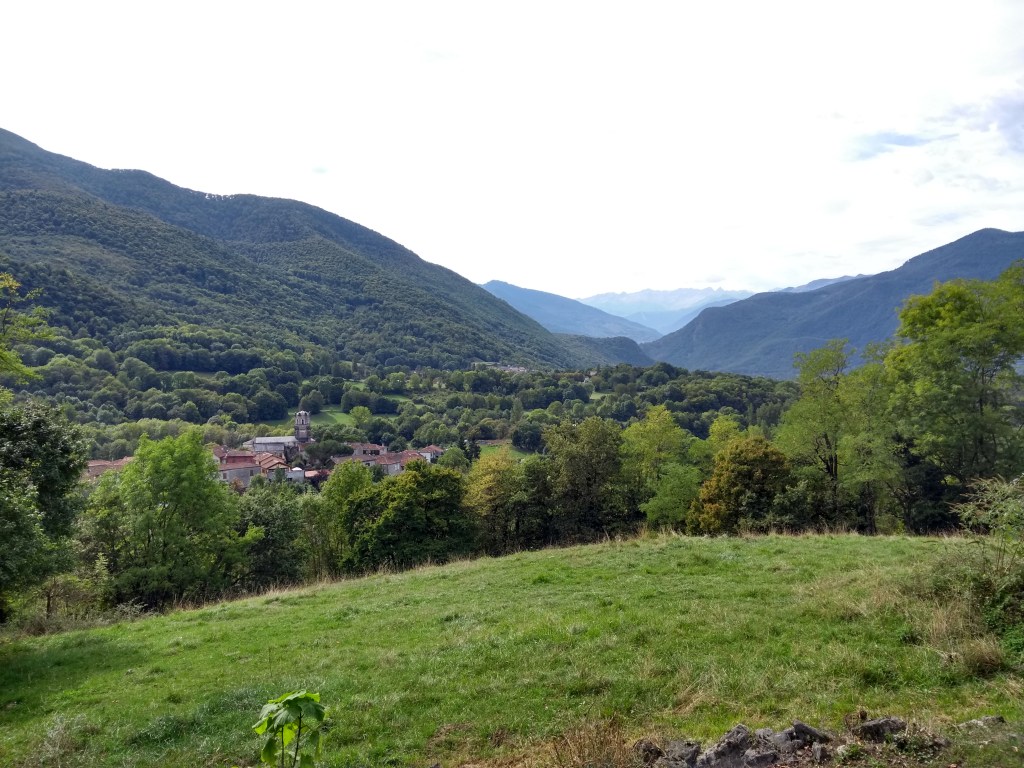
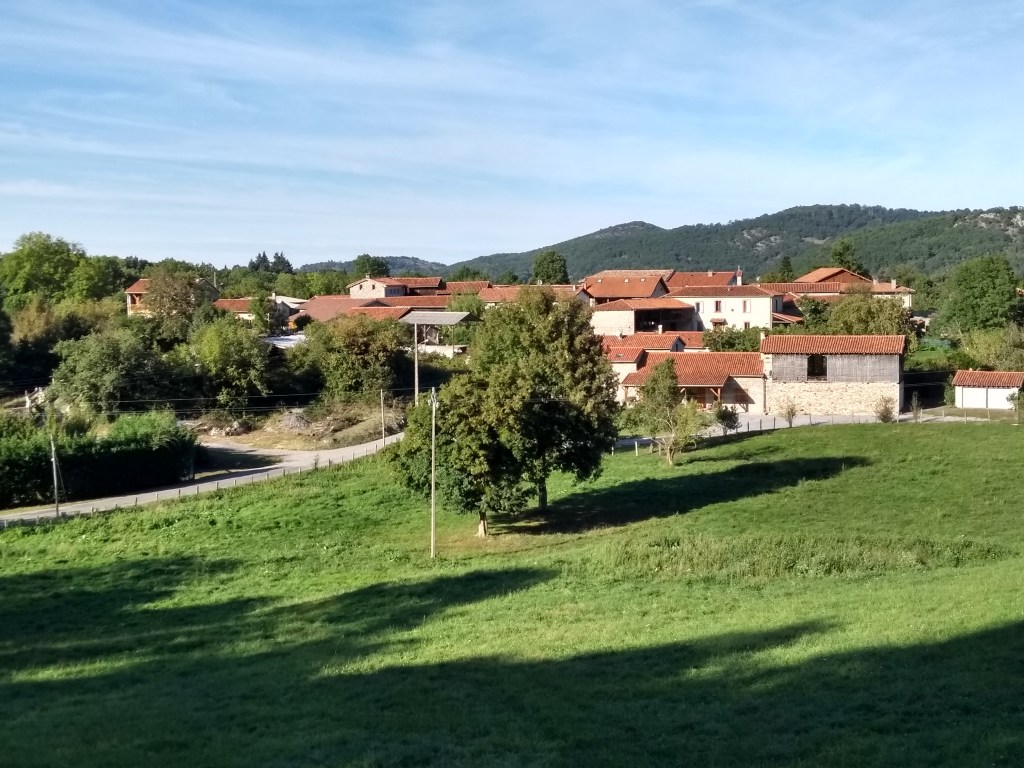
I am really in the Piémont : pastures and villages here, hills behind, and peaks in the background.
A cornerstone of the church in Nestier, with a carving of the Camino shell.
The village of Saint-Martin: round red tiles for the roofs, some houses use big round stones for the walls.
The cathedral of Saint-Bertrand-de-Comminges, as it appears from just outside Tibiran-Jaunac.

Day 23: Moulin des Baronnies to Lortet

September 28, 2019 – Departed 9:20 – Arrived 19:00

The day started late as I was waiting for the rain to stop. It did, and this enabled me to enjoy the first segment of today’s hike, which followed the Arros river upstream. The path then went through some gentle hills and valleys, under overcast but otherwise dry skies.

Near a village, as I was walking along a pasture, I noticed a baby lamb that must have been born only a few minutes earlier. It was flopping helplessly in the grass, trying to stand up but not having any success at all. Meanwhile, the mother was licking it very conscientiously to clean it. I stayed there watching the scene for a good 15 minutes, until the lamb was strong enough to stand up and get its first taste of its mother’s milk. It was magical.

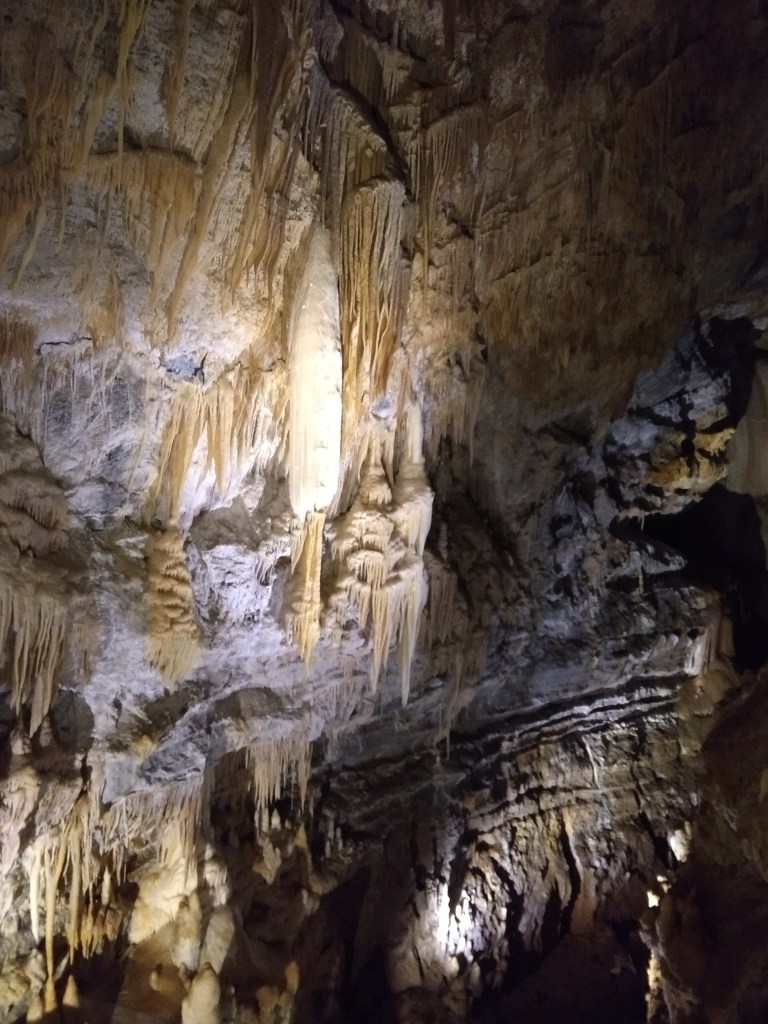
Later in the day, I took a lunch break in Esparros. There is a famous gouffre (cave) there, so I decided to go and visit. It was a guided tour – I was the only one at the 14:00 visit. The cave was discovered by famed French speleologist Norbert Casteret in 1938, and has been carefully developed to keep it pristine before opening to the general public. It is magnificent, not only because of its size but also because of the variety of shapes taken by accretions: some look like exquisite white flowers, others like corrals, etc. Quite beautiful.

After that I continued to Lortet. Unfortunately, I have been unable to find accommodation for tonight: everything either was fully booked, or had had its phone disconnected (never a good sign). So I pitched my tent in the mountain above Lortet, at the edge of a meadow. I can hear deers baying in the distance and owls hooting nearby, I just hope they won’t prevent me from sleeping!

Low hanging clouds over the countryside.
The Esparros cave.
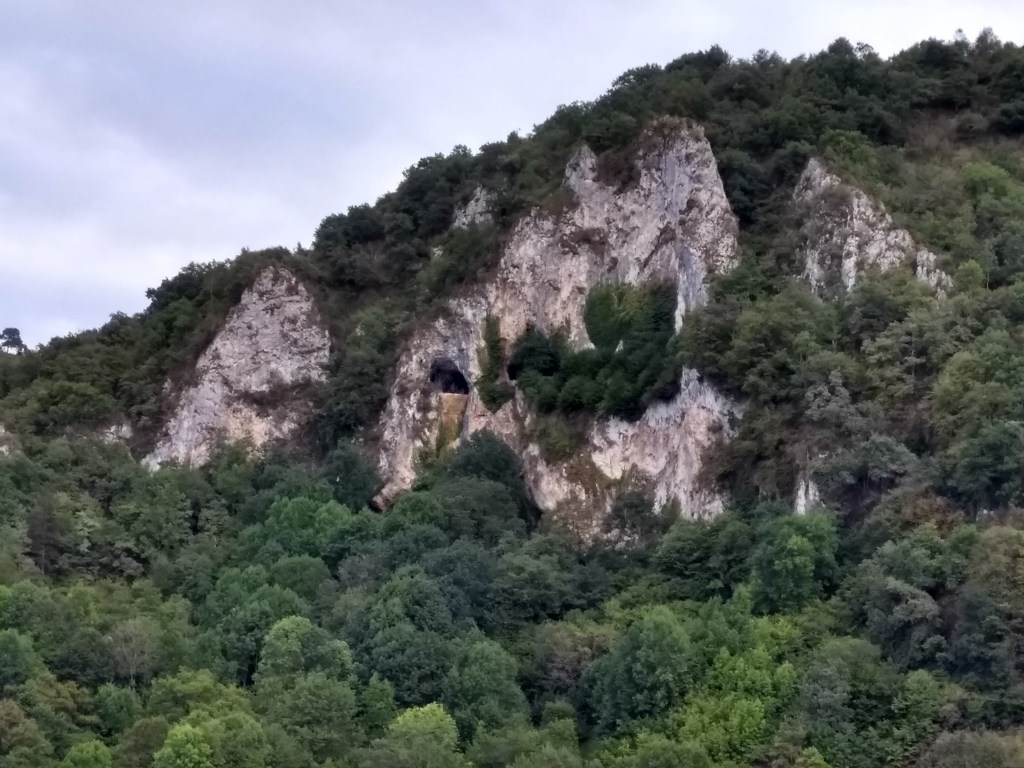
Cave houses above Lortet.

Day 22: Gerde to Moulin des Baronnies

September 27, 2019 – Departed 9:45 – Arrived 17:15

The path seems to be taking me further away from the very foot of the Pyrénées, and closer to the plain. Hills are gentler, there are many villages around. I also met quite a few hikers today, including two from Whitehorse. Who would have thought? We chatted for a while before continuing in opposite directions.

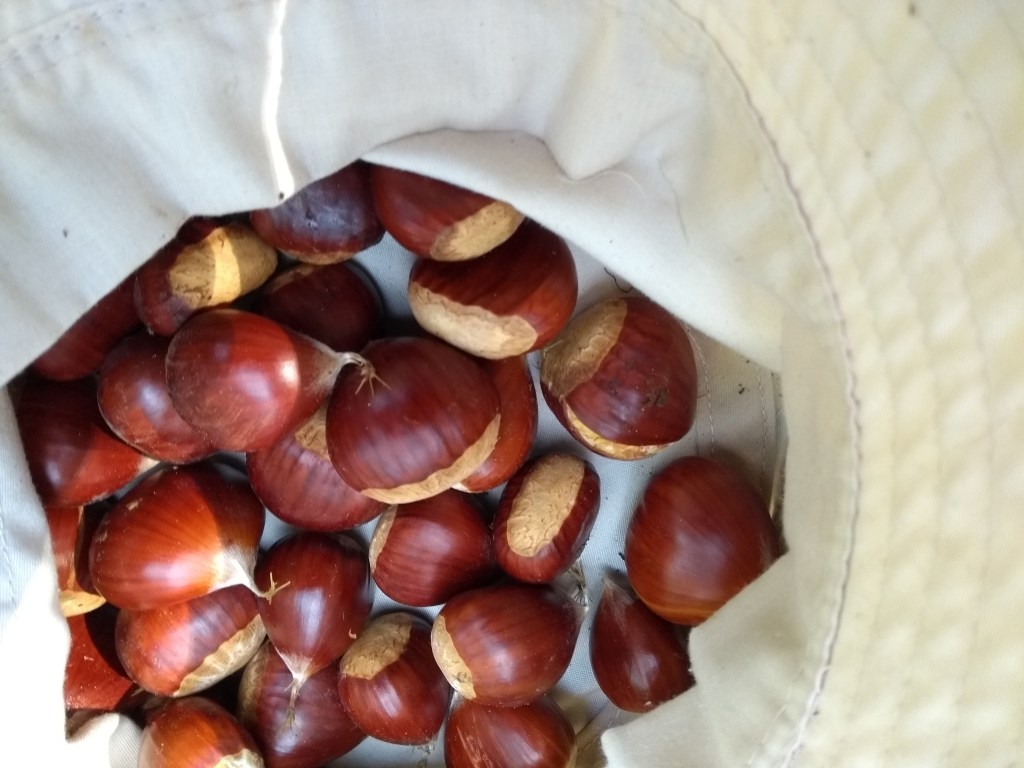
I had a nice surprise today. As I was walking through a forest, I came across a chestnut tree that had blanketed the ground with its fruits. Nothing extraordinary so far, as chestnut trees are extremely common here. But every time I had tried to open the fruit until now, I could only find tiny chestnuts inside, no bigger than the last phalanx of my little finger. Not this time: they were nice and plump, so I made a good harvest and I am going to try cooking them for desert tonight.

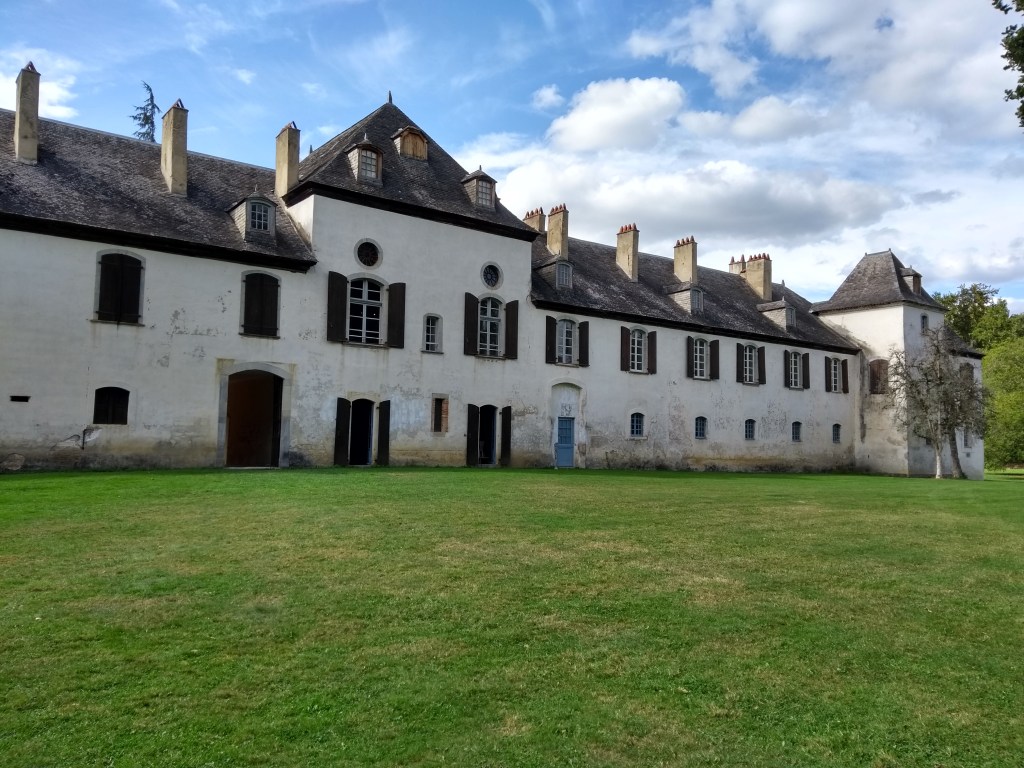
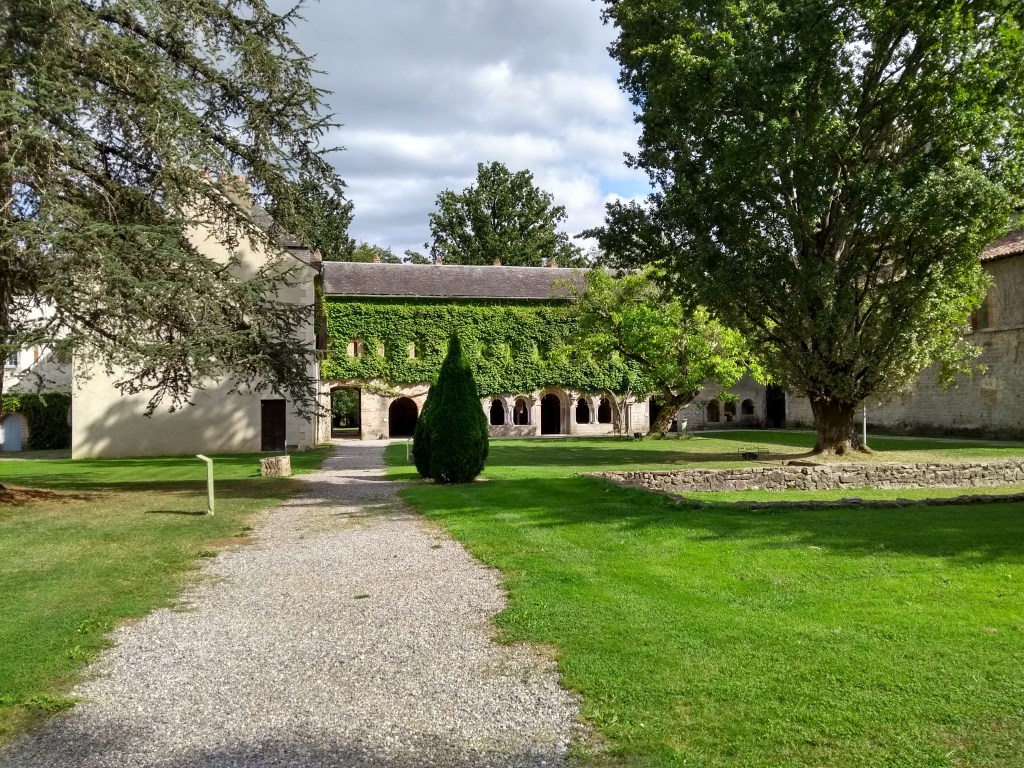
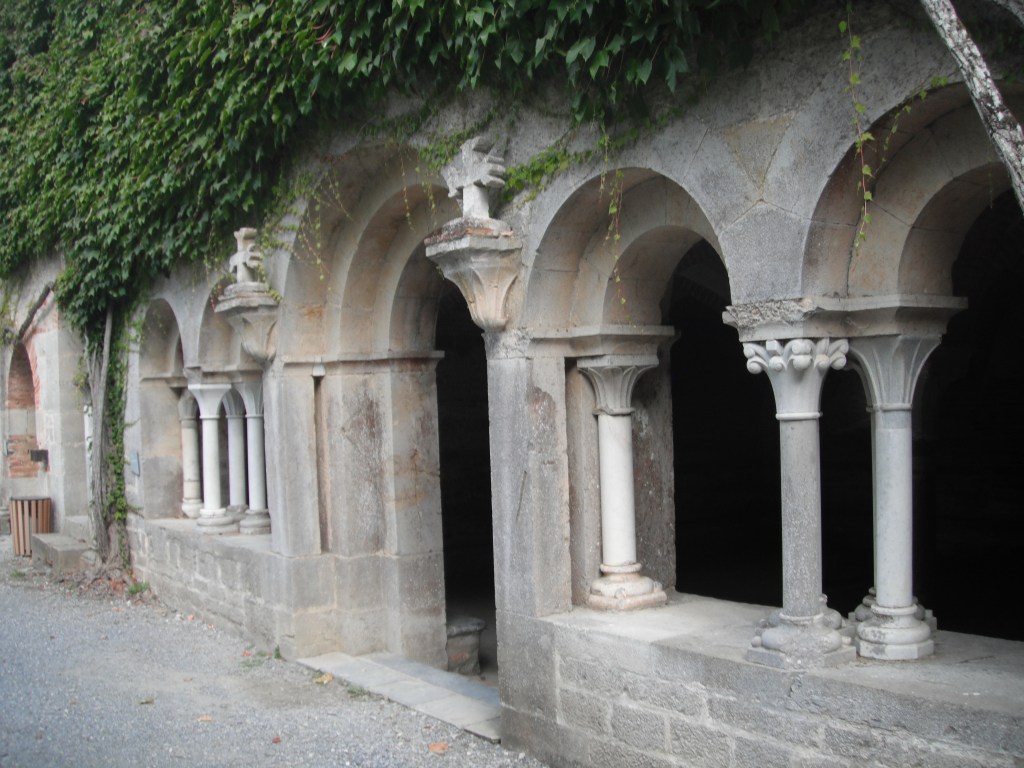
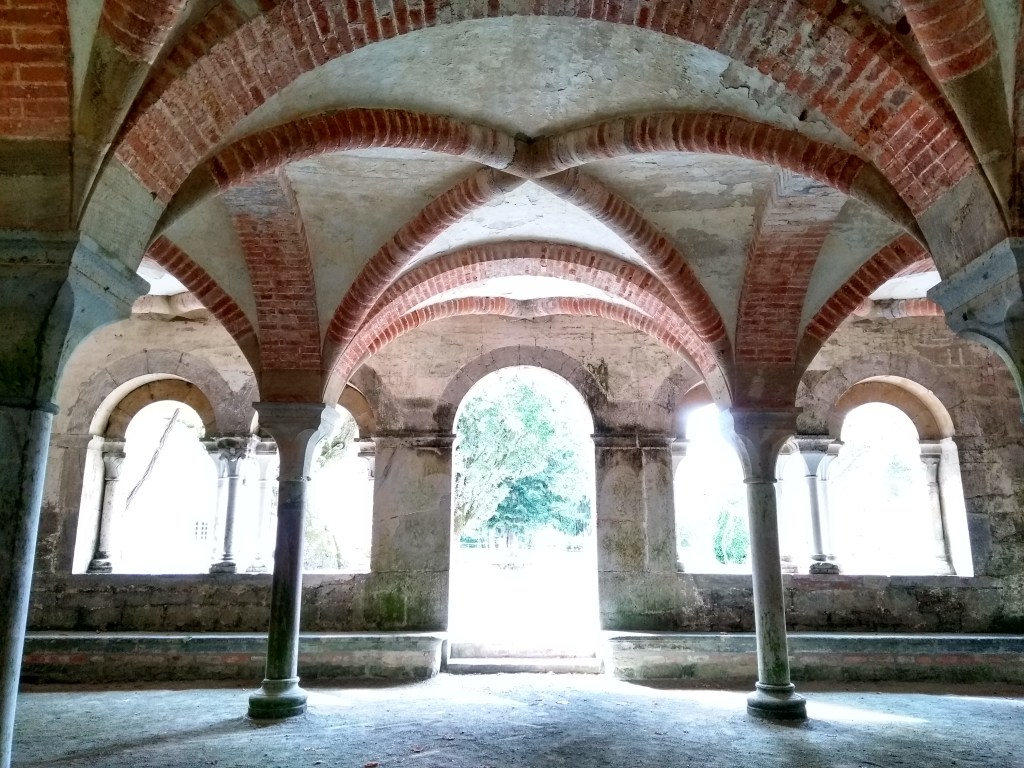
Later on, maybe an hour from the end of the hike, I visited l’Abbaye de l’Escaladieu, which is only a short distance from the GR78. This is a Cistercian Abbey from the XIIth century, which has suffered a great deal from age, neglect, the French Revolution, and a fire. So there isn’t much left, but what remains is still very nice and quite well restored. The abbey also houses a temporary exhibit of photographs from the last 100 years about the Pyrénées, taken by a dynasty of local professional photographers. Some of the pictures were documenting everyday life, some landscapes, some the construction of hydro dams, and many were quite spectacular (see here: https://www.calameo.com/read/0059337810b7a915dc71b?authid=YPHjM2nyA4cI).

Tonight I am staying at the Moulin des Baronnies. It appears that I am the only guest, so I will have the dorm and the kitchen to myself. However there are also RV’s in the camping area, and a nice couple from there just offered me a bowl of squash soup. Dinner time!

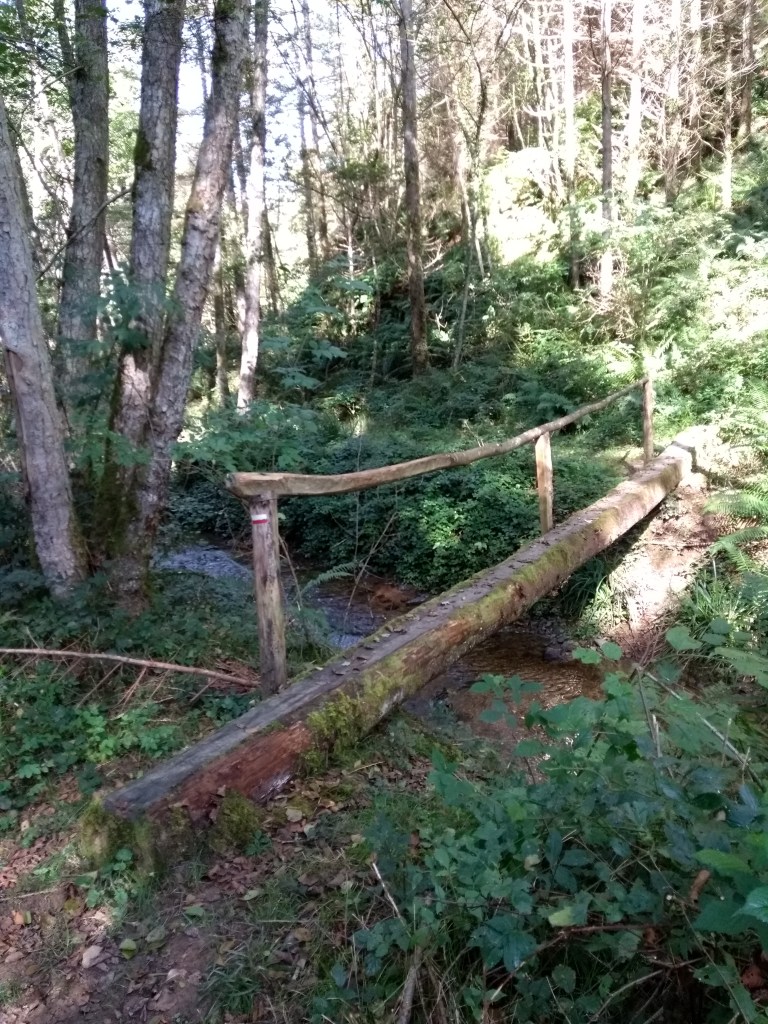
A bridge over a stream in the forest.
Today’s chestnut harvest.
The Abbaye de l’Escaladieu.
The Abbaye de l’Escaladieu – the former cloister.
Entrance to the capitulate hall.
The capitulate hall.

Day 21: Germs-sur-l’Oussouet to Gerde

September 26, 2019 – Departed 8:45 – Arrived 17:45

Tonight I am camping in Gerde, just outside of Bagnères-de-Bigorre (apparently I have been in Bigorre for a while, not Béarn anymore). It’s a three star campground, it even has wifi (although not very good), camping ain’t what it used to be. But for me it’s also an opportunity to take the tent and the air mattress out of the bag, they have not had much use since I started this trip. Plus the forecast is good so I am not taking inconsiderate risks. The camping is called La Pommeraie, which means it has some apple trees, some pear trees too, and some of the fruits are quite decent.

I arrived late here but only because I spent a couple of hours visiting Bagnères, more precisely the part of the Musée Salies devoted to Pyrenean life. It has tons of artifacts and tools related to things such as how thread and fabric were made, how slate was cut, etc. The curator offered to walk me through the two rooms and gave life to every object with very interesting explanations. I spent more time there than I intended to but it was worth it.

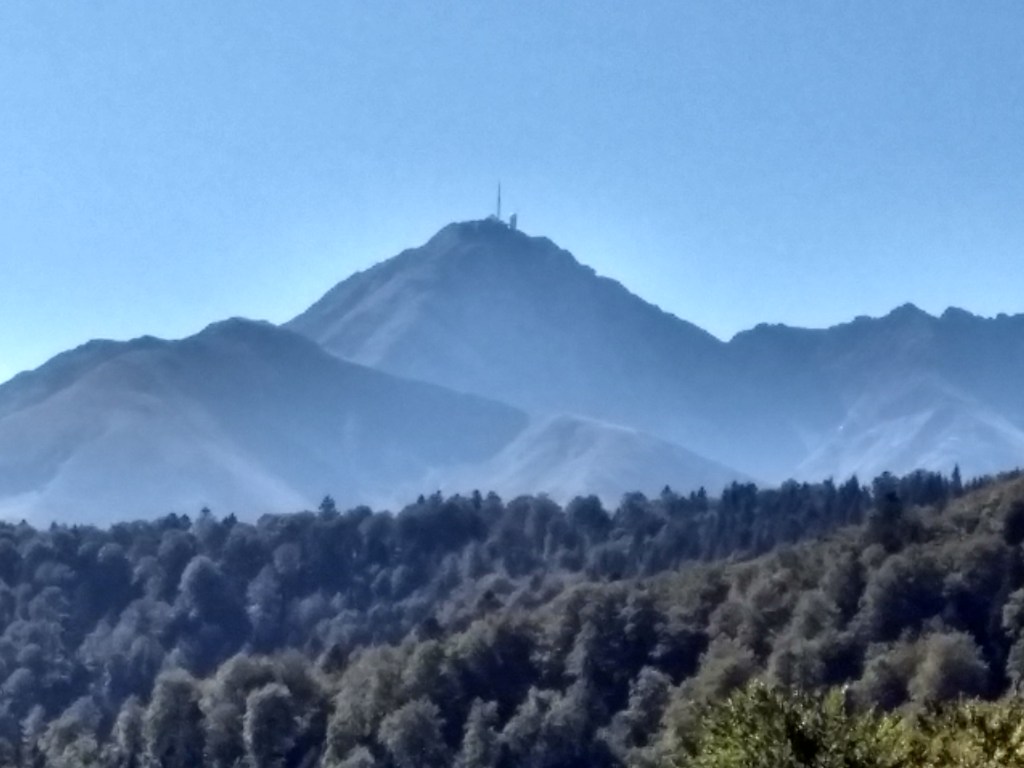
As for hiking today, it was smooth. There was a mix of small paved roads with hardly any traffic, forestry roads, and paths through forests and pastures; some climbs and descents, and from some of the high points some very nice views of the valleys below, of the Pyrenees to the South (with a great view of the observatory at the Pic du Midi) and later, after switching to the other side of the mountain, of the plain and Bagnères.

The view from l’Escale du Cardouets this morning.
The path around mid-day.
The Pic du Midi and its observatory.
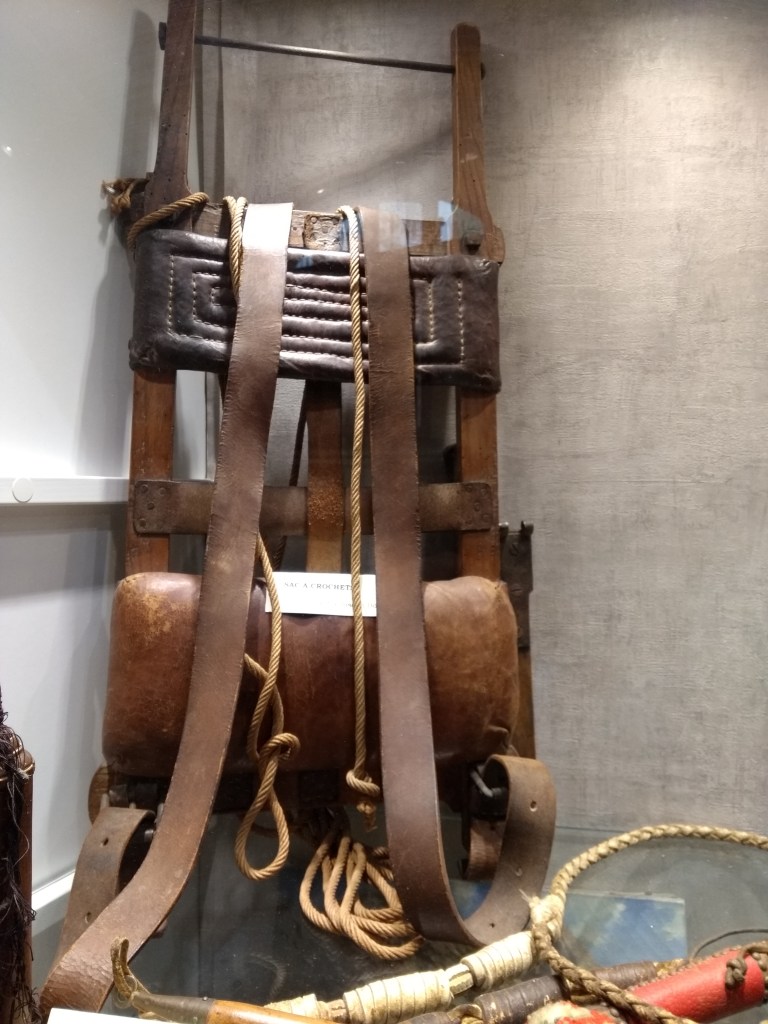
At the Musée Salies : the contraption used by workers to carry all the material to the top of the mountain when the observatory was built in the 1880’s.
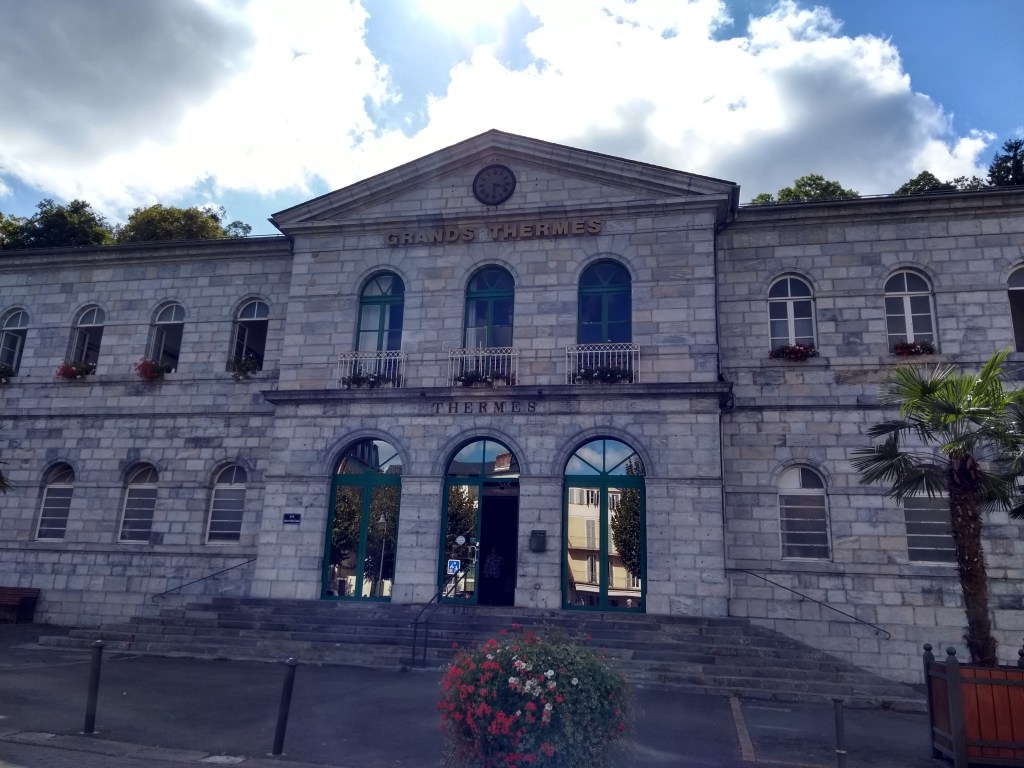
Les thermes (the spa) in Bagnères.

Day 20: Lourdes to Germs-sur-l’Oussouet

September 25, 2019 – Departed 8:35 – Arrived 16:35

For this next part of my journey I have decided to switch to the GR78, rather than go back on the GR10. The GR78 is one of the Camino trails, this one is known as the Pyrenean Piémont (or foot of the hills) route and it goes through Lourdes. There are several reasons why I decided to switch. The main ones are that the GR10 is difficult, with very long to and tiring climbs to high points between villages, whereas the GR78 stays at lower elevations; that it is the end of the season and many refuges are already closing; and that we are now in the fall and, should there be bad weather, sections of the trail above 2,000 may start experiencing snow. I am also a bit curious about the Camino and would like to experience part of it – although I will be doing it in reverse compared to the normal way.

I slept poorly the last two nights – I don’t know if it was the regret of leaving the Cité or my body telling me that it did not want to hike again, but the net result was that I did not have much energy today. On top of that I got lost or had to backtrack too many times to count, and this ends up being a day with many hours of walking but half the number of kilometers I intended to do.

The GR78 is okay but blazes are sometimes far apart and in places the path just vanishes – under ferns, or because of erosion. I have to get used to it and adjust my terrain reading accordingly. Otherwise it’s fine. It tends to go from village to village, but even if the next village is in one valley over, the climb and descent are much more bearable than on the GR10. Also nice is the amount of fruits I was able to gather – two peaches, three figs, and two apples, all fallen on the road!

Today’s hike started with a partial hike of the Pic de Jer that overlooks Lourdes from the South (although there are no good views of the city from the path) and then continued through several small and pretty villages – lots of stone and slate, and some had a pretty stream running through them.

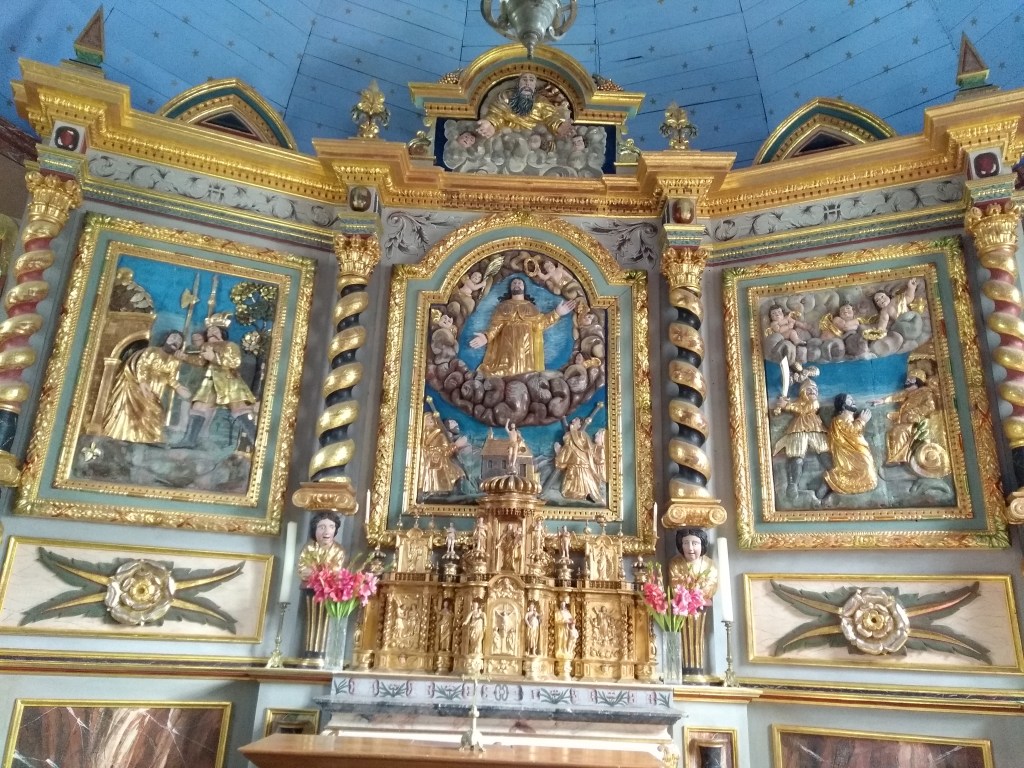
The last village before my current location is called Cotdoussan and has a small church named Saint Jacques which is a heritage site because of its importance relative to the French Camino. A contractor was doing work outside but had open the church to get power for his tools, so I got to see the rococo retable or altarpiece that depicts the last moments of St James and that the church is famous for. It has been restored recently and is quite nice.

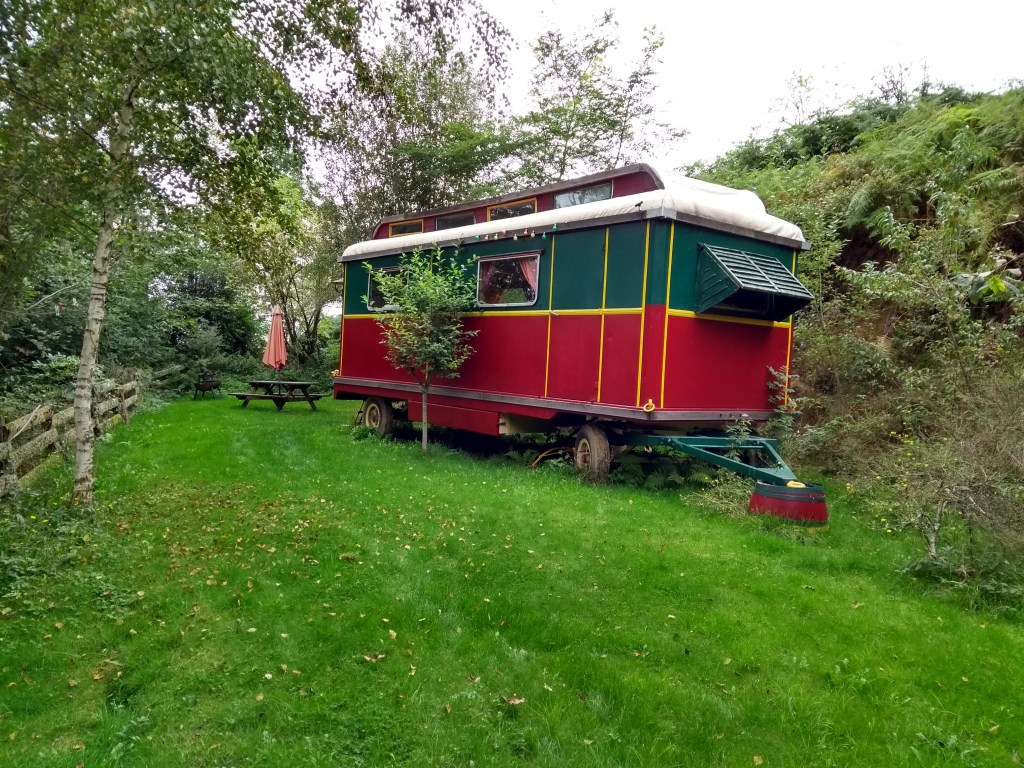
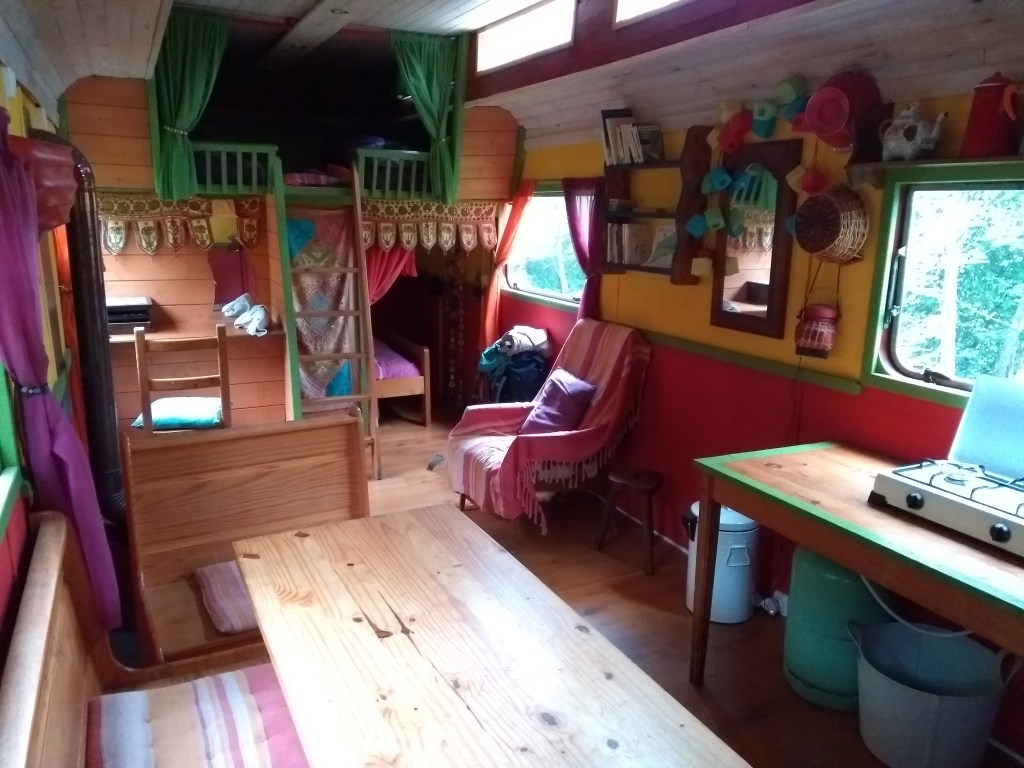
A short while later as I was nearing the end of my 8th hour of walking I felt like I should stop soon. I was debating whether to pitch the tent in the wild but on a hunch I called l’Escale du Cardouets near the village of Germs-sur-l’Oussouet that I was traversing at the time, and they had space, so that’s where I am for the night. For 17 euros they put me up in a funky roulotte (trailer) that has a couple of beds, a table and a countertop stove. Quite pretty actually, I hope I will sleep well and be able to recharge my energy for tomorrow!

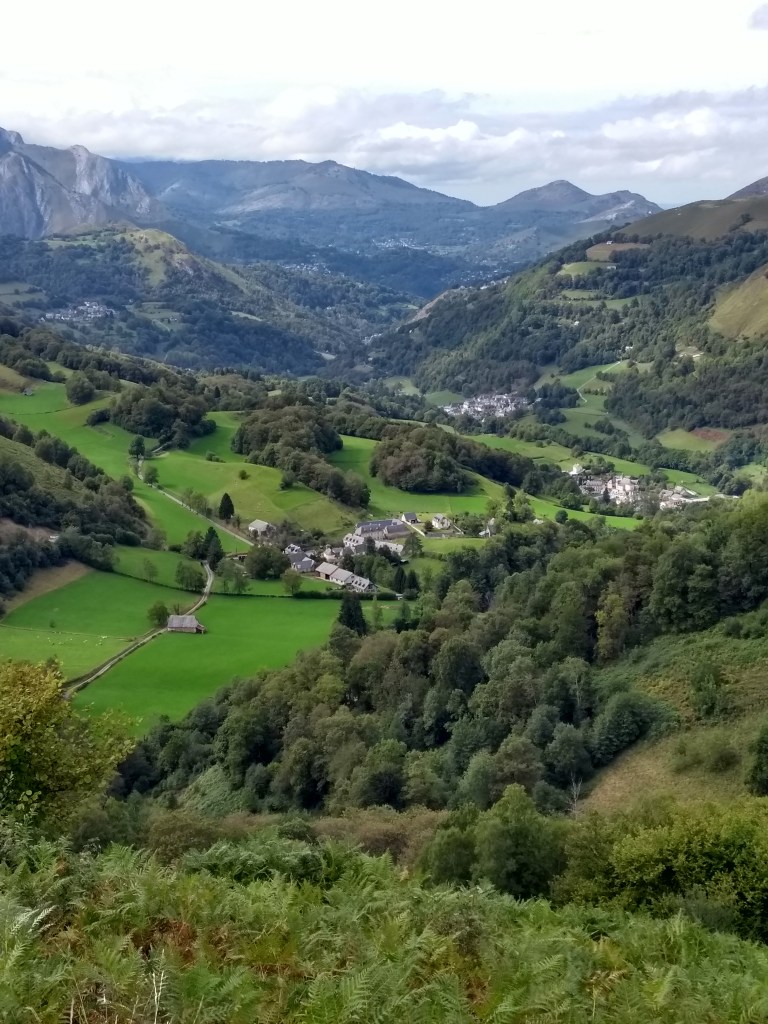
The valley of Castelloubon with the villages of Cotdoussan and Juncalas.
The retable in St James church in Cotdoussan.
My funky trailer.
Inside the trailer.

Interlude: Cité Saint-Pierre

September 17-24, 2019

For the past 7 days I have been in Lourdes volunteering at the Cité Saint-Pierre. The Cité was created in the mid 1950’s to enable poorer people to undertake the pilgrimage to Lourdes. It’s a fairly sprawling complex located a short distance from the Basilica (in any case there is a shuttle for the 10 min ride there) with several housing pavilions, a common building with services and the cafeteria, and other buildings such as chapels and oratories and a very nice ‘green cathedral’ among chestnut trees for outdoor celebrations. The complex is located on the side of a hill (arguably not ideal for pilgrims in wheelchairs) in a very relaxing setting, it’s quite nice.

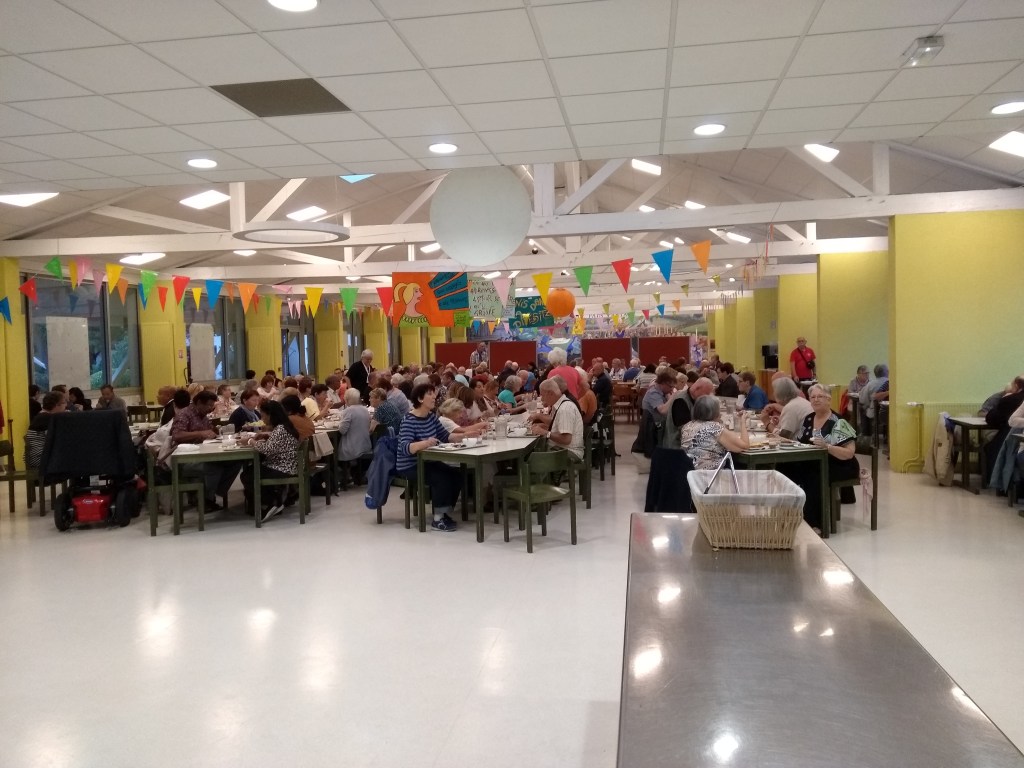
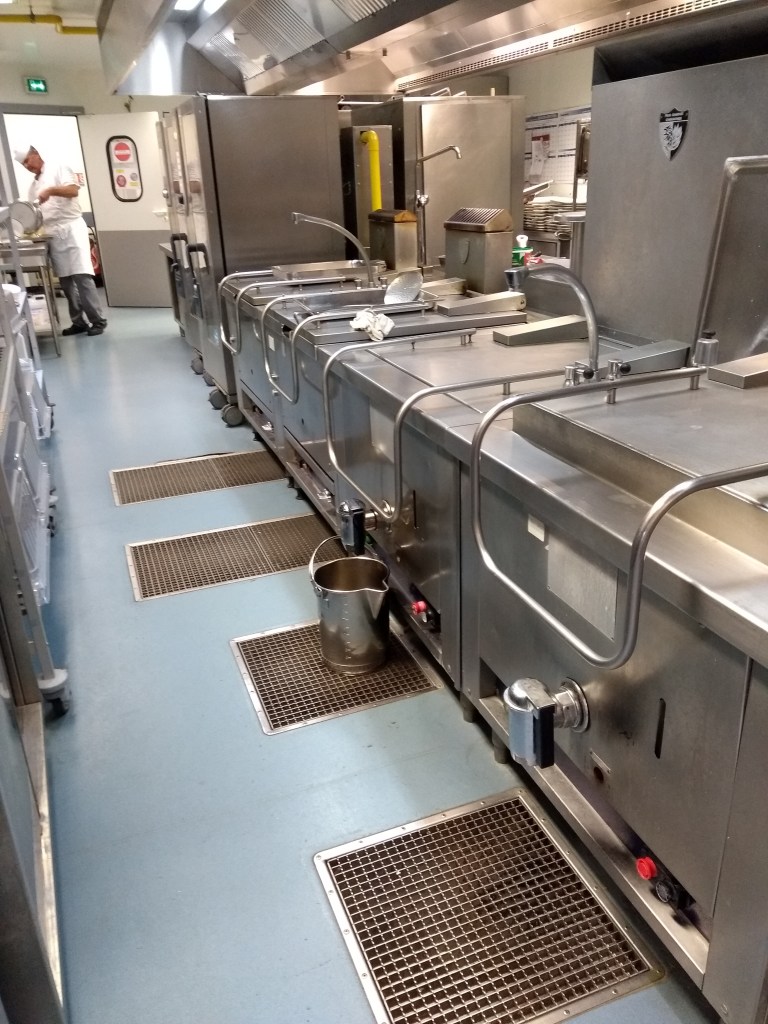
The Cité offers accomodation and meals to pilgrims (mostly groups) while they are here. My position was to help in the pilgrims’ cafeteria. This means being there ahead of meals to set up the space, during meals to serve and resupply, and after meals to clean up the tables and the room and prepare the next meal. In the mornings I have also been lucky enough to help with meal preparation itself. Nothing fancy, mostly putting cheese on individual plates or laying frozen items in pans, but this is done on a scale that I wasn’t used to. Our busiest meals over the weekend had over 350 guests; putting 350 slices of frozen apple pie on plates is time consuming indeed. It’s also a fairly menial job but I don’t mind; this is a reminder that every job has value.

This job was surprisingly tiring, mostly because of the long hours. On busy days the work goes from 6:45 until 9:30, then from 10:45 to 14:30, and finally from 17:30 to 21:00. These times include our own meals and are a bit shorter when there are fewer pilgrims.

In our area there are maybe 4 salaried positions, and 6 to 8 volunteers. Our roles are fairly well defined; the professionals tell us what to do and we typically follow orders, although after a few days we know most of the tasks that we are expected to accomplish. I admire the professional team for how they interact with a revolving team of volunteers – they are always patient and take the time to explain. Despite the stress of the job (particularly at meal times, with long lineups and all sorts of emergencies linked to special diets, people needing help, or shortages of some items) somehow everybody manages to keep a smile and be nice to each other. There are rare exceptions, I think I have only seen one in my week here. As for the way the restaurant is run, it could be better – on heavy days the lineups are excessive for example. My only regret as a volunteer is that we can’t really make a profound difference on anything organizational or structural that could improve things. But overall things run relatively smoothly.

Pilgrims are also super nice. I don’t know if it’s because they are catholics, but not once did I see one burst out in anger. To the contrary; people thank us, and one morning a whole delegation from the Netherlands came to the front of the cafeteria to sing us a thank-you song before boarding their bus home.

As for the volunteers, a lot of them are retired women or couples, a few men too, and a few of us are still working. Most are from France but a few from other places – Poland or Ukraine in my team. It’s also very striking that many come here every year for 2-3 weeks, and know each other from previous years. All volunteers come with their own backgrounds, life circumstances, difficulties. A very varied bunch. Some are employed in the restaurant like me or to do the dishes or work in purchasing; some clean up the residences, some do gardening tasks.

There are masses daily here – I have been to a few of them. I really like these small celebrations in an simple oratory that is no bigger than a living room, with a small community and a simple rite. Very comforting.

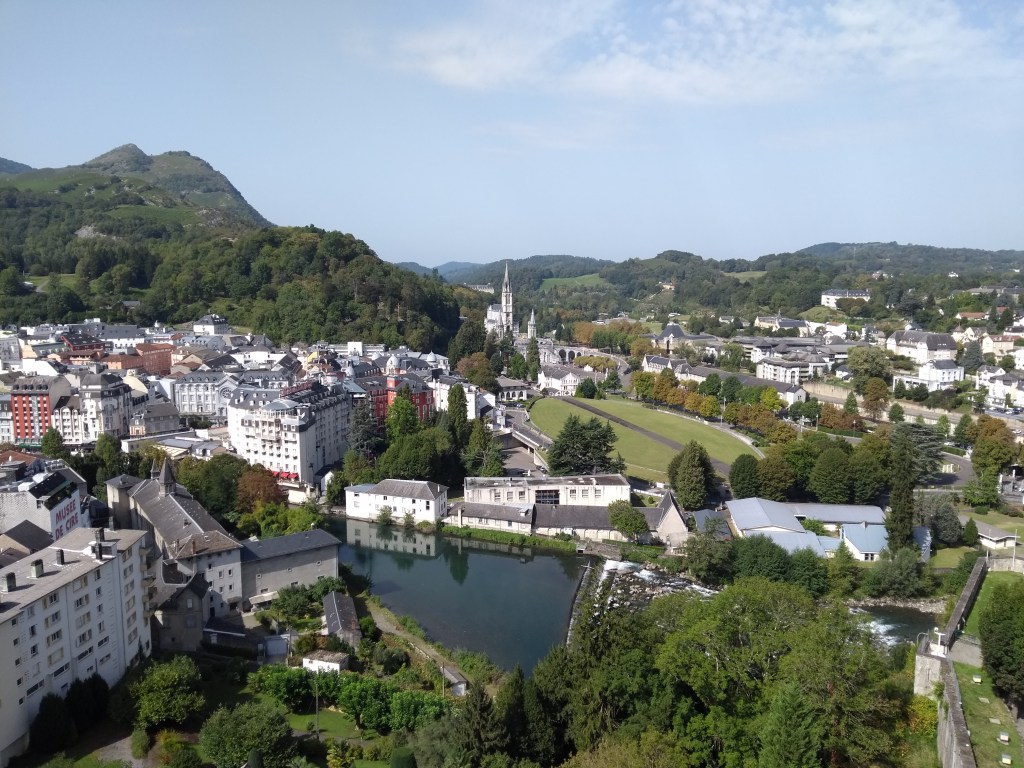
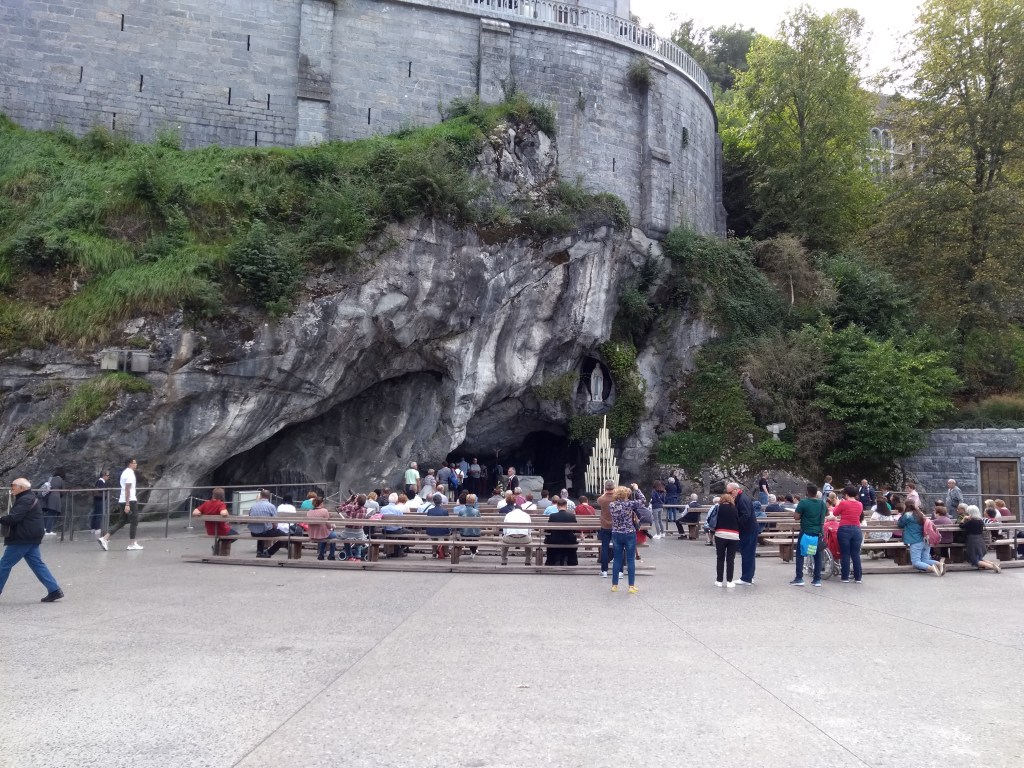
While I was here I also visited Lourdes – both the city and the sanctuary. Lourdes is very small city of 14,000. In the city I have seen the fort and the Maison de la Connaissance du Risque Sismique, a permanent exhibit about the risk of earthquakes in the Pyrenees that my sister contributed to; it’s very hands-on (there is an earthquake simulator) and informative. As for the sanctuary I was a bit afraid of what I would find (to be frank, these stories about the Immaculate Conception are not my thing) but the entire place is actually quite decent. I think it’s one of those places that bring the best out many people – whether it’s the pilgrims or the volunteers helping them. Whether you agree or not with its object or its expression, there is no denying that there is lots of faith here.

All said, it’s been a great week here. The Cité accepted m’y application so quickly (I only sent it from Saint-Jean-Pied-de-Port) that I was afraid they were accepting anybody whether there was a need or not. Not at all. The work I did here was very useful, made a smqll difference, and for me was fulfilling. Could I have asked for anything more?

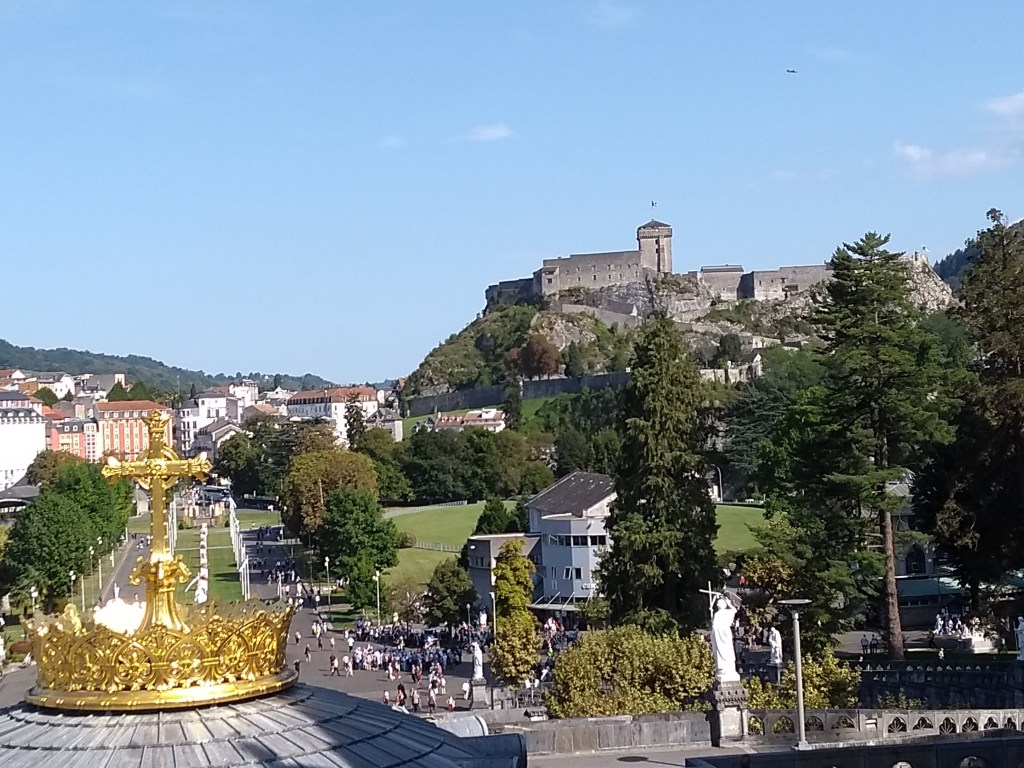
Lourdes – the fort viewed from the Basilica.
Lourdes – the city and the Basilica viewed from the fort.
The grotto.
The pilgrims’ restaurant at the Cité Saint-Pierre.
A view of part of the kitchen.
The building where I stayed while at the Cité.

Day 19: Refuge de Haugarou to Lourdes

September 16, 2019 – Departed 8:20 – Arrived 16:50

I assumed that going from the Refuge (elevation: 1,200 m) to Lourdes (420 mSe) would be all downhill. I was wrong of course, the GR101 goes up and down through several cols on the way.

It was nice though. The hike started on easy forestry roads downhill, then after an hour and a half I missed a left turn and did not realize for 20 minutes. My fault obviously, but the distance between blazes on this GR is sometimes so large that I wasn’t entirely sure. The trail then went up on the side of a hill through pastures until it reached a cliff. Some birds of prey were gliding quite handsomely all around. After that came a very long passage downhill through a gorgeous beech forest, and then the trail took me through a couple of villages and to Lourdes.

I was alone on the trail today – I did not see any other hiker. My only companions on the path were lizards – it’s very funny because I have always associated lizards with the built environment, like houses and cemeteries: but here they scurry all over the place, it’s very lovely. There were also some very pretty butterflies, with wings that were light blue on top and all patterned underneath. I tried taking pictures but of course they would fly off as soon as I got too close.

In Lourdes I am anything but alone. This is not high season anymore – I was able to find a decent hotel at a reasonable price – but the streets are still busy. Tonight I did the utilitarian stuff (I am typing this at the laundromat), tomorrow I’ll do some sightseeing – both the historical stuff (the castle) and the religious sites.

Tomorrow afternoon is when I will be joining the Cité Saint-Pierre for a week of volunteering. I will put this blog on hold during that time, and restart it if and when I hit the trail again. No firms plan yet. I must say that my body is quite tired at the moment and this week without hiking is a welcome respite. I’ll see at the end of the week how I feel and will make a decision then.

View from my window at the Refuge de Haugarou this morning.
Looking back at the first hour of today’s hike, with the higher Pyrénées in the background.
The trail through a very nice beech forest.
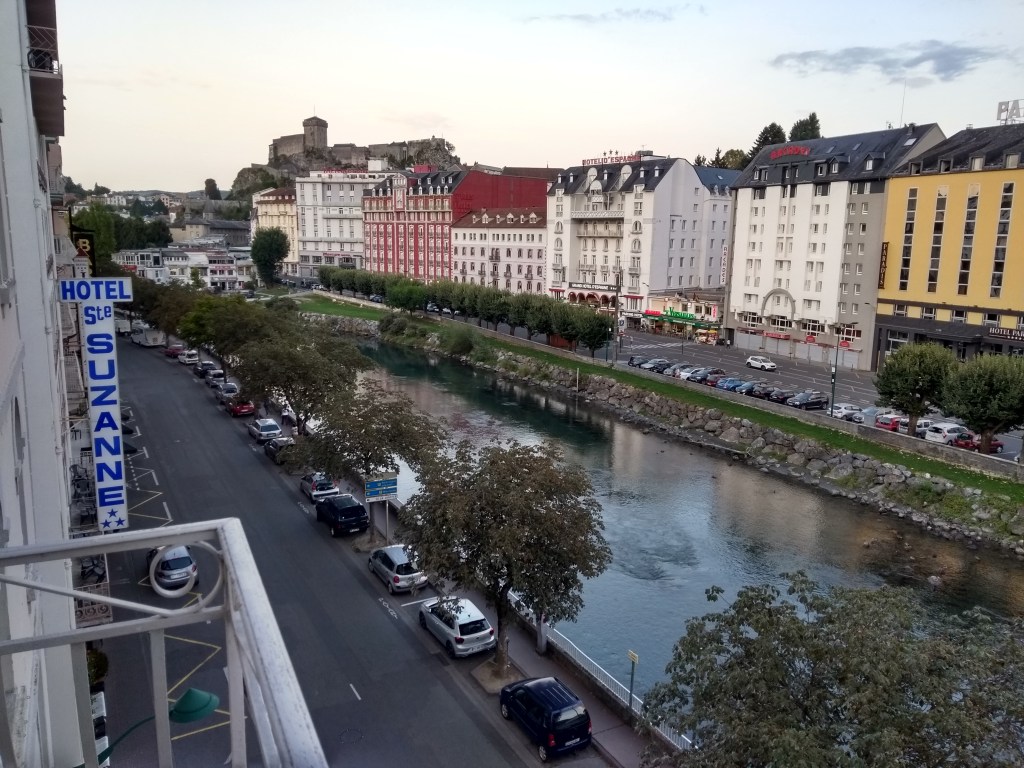
Lourdes. The river with hotels on both sides, viewed from my balcony.

Day 18 – Gourette to Refuge de Haugarou

September 15, 2019 – Departed 8:40 – Arrived 16:10

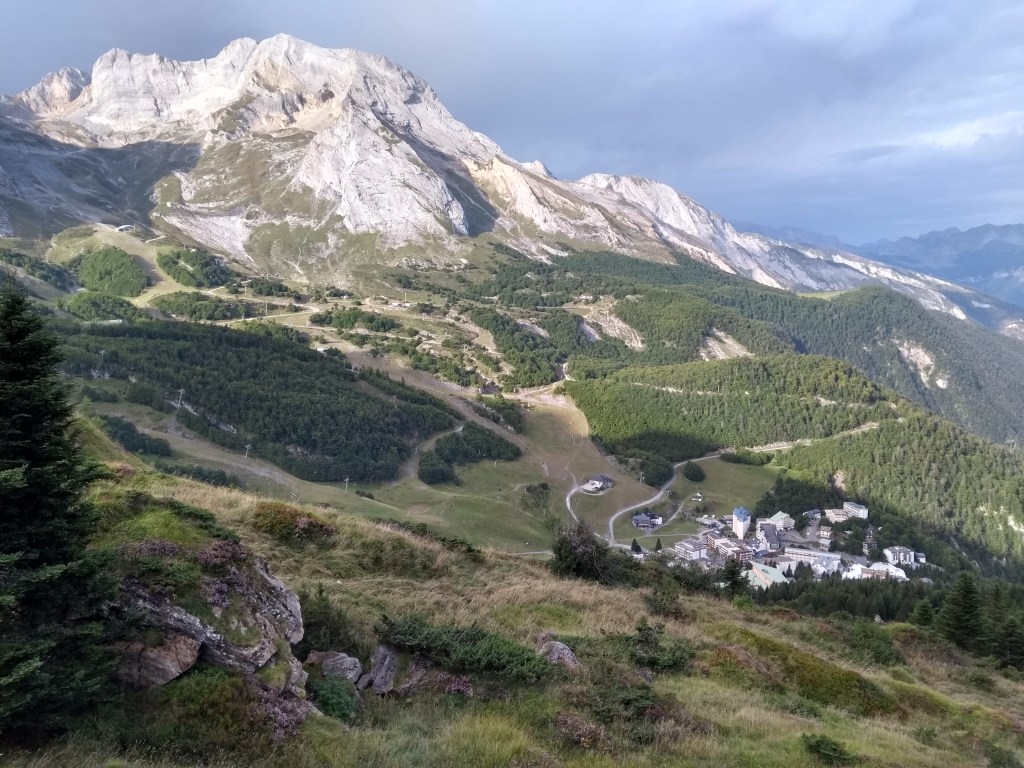
Starting from Gourette (elevation 1,362 m) it was immediately going up to the Col de Tortes (1,800 m). It was a steep climb and I could feel at once that I was still tired from the day before. I accepted it and took my time, looking back occasionally at Gourette. This is a ski resort with lots of concrete but in a beautiful setting with huge mountains overlooking it. I was sharing my dorm last night with two rock climbers and could understand why they were here!

On the other side of the Col it started raining. I covered myself head to toe in rain gear, but fifteen minutes later the sun came out and I was so hot that I had to take it all off.

Then it was a steep descent to a valley 600 m lower, then an equally steep climb to the Col de Saucède (1,525 m). I left the GR10 immediately after to take the GR101 which will lead me to Lourdes. I literally turned my back to the massive summits of the Pyrénées and started North towards lower mountains and the plain. The path was a little bit easier although by no means flat. It started raining again but, having learned my lesson from the morning, I let it pass while sitting under a tree.

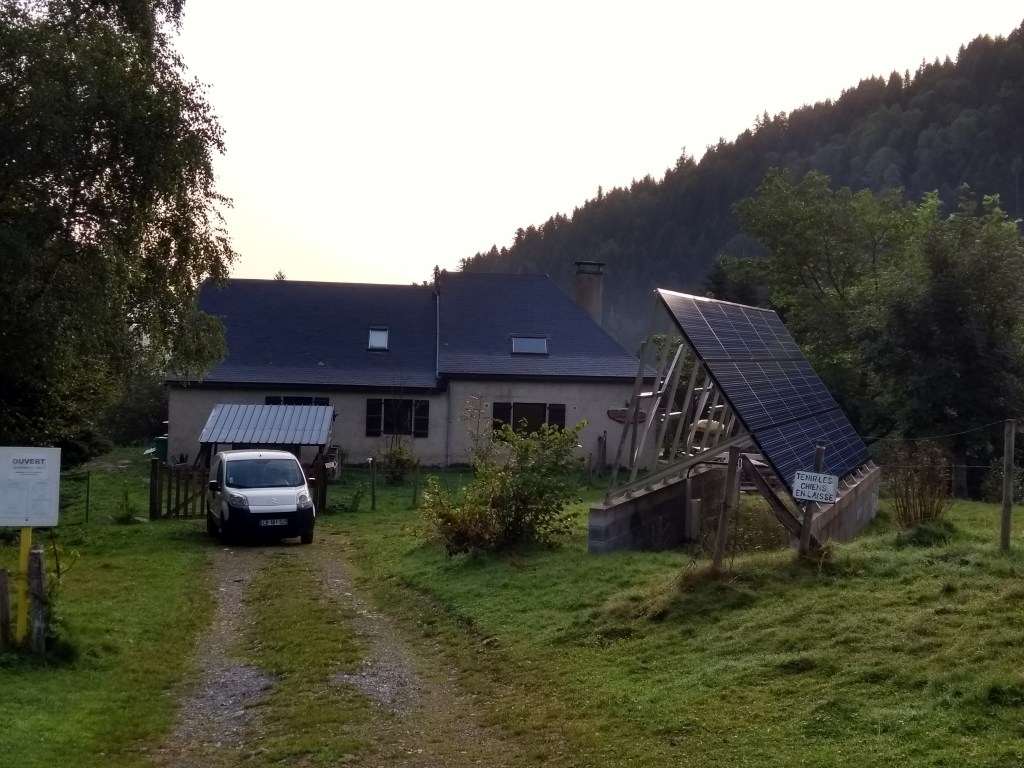
The Refuge de Haugarou where I am staying tonight is an off-grid property – as the owner puts it, “electricity – that’s the solar panels, water – that’s the source, and telephone – that’s satellite”. Half an hour after I arrived a thunderstorm started, and boy was I glad I got here when I did! The owners are a young couple from Lille who have been here only for 3 months. As I was their only guest tonight we had dinner together and they explained to me how they made their decision to take the Refuge over – it’s a courageous move and quite an adventure!

Looking back at Gourette from the climb to Col de Tortes.
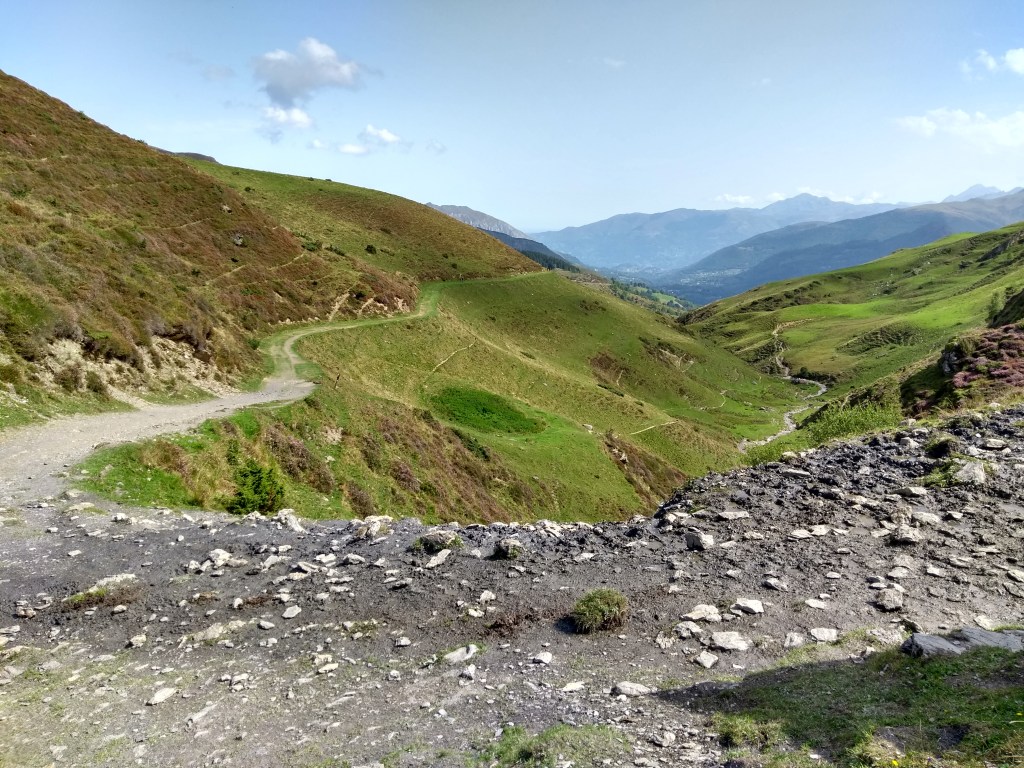
At the Col de Saucède. The path on the left is the GR101 to Lourdes, down the valley to the right is the continuation of the GR10.
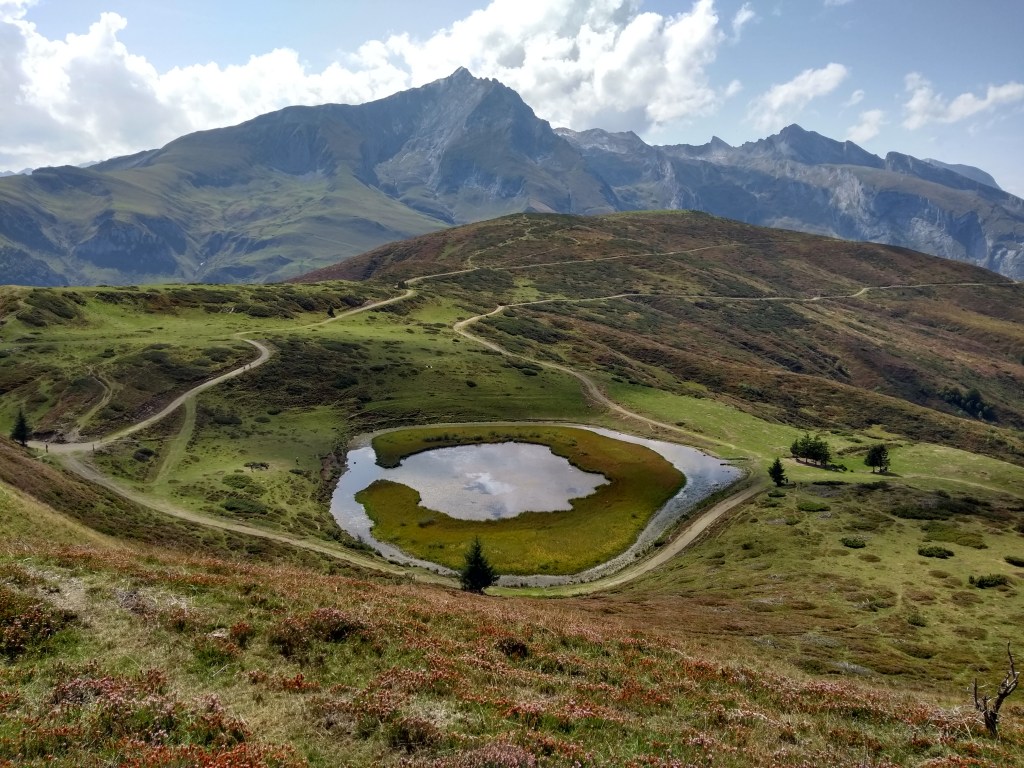
Looking back at the Pyrénées from Lac de Soum.
The Refuge de Haugarou.
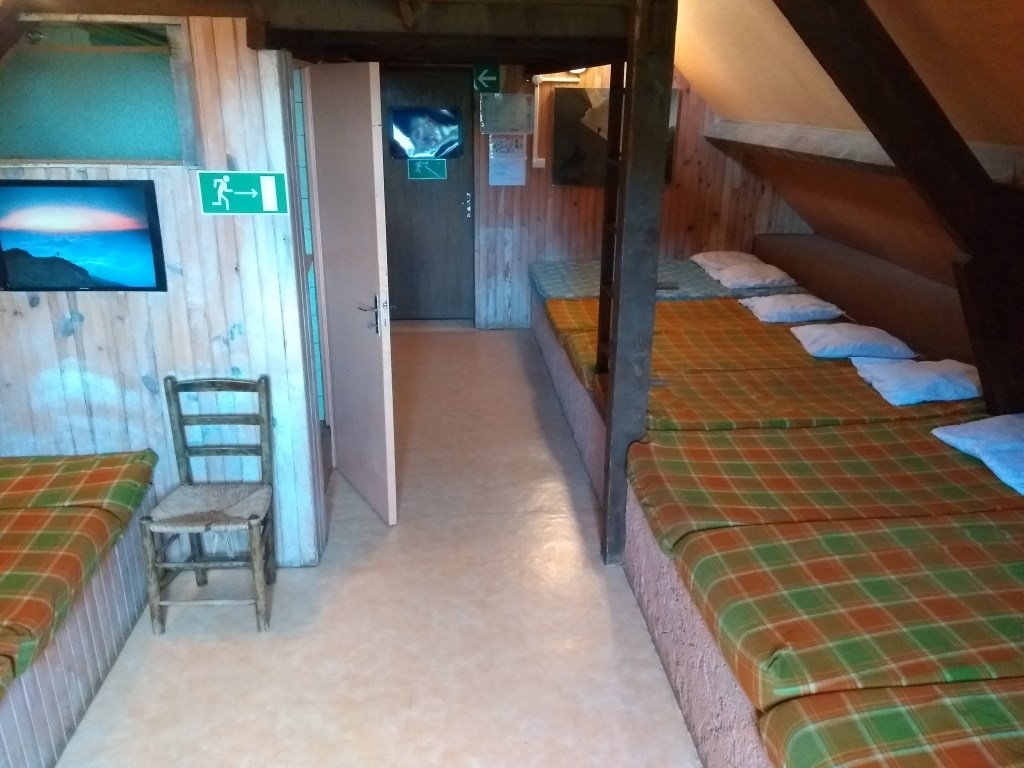
The dorm at Refuge de Haugarou.

Day 17 – Gabas to Gourette

September 14, 2019 – Departed 8:25 – Arrived 18:40

This was supposed to be a long day and indeed it was. Basically the hike was going up for the first 7.5 hours from Gabas (elevation 1,035 m) to the Hourquette d’Arre (2,465 m), then down to Gourette the rest of the time.

The climb represented a change of elevation of over 1,400 m, and at times – specially near the end – it was nothing short of brutal. Not what I like, as you know. In fact I was at times so focused on the physical effort that it really took away from the pleasure of being there. On the positive side I made it, and in one piece. But I really had to make a mental effort to look around, admire, take pictures, and enjoy.

There were indeed some pretty sights. The path at the Corniche des Alhas is running along a cliff and is quite breathtaking. Later on, the path crossed the beautiful plateau near the Cabanes de Cézy with tons of pretty flowers, and overlooking a vast plain below. At the midpoint of the hike, I came across a nice spot along a stream – it was perfect for a break, so I refilled my bottles with fresh water and dipped my feet in the stream while having peanuts and dates. Higher up, the final section before l’Hourquette d’Arre is also quite grandiose, although very challenging from a hiking point of view. There was some snow left from last week so I made a tiny snowman, my first of the season. It started melting right away and I am pretty sure it has now joined the many beautiful streams that I saw today.

On the other side of the pass as I was starting my descent it started raining. Big drops, but it didn’t last. It made the rocks a bit slippery but I got to Gourette without problem. I am staying at the chalet of the Club Alpin Français which at the moment is run by volunteers – they have been unable to find a permanent manager. They invited me to have the apéritif with them and a bunch of mountain bike riders. I then went to the local restaurant for dinner and had my first taste of garbure, a hearty soup local to this region.

The path at Corniche des Alhas overlooking the cliffs.
The path near the Cabanes de Cézy.
A perfect spot for a break!
The Pic d’Ossau as seen from below the Hourquette d’Arre.
The final section before the Hourquette d’Arre.
On the way down to Gourette.

Day 16 – Refuge d’Ayous to Gabas via Tour du Pic d’Ossau

September 13, 2019 – Departed 8:25 – Arrived 17:30

I had a terrible night, I am not even sure I slept at all. I can’t figure out why. With all the physical exercise I have been doing in the past two weeks I should be tired and sleep like a baby. Not the case.

On the program today was the tour of the Pic d’Ossau. I don’t know why, maybe because of my bad night, but it never really clicked. The landscapes are beautiful for sure, but the path has again a 600+ m climb and at times goes though screes and is quite unpleasant. I was also hoping to see some wildlife that I have not seen so far, particularly wild mountain goats, but either I didn’t look in the right places or needed binoculars but I didn’t see anything. A bit disappointing.

My original intent was to camp at the Lac de Bious-Artigues at the end of the Tour. I was a bit concerned because I didn’t have enough food for breakfast tomorrow which is a very long climb to Gourette – food is super important, it is what fuels the effort. I also did not like the bivouac area at Bious. I then decided to push on to Gabas. There I found an épicerie éphémère which was still open – but barely, they are closing this weekend and the shelves were almost empty. I scraped enough for a good breakfast. While talking to the attendant he informed me that he had rooms for rent, it sounded more appealing than pitching the tent and that’s where I am now. I even had a bath, a luxury I have not had since the start of this adventure.

The fun fact of the day (beside finding a good blueberry patch near Lac de Pombie) was witnessing sheep leaving their summer home or estive. As I was halfway through my hike around the Pic I saw the shepherds and dogs guiding the flock down the slopes. Later this afternoon I saw the sheep corralled near Bious. Finally around 7 pm as I was settling in my room I heard this incredible ruckus coming from the street, I went to the window: it was the sheep, taking the entire width of the road, making their way to the next village, one shepherd in front, half a dozen at the back – and all the bells ringing.

Lac de Pombie.
The trail near the end of the hike.
Finally a good patch!
Sheep leaving their estive in the mountains, guided by shepherds and dogs.
The sheep going through the village of Gabas.

Day 15 – Etsaut to Refuge d’Ayous

September 12, 2019 – Departed 8:10 – Arrived 15:20

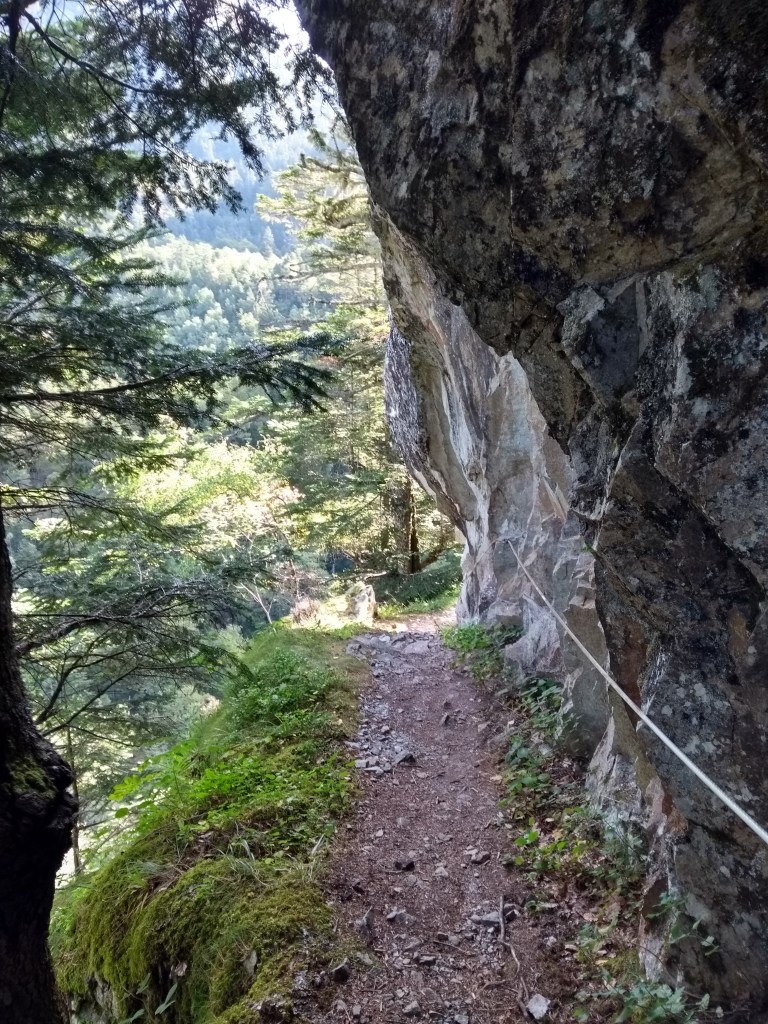
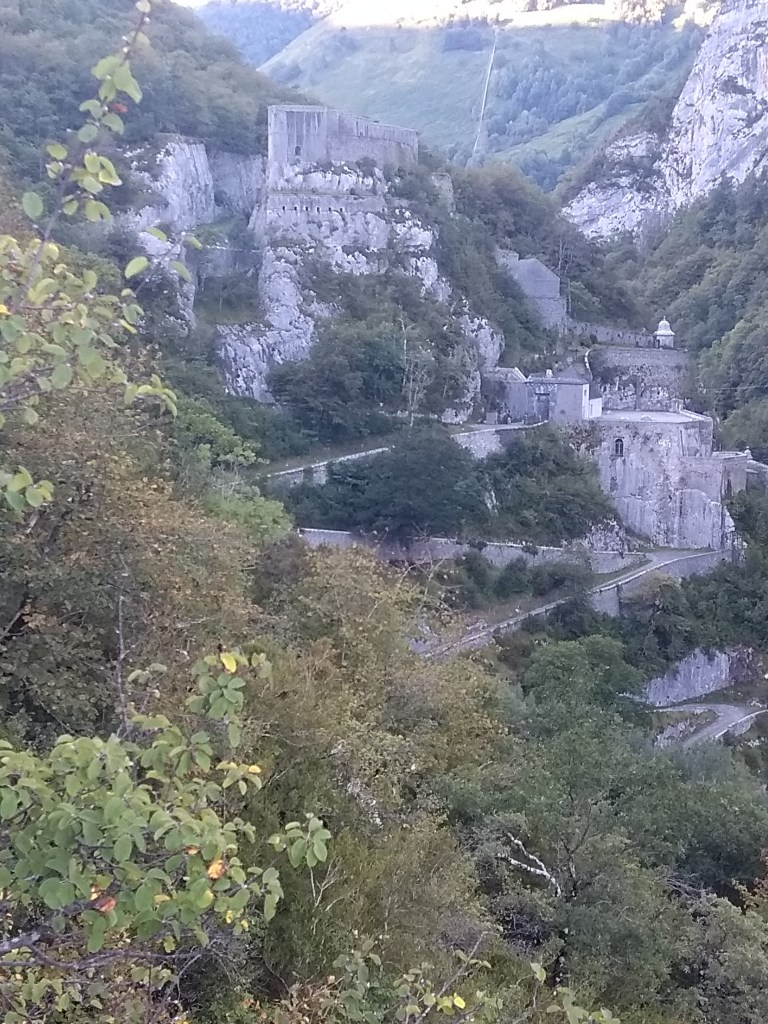
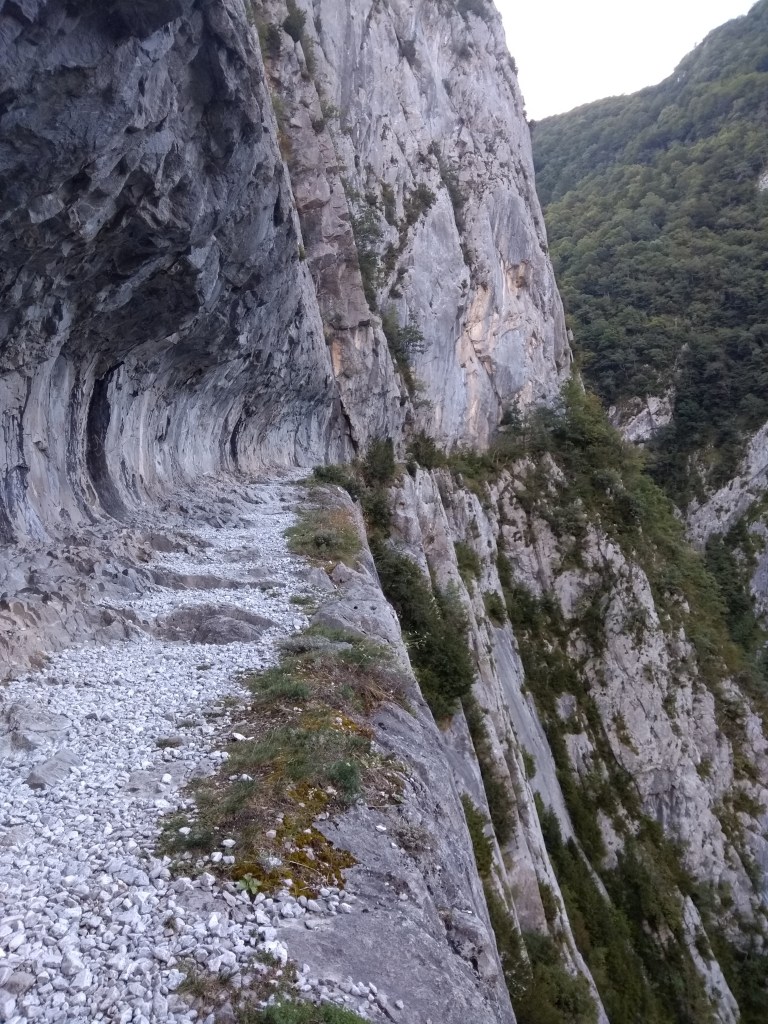
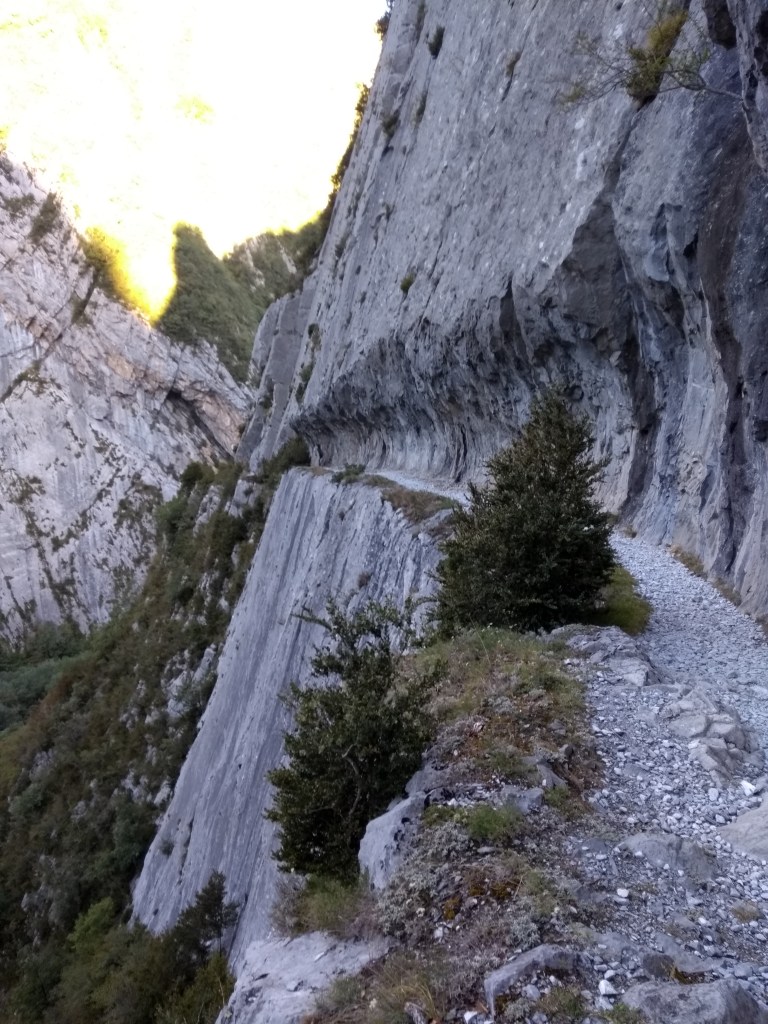
What a day! It started, just one hour into the hike, with two gems. The first to come into sight was the Fort du Portalet, a fort built I mid 1800’s to defend the valley against the Spaniards. The fort is located on the other side of a deep gully. On this side, the path is known as Chemin de la Matûre, so named because it was used in the 1700’s to carry tree trunks to make masts for the French Navy. The path is carved out of an almost vertical cliff. It’s quite an impressive piece of work. You can still see the marks of the holes that the workers filled with gunpowder to break the rock apart.

After that it was a long climb, at times gentle, at times steep, specially near the end, to the Col d’Ayous (2,188 m). This is the first time since Hendaye that the GR10 has crossed the 2,000 m mark. The climb to the Col took an entire 6 h 15 mins. I was exhausted. But it was worth it. The view from the top is incredible. There were 6 or 7 letting it soak in, taking pictures, and getting our first look at the imposing Pic du Midi d’Ossau just across.

From the Col it was another hour down to the refuge which is right on the side of Lac Gentau. The setting is incredibly beautiful. As for the refuge itself it’s very basic – no hot water, no showers, no electric plugs (it’s all photovoltaics with batteries) and in any case no wifi and no cell service. But there were some 30 of is who spent the night and had dinner there. The two women who were operating the refuge were incredibly organized and energetic and love their job; before dinner they took time to explain to us how the refuge was built and how it operates, and between the main dish and cheese they made us go outside to admire the shadows setting on Pic d’Ossau as night fell. A bunch of us volunteered to do the dishes afterwards, and it was really the least we could do to thank them.

Fort du Portalet.
Chemin de la Mâture.
The climb to Col d’Ayous.
Lac Gentau with Refuge d’Ayous on the right and the Pic d’Ossau on the left.
The refuge with the Pic in the background.
Nightfall.

Day 14 – Etsaut

September 11, 2019

Resting today, and giving my muscles, knees, hips, and shoulders a break. I am not exhausted, just tired, but otherwise in good physical and mental shape. While on the path I try to keep my mind free from thoughts and focused on what surrounds me. With medium success I must say – if I was so attentive I would not miss turns! But overall it feels good and I am reasonably relaxed.

I started the day with laundry – by hand in the sink. Later on as I had put my clothes all soaking to hang the cleaning lady approached me and offered to put them through the centrifugal extractor so that they would dry faster. It’s something I have come across several times during this trip – people offering to help, even without being asked. People are so nice here!

I also spent some time visiting the villages – Etsaut is maybe less spectacular despite a tower from the middle ages. Borce is prettier with lots of stone houses dating way back, a very curious lavoir, and a small hospitalet that was catering to Camino pilgrims on the Via Tolosana. They have converted the hospitalet into a small exhibit about the Camino which I found quite interesting. I was also hoping to visit the Maison du Parc National des Pyrénées in Etsaut, but unfortunately it is open only during school holidays. But there are numerous signs and maps throughout the village that clearly indicate that we are in a hiker’s heaven.

The rest of my day was spent reading, and preparing the five next days which will take me to Lourdes.

Medieval tower in Etsaut.
The main street in Borce.
The hospitalet in Borce, which used to cater to Camino pilgrims.

Day 13 – Lescun to Etsaut

September 10, 2019 – Departed 9:15 – Arrived 15:30

A quiet day. It was raining when I left, so I put the rain cover, K-Way and gaiters on. The weather alternated between rain and no rain all day, so I kept removing the K-Way and putting it back on, but that was a minor inconvenience. Walking in the rain was actually quite nice, at times I could see clouds in the valley and at times I was in the middle of them, with light rain falling softly.

Today was as green and lush as yesterday morning had been dry and rocky. The climb to Col de Barrancq (1,600 m) was a gentle slope, the way I like them, through a very green beech forest. On the other side, the forest became pastures or ferns, and the path was much steeper. Shortly after the the top I came across another blueberry patch, I was able to pick a few but they were very isolated – one here, one there, obviously it is past the season.

Borce and Etsaut are two small villages that almost touch each other and are nested at the bottom of a deep valley. I dropped my stuff at my auberge in Etsaut, then after a shower walked back to Borce to buy dinner – they have a small épicerie with fresh fruits; it also serves as a bar and I am writing this while having a glass of cider. Tomorrow is a day of rest for me so I’ll spend more time exploring both villages. I’ll also do laundry, repack my backpack, etc. For an extra 3.50 euros a night I have treated myself to a private room and I also hope to get two good, undisturbed nights of sleep, something I rarely get in dorms.

The path up from Lescun.
Between the clouds, snow above 2,000 m.
On the way to Borce.
Borce and Etsaut viewed from the fern-covered slopes above.

Day 12 – La-Pierre-St-Martin to Lescun

September 9, 2019 – Departed 8:45 – Arrived 15:45

La-Pierre-St-Martin marks the Eastern limit of Pays Basque. Today I crossed into Haut-Béarn, and tonight I am staying in Lescun (895 m), a picturesque village that is surrounded on all sides by big mountains and cliffs. The architecture looks different too, with big stone houses and slate roofs. The Gîte du Pic d’Anie in the middle of the village is where I will spend the night, and cook my own meal too.

Compared to previous days the landscape has changed too. Leaving La-Pierre-St-Martin I was immediately surrounded by dry rocks and big cliffs. The GR10 goes through it all, cairns occasionally supplementing blazes. An hour into the hike I missed a turn, tried to retrace my steps but all stones looked alike and I somehow ended up walking on top of what looked like vertical slabs of stone with edges as sharp as razor blades, with deep crevices between the slabs. It was a bit stressful. It took me a good 40 minutes to extract myself from this mess and find the path again. The only benefit was that I came across a patch of wild blueberries that was so far from the beaten path that no one had touched it. These were my first and so far only wild blueberries of this trip. Later in the afternoon I also came across wonderfully ripe blackberries that I really enjoyed.

This little adventure reminded me how easy it is to get hurt on the trail. In fact I have met quite a few people in the past few days that have had some health concerns, going from a broken nose – the result of a fall – to knee and ankle issues. A young woman the other day was hoping to hitch hike down the mountain because her damaged knee made walking down too painful. I try to be always super careful but a misstep can happen very easily.

Down from La-Pierre-St-Martin to Pas de l’Osque (1922 m) and then Pas d’Azun (1873 m) were more massive barren mountains and equally massive scree slopes. The path was all small, sharp rocks. Only as the path wound its way down the valley did the vegetation reappear – trees, and down here lots of meadows. The path was still small rocks but mixed with soil and actually quite easy. Overall this was a good day, the hike was not too difficult, and I arrived early enough to spend some time walking through the streets of the village and admiring its houses and lavoir, and then restocking and shopping for dinner at the local épicerie.

Is this the path?
View from Pas de l’Osque (spot the hiker!).
View below Pas d’Azuns.
Lescun.

Day 11 – Ste Engrâce to La-Pierre-St-Martin

September 8, 2019 – Departed 8:20 – Arrived 14:05

As expected the day was almost only going up, except at the very beginning and the very end. I don’t mind going up when it’s a gentle slope like that of a forest road, what I don’t like is when the path cuts directly through the slope and is very steep – that’s where I still have difficulties. Nevertheless the climb went well, despite me missing a turn and losing a good 20 minutes in the process, going up and down the wrong path.

Three quarters of the way up I saw a sign for ‘Cabane de Feas – 300 m’ and since this was not too out of the way I decided to have a look. It’s a small shepherd’s hut which (as some locals who happened to be there explained to me) has been rebuilt by volunteers from the village into a small refuge big enough for 4 to 6 people. It’s quite well done and the volunteers put quite a bit of effort into it, it’s quite amazing. Inside there are two platforms for people to sleep, a table and two benches, and a wood stove. A tiny house before tiny houses were in fashion. The volunteers built this so that it is available to any hiker who needs it for an overnight stay. Isn’t that amazing?

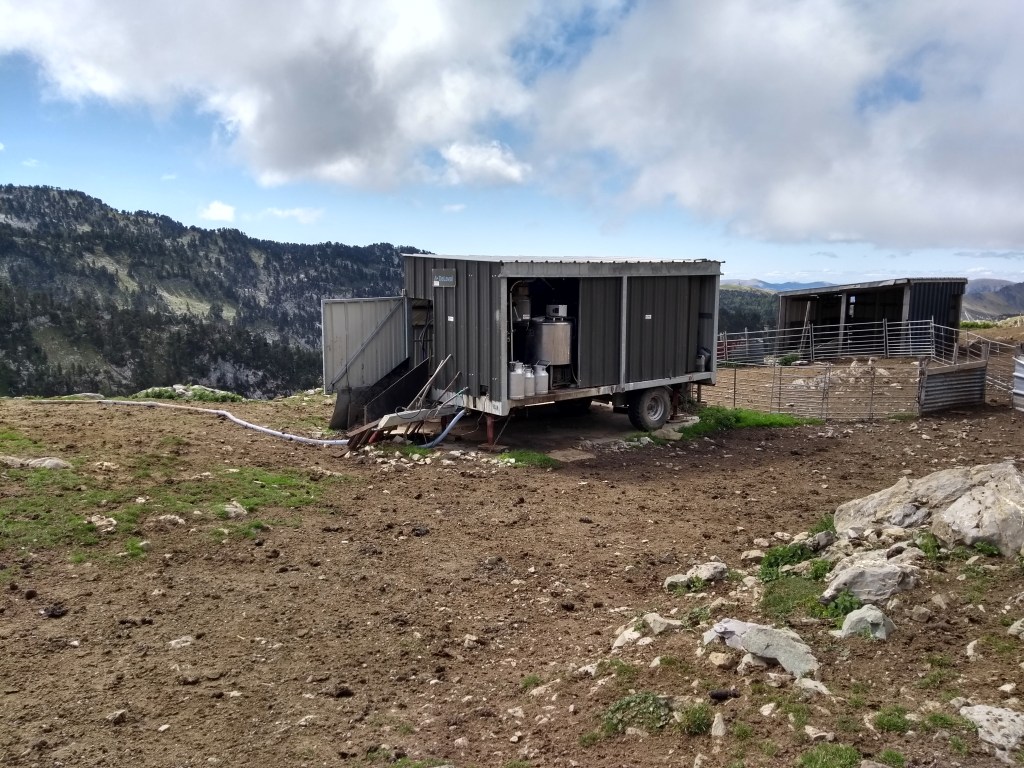
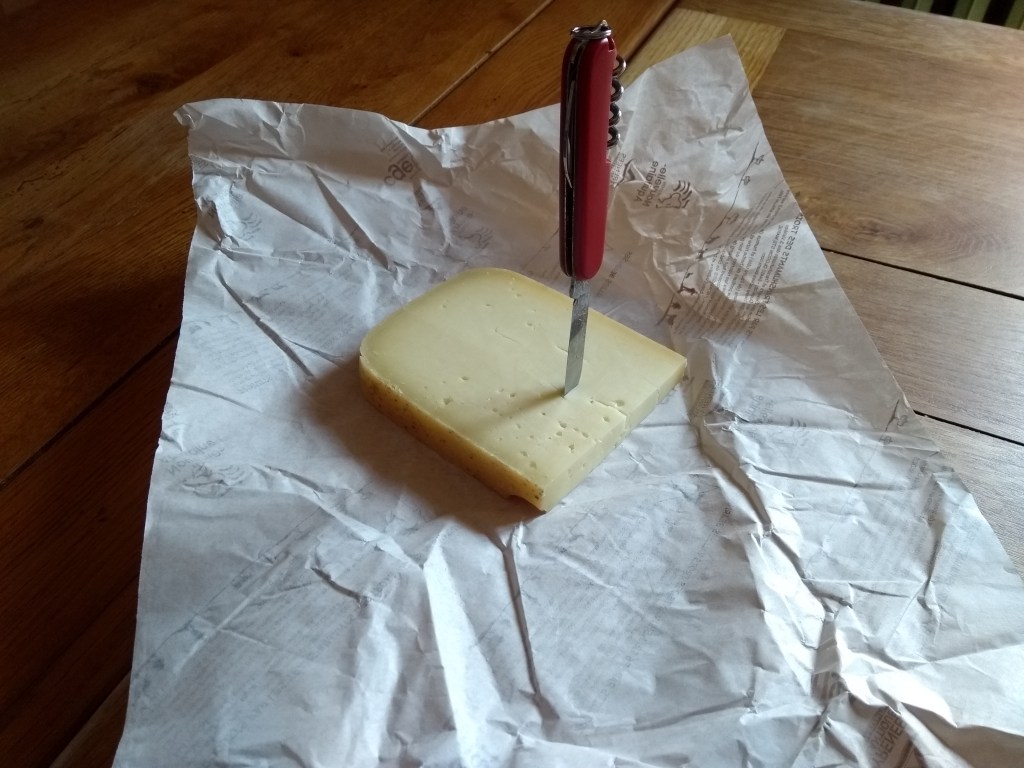
At the top of the Col de La-Pierre-St-Martin (1,760 m) I saw a mobile milking station for sheep, complete with 12 stalls, tank for the milk, etc. The shepherd lives in a small house nearby and sells cheese he makes right there. I bought myself a chunk and chatted for a while with him. He was a bit concerned about the weather turning cold early – indeed it was quite chilly and the forecast for two days from now calls for snow above 2,000 m. Even now at the refuge in La-Pierre-St-Martin (1,630 m) I need to have some extra layers. Speaking of the place, I didn’t know what to expect but La-Pierre-St-Martin is actually a ski resort, with big concrete buildings – quite different from the small villages that the GR10 has given me so far.

The group of people I hike with keeps changing. We actually don’t hike together, we all go at our own pace, but we meet again at the next auberge and usually share the dinner and the dorm. “It’s very convivial”, as one of them put it. A mother-and-daughter team that I have seen for the past 5 or 6 nights is finishing here. Two brother-in-law that I had dinner with for a few nights have left a couple of days ago, so have a husband-and-wife team. Two very funny Dutch men have decided to leap further ahead. We get to share stories, experiences, advice, laughs, just the time of a few evenings, and then we all go our separate ways.

The view above Ste-Engrâce.
Cabane de Feas.
Inside the cabane.
The mobile milking station.
Bon appétit !

Day 10 – Logibar to Ste Engrâce

September 7, 2019 – Departed 9:00 – Arrived 17:50

Another very long day. There was no other option today, as there was no auberge between Logibar and here. I must say that I am not too fond of long stages, like the one two days ago (11 hours) or the one today (almost 9), specially when I don’t start very early. I prefer 6 or 7 hours. More than that and after 6 hours I only want to arrive, and once there there isn’t much time left except for shower and dinner.

Tonight I still managed to go to church since there was a mass celebrated at 7 pm in the 11th century church here, right across the auberge. What an experience! When I entered I saw the men at the very back of the church, the women near the front. Not knowing any better I sat by myself in the middle. There were maybe 30 people in all. The office was all in Basque, except for the day’s prayers, the readings and the homily which were in French. All songs were in Basque, sung by the priest with a powerful voice. The men and women were responding in song to each other, and everybody was singing. It was very beautiful.

At 8 pm the auberge treated us to a great dinner, including tomates farcies and confit duck legs. The mom did the cooking, the dad came and sat at our table to tell stories and recommend local cheeses. The daughter manages the gîte and the café.

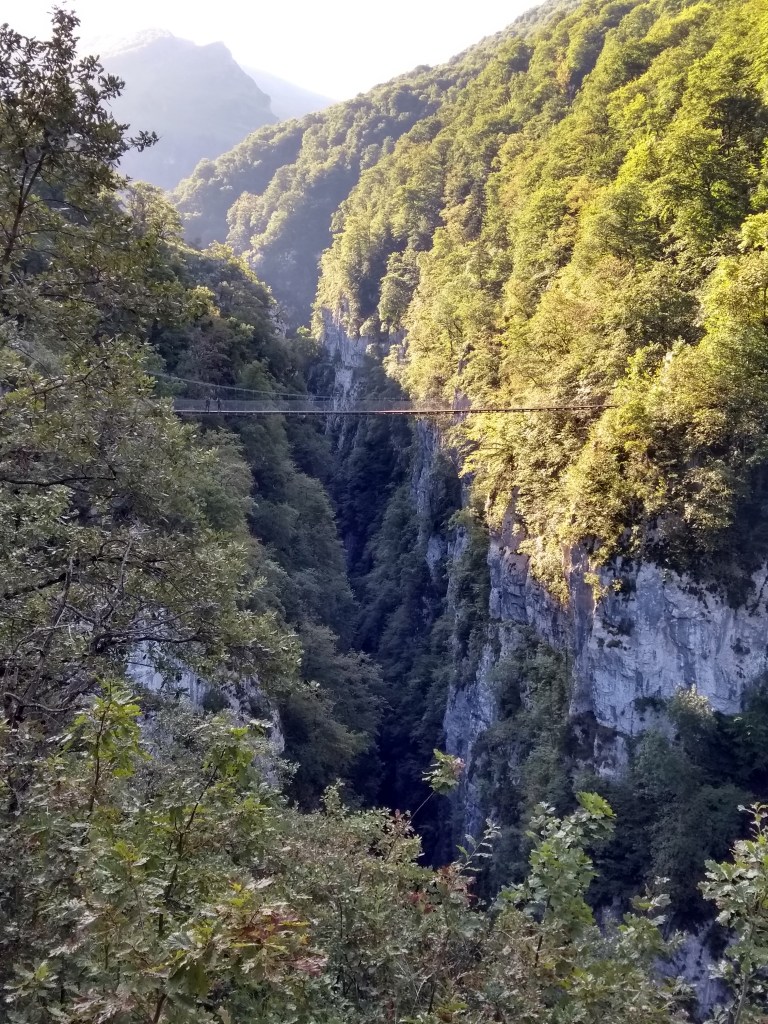
But enough for what has happened here in Ste Engrâce. On the trail this morning the first hour of a steep climb took me to the Holzarté suspension bridge, which is quite spectacular some 150 m above the canyon below. At the end of the bridge I was approached by three or four scruffy teenagers, they were quite friendly so I sat down and shared with them 1/100th of a cereal bar. They occasionally squabbled but apart from that did not say much.

The rest of the hike was going up, up, up, and then down, down, down. The mountains were beautiful, massive, imposing, everywhere. Some are covered with trees, some with ferns, some with grass; the tops are baren, and big slabs of rock stick out here and there. It’s quite an awe-inspiring sight. Also lots of streams around here, and sheep in places where you would not expect anything to be grazing.

Speaking of up – tomorrow is a shorter hike, only 5 hours, but apparently it’s only up up, up, so I am going to try and get a good night’s sleep to prepare for it.

The Holzarté suspension bridge (built 1920).
Sharing my cereal bar.
View of the mountains from the Col d’Anhaou.
The church in Ste Engrâce (note the discoid gravestones).
Inside the dorm.

Day 9 – Chalet Pedro to Logibar

September 6, 2019 – Departed 10:20 – Arrived 16:10

I slept okay and wasn’t cold at all – a god sleeping bag helps. I was a bit slow to get going but given the previous day I had an excuse.

I took it easy to Chalets d’Iraty. The path follows trails that are, this coming weekend, going to be used in some kind of all-terrain car racing event, so there was signage in various places, otherwise the forest is very pretty.

For the second half of the hike I decided to take the shortcut through Larrau, to save me some time and effort. The shortcut is unmarked and I got lost so many times that it was very frustrating. It alternates between road sections and a path through the ferns, but the path is often so narrow and uneven that I was actually glad to get back on the road. At the entrance of Larrau I stopped to have an apple I had found under a tree at the side of the road.

The last part from Larrau to Logibar is half an hour downhill on the road. As I got almost to Logibar I realized – I don’t know how, it’s sometimes funny how memory works – that I had left my pocket knife in Larrau after slicing my apple. I dropped my stuff off at the auberge and then walked back to Larrau to fetch it (it has sentimental value to me). It was still there. And then back to Logibar, but without the backpack on it was a completely different experience.

Dinner at the auberge was one of the bests so far – quite balanced with even fruit and fromage blanc. I will need the energy tomorrow which is a long hike to Saint-Engrâce.

On the way to Logibar.

Day 8 – Saint-Jean-Pied-de-Port to Chalet Pedro

September 5, 2019 – Departed 7:40 – Arrived 18:50

I was ready early and left then. The path out of Saint Jean was a paved road meandering through the outskirts of the village, which as a warm-up I did not mind. This was followed by a very steep climb and more rural trails. Everything was wet, I assume it must have rained during the night. Then at 10:00 it started raining again. I got all the rain gear out, but fortunately the rain stopped after only 10 minutes.

I reached Estérençuby ridiculously early. The GR10 guidebok says it should take 4 hours to get there, I was there in 3. Not sure why, maybe the bread I ate at breakfast had magic powers? In any case I took a break on the steps of the church, removed my rain gear, and continued to my goal for the day, Kaskoleta, which I reached shortly after noon.

I had a bit of a dilemma with Kaskoleta. I had tried reserving a spot at the gîte the day before, had left a message but never got a response. On my way there, I met another hiker who had been turned away the night before – they were full. When I got there, there was a sign on the door: ‘I am away for the afternoon. If you have a reservation come in and choose a bed. I will be back by 6 pm to prepare your dinner’. I checked the dorm, it was tiny – only 5 beds – and as I wasn’t sure I had a reservation and it was still early and I was in good form I decided to continue towards my goal for the next day, Chalet Pedro. I cancelled my reservation later in the afternoon once I got cell signal.

I hesitated a bit to continue because another 6 hours of walking was significant. I also wanted the hike to be enjoyable, and above all safe – I was somewhat concerned with extra risks associated with walking when tired so I was extra careful. My next stop was a bivouac (camping) so I figured that of I got too tired I could just pitch the tent early somewhere else.

There were another two very serious climbs, the first one to Col d’Iraukotuturru, the second to Occabé summit. Both went well, when it got too steep I alternated walking and resting and this enable me not to be completely out of breath during the climb.

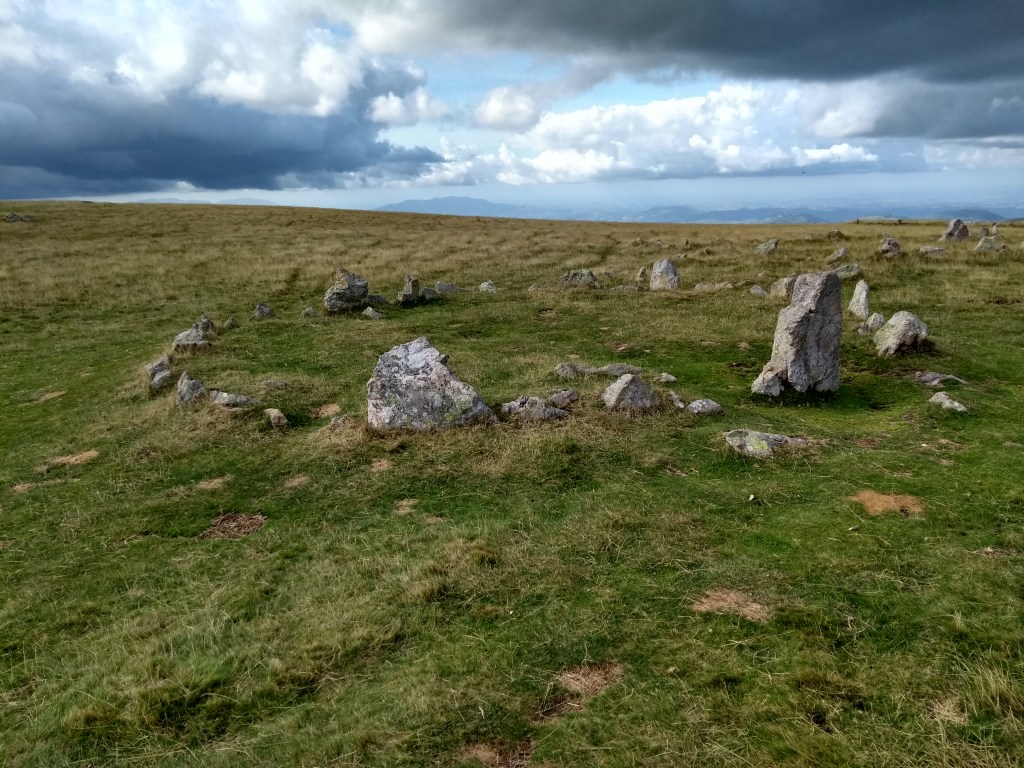
I spent quite some time at the cromlechs near the summit of Occabé. Cromlechs are circles of stones that date back 2000 or 3000 years BC. I love that stuff, I always find it a moving experience to contemplate and touch things placed here so long ago by humans just like us.

Something else that struck me today was the wind. As I got up higher through passes and summits the wind really picked up. Combined with elevation, and the overcast sky, this made for cooler temperatures, and I kept my jacket on top of my shirt all day. I also felt that the wind made me more tired than usual.

Finally I reached Chalet Pedro around 18:30. I decided that after all these efforts I deserved a reward. Chalet Pedro is a restaurant so I looked at their menu posted on the side of the road, settled on an omelette aux cèpes (scrambled eggs with local mushrooms) and a salad. Unfortunately I realized shortly after that the restaurant is open only for lunch, so I had begun salivating for nothing. Instead I went to the bivouac area half a km further down the road to pitch my tent.

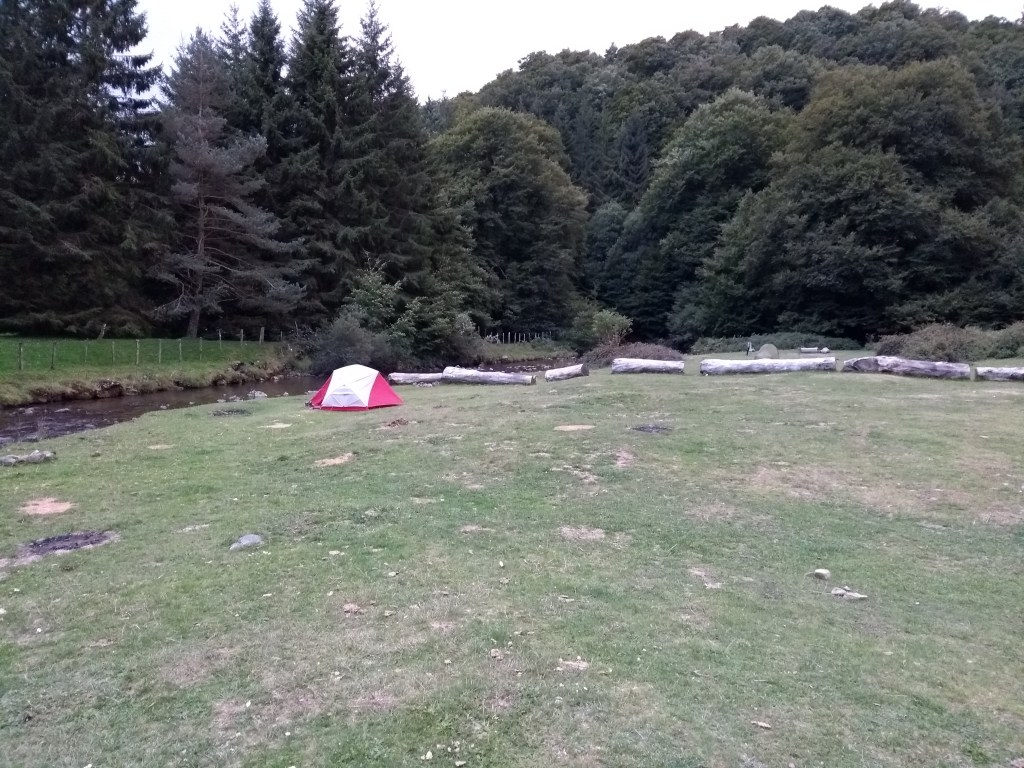
The bivouac area is actually a pasture, complete with cows and cow patties, with half reserved for RV’s and the other half for hikers. There were three tents including mine. RV’s are 5 euros, hikers are free. On the other side of the road there is a not-too-good-looking building with washrooms and – wonderful surprise – free hot showers. I set up camp and had a shower, then had dinner – dehydrated mashed potatoes and beef which was actually quite decent.

The site is super windy. I hope that the tent will stay in place and that I won’t be too cold.

View on the way to Col d’Irau.
Didn’t get lost (at least this time).
One of the cromlechs d’Occabé.
Camp site.

Day 7 – Saint-Jean-Pied-de-Port

September 4, 2019

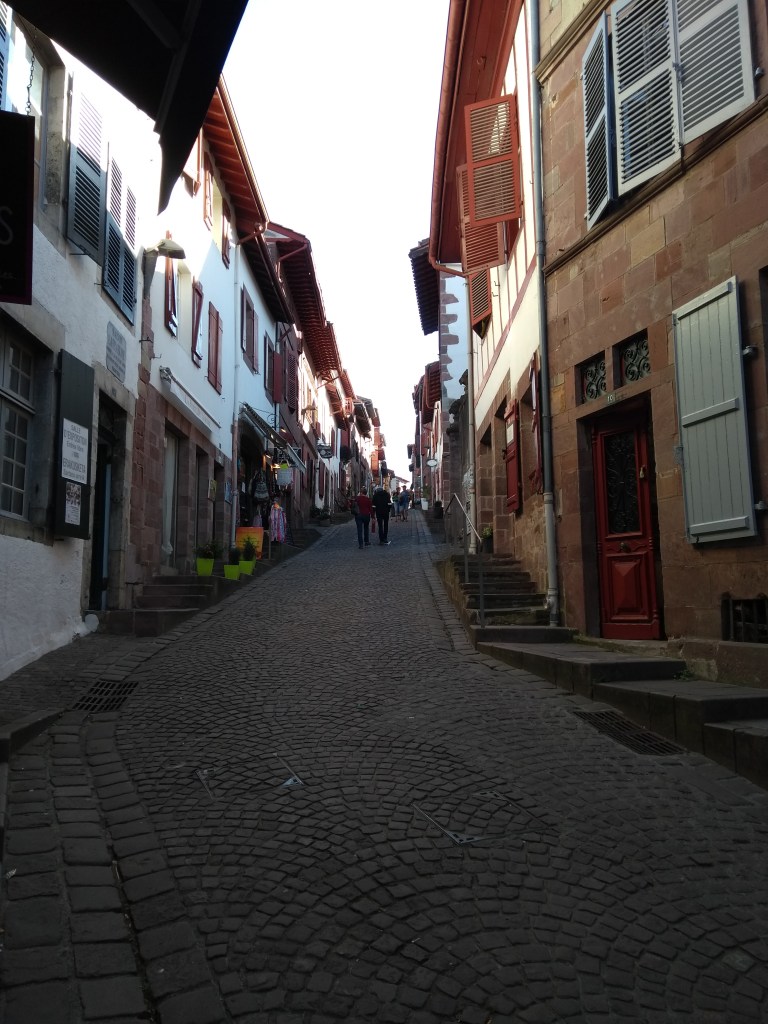
This was a rest day. I could not really sleep in because all the other hikers were getting ready to leave starting at 6:00 – mostly pilgrims on the Camino. The town is very funny in the sense that is gets very busy early in the morning, then by 8:00 or 8:30 the streets are empty and everything is calm again, only to get busy again around 10:00 with tourists. And busy again at the end of the day with a new wave of pilgrims. According to the manager of the auberge, September is high season for the Camino.

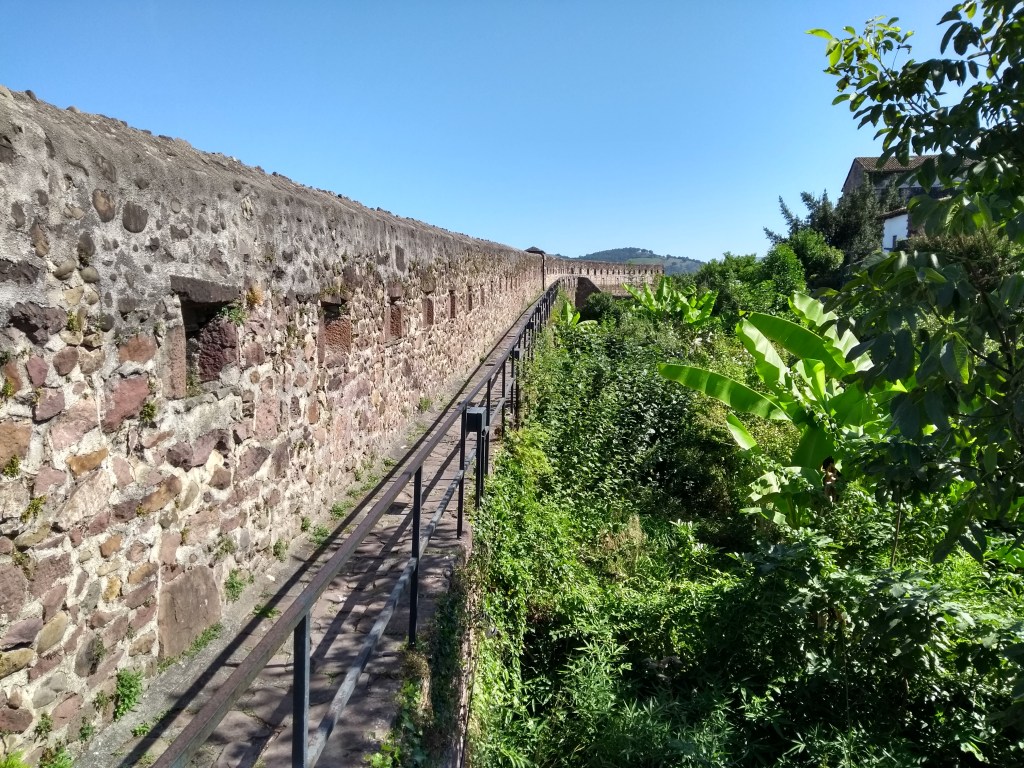
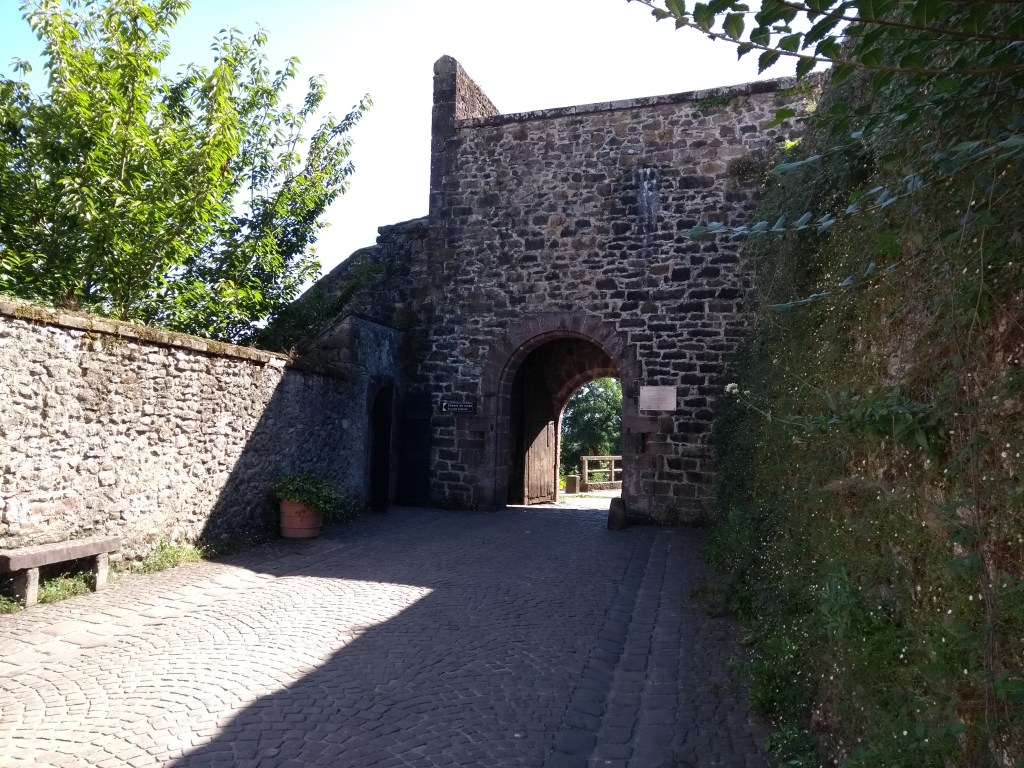
I went about exploring the city, mostly the Citadelle (fort) at the top, and the city walls, as well as the Roman bridge and the church. The city is very pretty and has retained a distinctive character despite all the outsiders.

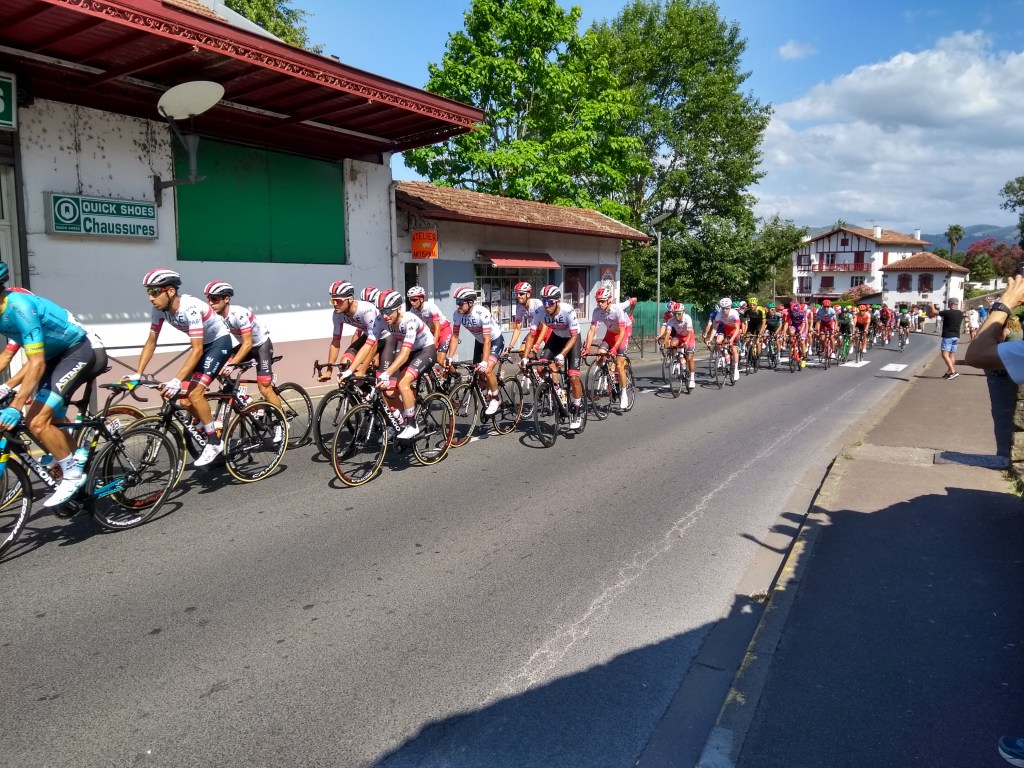
The other event of the day was the passage of La Vuelta – the Spanish equivalent to the Tour de France, which was venturing on this side of the Pyrénées. I joined the thin crowds on the side of the road to see them go by. I swear that all the motorbikes of the Guardia Civil de Tráfico had come here and were preceding the racers. Finally they came, in two groups, and were quickly gone. It was fun though. The rest of my day was spent restocking on supplies and mailing a couple of postcards. Tomorrow is back to hiking, with several fairly long days lined up.

A street in the old part of the city.
The walkway on the city walls.
The Porte Saint Jacques through which pilgrims would enter the city.
La Vuelta.

Day 6 – Saint-Étienne-de-Baïgorry to Saint-Jean-Pied-de-Port

September 3, 2019 – Departed 8:30 – Arrived 15:15

The hike to Saint-Jean-Pied-de-Port was uneventful. Following yesterday’s pattern it started with 3 hours of walking uphill through various cols (passes) to the summit of Monhoa (1,021 m). The slope was not too steep, or I am getting used to it. There were great views from the summit, including of Pic d’Iparla – it was nice to see it this far and this tall and to think that I had been there the day before.

While at the top and having a snack to celebrate, a young hiker from Quebec arrived. I shared my cookies and refilled her water bottle, as she was out of water and I had plenty. She was coming from Saint-Jean-Pied-de-Port and had been on the Camino starting from Le Puy for a month. She was now continuing through the Northern route, but chose to go through the mountains (rather than the valley) ‘to get better views’. A bit of a free spirit, she sleeps à la belle étoile (in the open) – I admire her true sense of adventure. Since we were going in opposite directions we exchanged tips about what to expect next on our respective ways.

The descent to St Jean was as continuous as the climb to the summit had been. It concluded with one and a half hour of a very boring road and I was glad to arrive.

Many times today the path meandered through slopes covered with ferns. In fact, looking at the mountains nearby from the top, slopes are mostly dark green from the ferns, with only occasional patches of lighter green where the ferns have given way to grass meadows. I was told by the farmer’s daughter the other day that they actually harvest ferns, to use as bedding for the sheep in winter (just as straw is used in other places).

Saint-Jean-Pied-de-Port is a pretty village. I will have more time to explore it tomorrow as I will take a full day of rest here. Walking though the streets as I was waiting for the auberge to open I have seen a throng of hikers – dozens and dozens, mostly people doing the Camino. All sorts of languages can be heard, with French, Spanish and English the most frequent. The village is the starting point for the Camino Francés, one of the most popular routes to Santiago.

Tonight I will take care of mundane things – the wonderful auberge where I am staying has a clothes washer already running with all my stuff from the past six days. Since there is a kitchen here I will also cook for myself. It’s been great relying on the auberges for dinners so far but the diet is not well balanced: French fries every single day, and barely any fruit. Time to take a breather!

Pic d’Iparla as seen from the top of Monhoa.
The path meandering through fern-covered slopes (with pretty yellow flowers along the path).
Saint-Jean-Pied-de-Port.

Day 5 – Bidarray to Saint-Étienne-de-Baïgorry

September 2, 2019 – Departed 8:05 – Arrived 16:30

Things got more serious today with the crossing from Bidarray to Saint-Étienne-de-Baïgorry. The first three and a half hours were a steep and continuous climb from Bidarray (elevation 140 m) to the Pic d’Iparla (élévation 1,044 m) which is the first time the GR 10 has been above 1,000 m since the start. Great views from there, all the way to the ocean and to higher peaks in the Spanish Pyrénées. The path followed the edge of the cliff to a couple of other peaks, then dipped to lower peaks before starting a continuous, strenuous two and a half hour descent to Saint-Étienne-de-Baïgorry.

In the mountains various animals were grazing, mostly sheep an pottoks. I also saw (and smelled) my first goats, impressive with their big horns. Because of all these animals the ground was in places literally covered with dung and probably in relation to this I saw quite a few beetles today.

This was of course very, very tiring – not only because of elevation differences but also because of the length of the hike. But I was rewarded with truly beautiful sights – the mountains, the cliffs, and the sheer majesty of it all. I spent also some amazing minutes watching birds of prey gliding effortlessly along the edge of the cliff, right below me. According to a local couple I met at the top these were vultures. They seem to be able to glide for hours without ever flapping their wings.

There were lots of folks on the trail – some through hikers going both directions, some day hikers, also quite a few runners. Individuals, couples and teams of two, and groups. Except for the descent, I was never alone for more than an hour. The weather was great – so great in fact that I had unzipped the bottom of my pants and got a sunburn on my legs as a consequence. I’ll be more careful tomorrow.

Tonight I am staying at an auberge in St-Etienne. This one is a commercial operation adjoining a small restaurant where they will serve dinner. Yesterday’s was of a different kind, an old parish hall that had been converted first to house summer camps and then to house hikers and pilgrims. It was run by a very dedicated woman from the parish on a semi-volunteer basis. I found this quite impressive and was certainly grateful for the service, so were the other five people staying that night – four who were walking the GR 10 in the same direction as me (we passed each other several times on the trail today and they are staying here tonight as well) and one who was doing the Camino and going the opposite way.

Tomorrow is another big day with again a peak above 1,000 m between here and Saint-Jean-Pied-de-Port.

The cliffs around Pic d’Iparla.
The cliffs.
Mountain views.
The Roman bridge in Saint-Étienne-de-Baïgorry.

Day 4 – Col des Veaux to Bidarray

September 1, 2019 – Departed 9:40 – Arrived 14:00

No rain after all, and I am not complaining. Today’s hike took me through some gentle sheep and pottok pastures to the Col d’Espalza. Then it was a one hour, very steep climb down a rocky gully to the valley below. A bit hard on the knees despite my best efforts, but overall quite fun.

There was a farm at the bottom, and the farmer’s children, aged 19 and 21, have started a small buvette selling cold drinks to hikers. After all my efforts it was hard to resist, so I sat down for an Orangina. The farmer’s daughter kept me company, and we started talking about the farm. They have 600 ewes that they have to milk twice a day – three hours each time. With twelve milking stalls, a quick calculation shows that it corresponds to 3 minutes per ewe. It’s faster than a cow, but of course they don’t produce as much. There is no production in summer either, as the ewes are dried off while the farmers are busy with harvests and such (the same can be done with cows, I learned earlier this summer. All one has to do is properly time the birth of the new calves so that production can restart in the Fall).

From the farm to the center of Bidarray was another easy hour. I now have the whole afternoon to relax, maybe do a bit of laundry, and have dinner somewhere in the village. I was going to buy some groceries and cook for myself for a change, but the farmer’s daughter kindly reminded me that today is Sunday and the épicerie is closed. It’s a good sign that I have lost track of days.

The view from Ferme Esteben this morning.
GR10 blaze.
Mountainside.
On the way down from the Col d’Espalza. Can you spot the five hikers?

Day 3 – Sare to Col des Veaux

August 31, 2019 – Departed 8:20 – Arrived 15:00

I had a bad night – maybe choosing the gateau Basque for desert yesterday wasn’t a good idea. My roommate was up at 6:00, and started his hike by 7:00 – it was barely daylight. I had breakfast at 7:00 and was ready to go by 8:20, which is not so bad. My goal was to arrive before the start of rainfall scheduled for later in the afternoon.

The first part of the hike was super easy. Quite a few roads and wide agricultural paths, all fairly flat. Pleasant though, with cows and sheep in pastures along the way, and nice streams next to the path at times. This got me to Ainhoa around 10:40. It’s a lovely Basque village, which I set out to explore. I had my snack near the fronton where a dad and his 5 year old were hitting the ball, visited the lavoir and climbed the church steeple (with my backpack on; unfortunately, there was nothing to see). The church though, like all the ones I have seen so far in this region, has inside balconies overlooking the central nave on each side.

The second part of the hike was a fairly steep climb to the Col des Trois Croix, which I managed to do quite efficiently. Yesterday I was complaining about hills, if I am going to complain then I obviously chose the wrong part of the country for my hike! But no, I am hopeful that after a week hills won’t be a challenge anymore. After the climb today it was fairly flat, but at 13:45 it started raining, which forced me to get the rain gear out. When I arrived here at the Ferme Esteben the backpack was dry, but I had transpired so much that my clothes were in a fairly sorry state. They will dry – hopefull, although the air is so damp that I doubt they will be dry by tomorrow.

This second leg of the hike was again in Pottok country. They also warn hikers about wild cows called Betizu but I saw only one. At first the path stayed on the northern side of the mountain, overlooking villages in the plain. But then it crossed to the other side, facing other mountains with mostly forests and the occasional meadow. I took a break on the side of the path; on the opposite side of the valley, well, well below me there was a bergerie with tiny horses and even smaller sheep. All there was to be heard were the bells of horses, a stream running at the bottom of the valley, and the occasional cry of a bird. It was beautiful.

Tomorrow is a short day to Bidarray, which is just as well since the forecast calls for more rain.

Ainhoa – Main street.
Ainhoa – Church and fronton..
Practice your Basque!

Day 2 – Col d’Ibardin to Sare

August 30, 2019 – Departed 9:45 – Arrived 16:45

Today the hike was longer but easier than yesterday. A reasonably good night likely helped. I also came to realize that part of my difficulties yesterday were due to improper nutrition: all I had in my stomach when I started at noon was a pain aux raisins and an orange juice I had got at the train station before 7:00. This morning I had a much more substantial breakfast and it fueled me through the day.

I am still having difficulties uphill – hills are not my friends, which I already knew: but from the beginning today I used the same technique as yesterday, alternating walking and resting as soon as the slope became too steep, which fortunately was not too often – although the elevation difference was significant. This worked great.

From the path at one point I could see the plain on the one side, all the way to Hendaye and Saint Jean de Luz, and the mountains on the other, undulating, green and lush. The path was definitely in the mountain though, as could have been expected. Compared to yesterday, there was also an abundance of streams and, in some places fountains, which I used to refresh my face and refill my bottles with cold water.

Today was a land of chesnut trees and horses. There are lots of chestnuts trees everywhere, with branches heavily loaded with fruits, a wonderful sight. As for the horses, they are an almost constant presence on the path and around. They are small hardy horses or rather ponies called pottoks that are specific to the Basque country. They are put to free pasture in the mountains. I could hear them because they have bells, but sometimes I just could not see them in the dense bush or the forest.

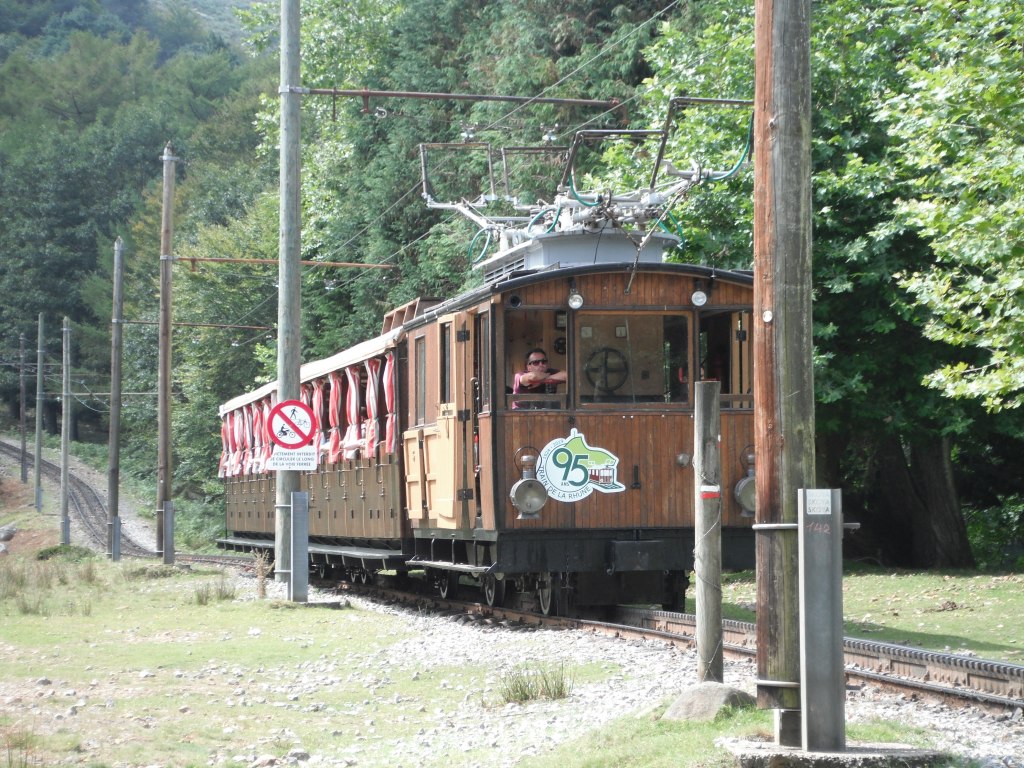
I took my time again today, taking pictures of the horses at the Col des Trois Fontaines, and waiting for the petit train de la Rhune to pass by – a small cog railway going from Sare to the summit of the Rhune mountain. Arriving in Sare I got myself some yaourth au lait de brebis and a nectarine at the village supermarket. Tonight I will eat at restaurant nearby which according to the manager here has a great menu du randonneur. Later Dostoievski will keep me company (I started Crime and Punishment yesterday).

I am staying at La petite Rhune, a wonderful gîte catering to hikers, campers and tourists alike. I will be sleeping in a 6-bed dormitory (at the moment the only other occupant is a Basque hiker from Spain). The place has a great swimming pool which I took advantage of, trying to relax my muscles with some weightlessness. Now, that’s life! Pool after a day of hiking! Quite different from my last hike in the backcountry of Northern Ontario! All for 23 euros. And the manager apologized because the bread and pastries for breakfast tomorrow morning won’t be fresh but will come out of the freezer!

The Col d’Ibardin this morning.
Pottoks.
Le petit train de la Rhune.
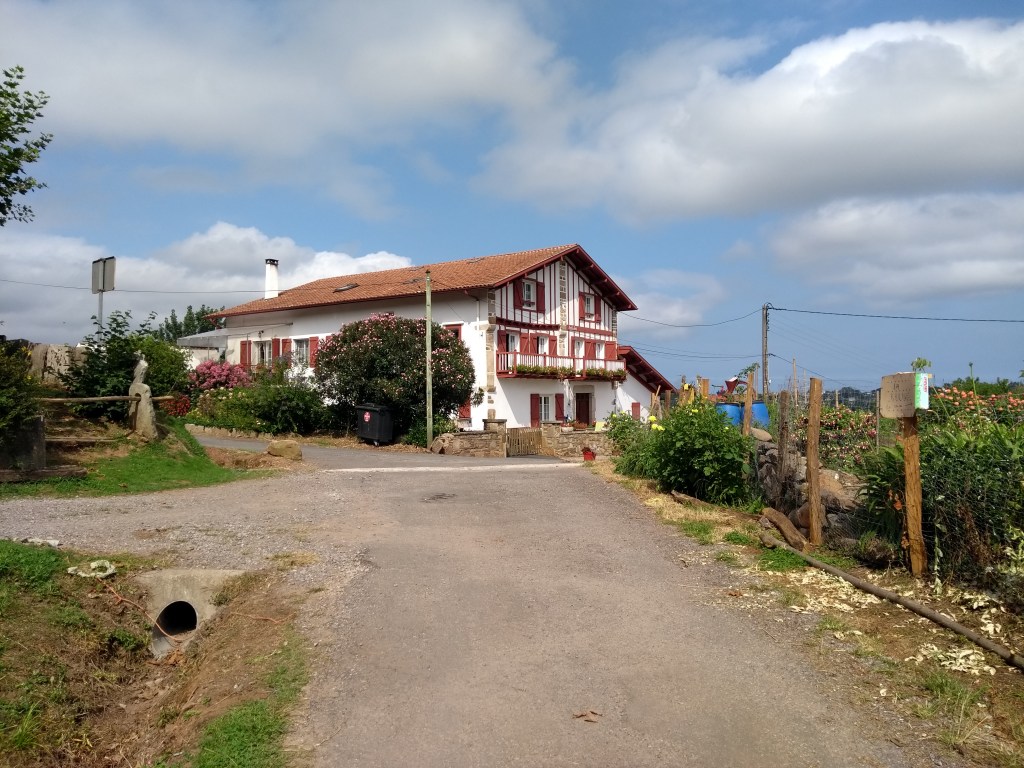
A Basque house

Day 1 – Hendaye to Col d’Ibardin

August 29, 2019 – Departed 12:30 – Arrived 18:00

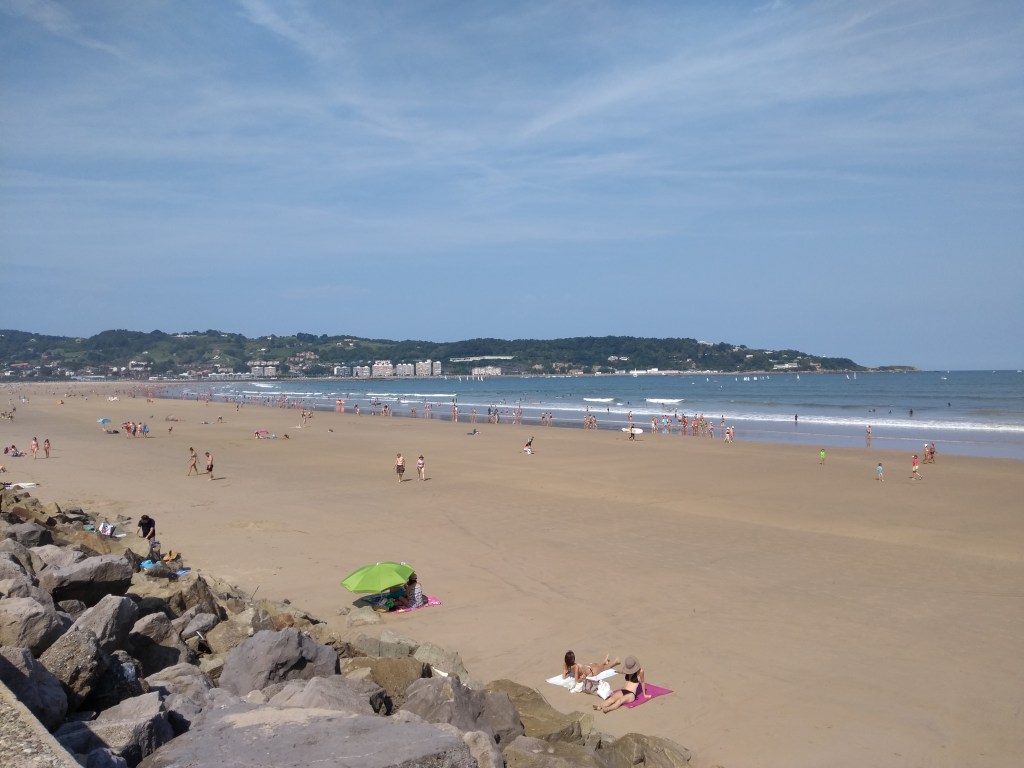
The train arrived close to noon, and I spent a few minutes on the beach getting my feet wet. Then I started hiking and got immediately lost, which happened at least three times today.

The first couple of hours were okay. Then the slope got steeper and it became really tough. I don’t know if it’s the weight of the backpack (15 kg) or my age or my lack of shape or the heat of the afternoon, but I got really discouraged and had to sit down several times. Then I met two people who were just finishing the GR 10, having started 45 days ago – they said that the first four days are the hardest, until the body has had a chance to adjust. The rest of the hike I really took my time when going uphill, alternating walking 10 s and resting 20 s. It may seem silly and lame but it really helped.

I am staying at the Venta Elizalde, which offers the luxury of individual rooms with showers. That felt nice. Had dinner there too. The Venta is on the Spanish side of the border, which is kind of fun. I am in Spain!

The high points of the day were the fruits that had fallen on the road and which I gathered as walked along – two peaches, two apples and a fig – and the sight of horses roaming freely in the pastures that the path was traversing high up in the mountains. Horses with bells! Also loved the Basque writing everywhere, and the kindness of a man in Biriatou who saw me searching my way and spontaneously pointed me to the right direction.

The beautiful beach in Hendaye.

This blog

This blog was simply a means for me to keep loved ones and friends informed of my progress (or lack thereof) on the trail while I attempted parts of the GR 10. I started on August 29, 2019, and I had no idea of how far I would be going. Maybe I’d stop after two weeks, maybe after two months, time would tell. For me the measure of success was not be how far I would go, but how much I enjoyed the trail. The goal was to stay in the moment, not achieve any particular number of kilometers.

Every day I posted a short summary. There were technical reasons for it being short, as I was posting from my cell phone. Its tiny keyboard doesn’t make it easy to write long posts. Also, I was posting whenever I got a good connection, which was not every day – and I let everybody know not to be alarmed if nothing got posted for a few days. I posted pictures too, but that was possible only if they were taken with my phone. Additional pictures were taken with a small camera that was not linked to my phone, and some of these, and the map below, I added when my trip was over.

Enjoy this blog and don’t hesitate to share your comments!

Design a site like this with WordPress.com
Get started